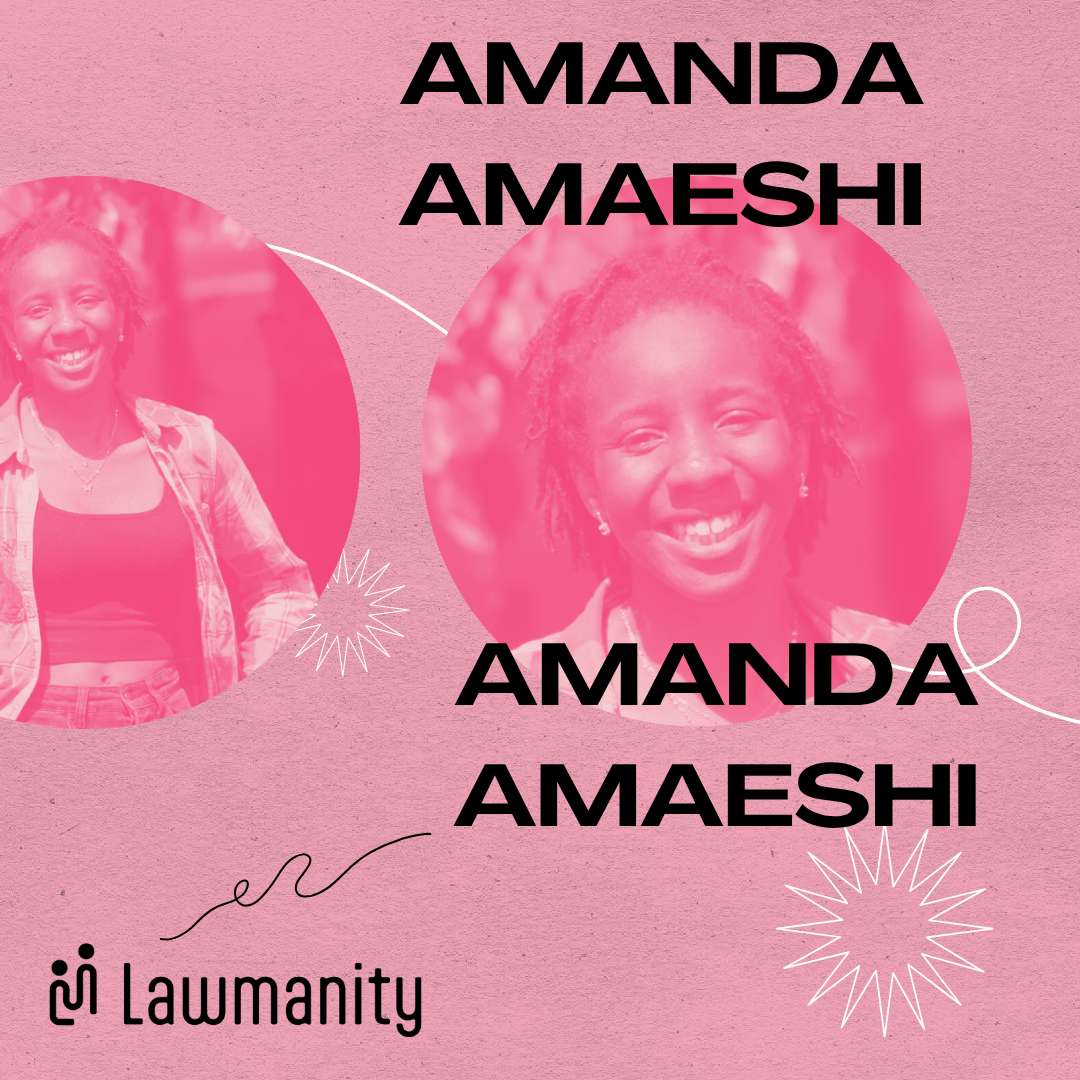
Transcript: Access to Justice: A Student Perspective on Law Clinics, with Amanda Amaeshi
Host: Jen Ang
Quote: Amanda Amaeshi
“Issues of equality and justice can easily be sidelined in terms of self-interested party politics. But justice has to be braver than that. It has to put people and their dignity at the centre.”
Background music lyrics:
“We’re musicians in exile and this is the song of hope saying…”
Jen Ang
Welcome to the Lawmanity podcast where we explore the complex relationship between law and activism and discuss the different ways that law can oppress but can also lead to real social change.
I’m Jen Ang, a human rights lawyer and activist based in Scotland and your host on the Lawmanity podcast. We’re back this week with more one-to-one guest interviews. And kicking things off is today’s interview with Amanda Amaeshi: activist, law graduate and – as announced a couple of weeks ago – Lawmanity’s new Legal Caseworker.
Amanda writes and campaigns on gender equality, anti-racism and youth political participation. Her advocacy journey began as a Year of Young Person 2018 Ambassador and a member of the Girlguiding UK Advocate Panel. For her work, Amanda has won numerous awards including the Young Women’s Movement 30 Under 30 list for 2020, the Glasgow Times Young Scotswoman of the Year award in 2021 and in November 2024 she was named My Life My Say’s Next Generation Changemaker of the Year.
Last year Amanda graduated with an LLB from the University College London. She currently serves as a trustee for the Young Women’s Movement and until recently – alongside me – as a member of the First Minister’s Advisory Council for Women and Girls in Scotland.
I’m delighted to welcome Amanda to the show today, and also to her new role as Legal Caseworker at Lawmanity.
Jen Ang
Just to get us started or warmed up, I have a kind of surprise opener question which was indeed a surprise for you today, and it is this: so a good friend of mine told me that our sense of smell is our oldest sense as a species, because it connects really quickly to deep memories that we might have of a place or a time. So I like to ask people, what is a smell that is meaningful to you? Maybe one that you like or one that just, you know, takes you to a place in your memories or your imagination that you like to go to?
Amanda Amaeshi
I thought this was quite a funny question because I notoriously have quite a bad sense of smell! But, I was trying to think of something quite recent, actually I went, I went to this candle-making session at UCL East with my friend a couple weeks ago. So we got to make our own candles. And I remember the scent that I picked out was like chamomile and lavender, I think. And I just really liked that smell. And I thought it was quite peaceful and it was a really nice, relaxing activity to do with my friend in the midst of assessment season, all these deadlines, all the stress, and also because I made the candle for my mum, so I just felt this is something that she really likes. It was kind of like that combination of doing the nice, fun activity and then also making something that would be for someone that’s really meaningful to me. It brings back lots of nice memories.
Jen Ang
Oh, that’s lovely. Those are such soothing smells, aren’t they? Very much. It reminds me of, I have a sleeping time tea and chamomile lavender is very much a part of that.
Amanda Amaeshi
Yeah. Because I know my mum really likes chamomile tea. So I felt like she would like it. And I mean, she did like it. She was really delighted when I brought it back.
Jen Ang
Oh, star gift. Star gift and lucky mum. Thank you so much for sharing that.
So now we’re going to turn from fun opener into kind of, you know, why we’re here. Ah, so the first question, it’s a big one. Okay, so the first question is basically, do you feel that the law treats you or your community equally? So does it work equally for you or your community, however you wish to define that and why or why not?
Amanda Amaeshi
I was thinking about this, I thought about my community as like… I’m a young Black woman, so I was thinking about it through those lenses of youth, of race, of gender. And I mean, there’ll be plenty of ways where the law does work, but, I focused on examples where I found that it hasn’t worked so well.
And, one of the first things that came to mind is just how the legal system is failing survivors of gender-based violence in regards to their access to justice is being denied because – legal aid is technically available for these cases [but] – nearly a third of survivors were forced to represent themselves in courts in 2023, which has nearly doubled since 2011. And this means that survivors are having to navigate these complex, and often retraumatising, legal processes, and they have to face their abusers without that legal representation. And also Rape Crisis England & Wales has also raised concerns about how the asylum system retraumatises survivors of sexual violence, particularly those who are housed in unsafe and unsuitable accommodations by the Home Office. This shows the overlap between gender and then race and migration status as well. And whilst these people are trying to face or trying to seek protection, they’re met with these systems who are then compounding their trauma rather than alleviating it.
Another thing that I found was in regards to policing, policing is actually one of the first things that came to mind because anytime I see police in the street, even though I’ve never personally had a bad experience, just instinctively because I know about the rates of over-policing in Black communities, I always feel a bit unsettled whenever I see them about… but there’s been civil orders like the Serious Violence Reduction Orders which have been disproportionately targeting Black communities and particularly Black men.
Jen Ang
That is a long and sobering list of really poignant I suppose statistics just to illustrate the wide range of ways in which the law may not equally protect or equally support women. You’ve highlighted as a community, so women survivors of violence but also Black communities and migrant communities.
Do you then as an activist and a law student, you know, knowing that the law doesn’t treat communities that you care about equally, do you see the law as more of a tool or a barrier for change or maybe a little bit of both?
Amanda Amaeshi
I think it’s definitely both. Like it’s a barrier and a tool.
In regards to being a tool obviously people go to court, have a case and especially with cases of like strategic litigation where individual cases can be leveraged to advocate for wider legal precedents that can address broader systemic issues. And there’s also legal protections embedded in anti-discrimination legislation like the Equality Act for example, which equality is in the name. So I suppose in that sense it’s definitely a tool but I think it can also be a barrier as well.
So firstly in regards to the practical barriers, so I thought about this through – I’ve volunteered over the past year at UCL’s Integrated Legal Advice Clinic. So it’s located in East London in Stratford and the clinic offers legal aid and also pro bono support in regards to housing, welfare benefits, community care and education. And so I had the opportunity to volunteer there both as an admin volunteer and also through one of my final year modules which is called Access to Justice and Community Engagement. So I got to help out the lawyers with their casework.
So I guess thinking about that experience, it really illuminated for me the practical, barriers that come with accessing law.
First off, to do with the cost: the fact that so many people are having to access legal clinics like UCL’s iLAC, it shows that just accessing legal support is really prohibitive if private legal services are charging exorbitant fees and it just becomes really inaccessible.
And then even where obviously Legal Aid does exist and the aim of that is supposed to be to provide access for those who otherwise wouldn’t be able to afford it, Legal Aid is being slashed. There’s been lots of cuts and it’s had a major impact on the sustainability and Legal Aid sector. And as a result I’ve seen that there are relatively few services offering free legal assistance, especially when it comes to ongoing support or representation beyond initial advice. And the limited numbers of clinics that do exist, like UCL’s iLAC are often inundated with inquiries and they have no option to signpost clients elsewhere. And especially when I was working on the telephones, answering client enquiries, I found myself having to do this a lot, having to do some research to find other places that the enquirers could go to. But then it also becomes a kind of inescapable loop because I remember quite a lot of the times I would say, “oh, maybe you can go here or you can go here”. And then the enquirer would be like, “oh, I’ve already been there and they already didn’t have capacity and in fact they were the ones that told me to come to you”. It almost becomes a bit hopeless. You’re kind of just going round and round in circles
And if you are lucky enough to get that support, there’s then so much bureaucracy and opaqueness within the legal system. Statutes, regulations, guidance, it’s often difficult to find and even more difficult to understand, lots of technical language. And I remember I was helping out with the casework, having to come up with legal arguments and I’d spend ages reading these documents. And even for me as a law student and even talking to the other lawyers as well, it wouldn’t always be so straightforward to figure out what does this mean? So if it’s already difficult for those of us who have some experience already with the law, then how much more difficult would it be for those who are in a legal crisis and then in a heightened state of vulnerability and perhaps with other compounding inequalities on top of do with race or disability or age, how are they supposed to navigate this system?
And sometimes, maybe I’m being a bit cynical, but it also sometimes seems that this opaqueness and difficulty to navigate the system is not just a flaw, but kind of a purposeful design. I remember there was a client we had once needed to challenge a decision, regarding the Department for Work and Pensions. And the deadline for submitting the application to challenge the decision had technically passed. But the lawyer who was supervising me said that appeal could probably still be made because of exceptional circumstances, in this case to do with recent house moves and disability-related difficulties. It raised the question for me of who gets the benefit of this procedural flexibility? And the fact that late appeals could be accepted suggested to me that deadlines could function more as deterrence as opposed to absolute cutoffs, which could potentially discourage claimants who assume that they have no further options after they’ve gotten this decision.
And if there is this flexibility in regards to extenuating circumstances, why isn’t this more explicitly communicated? Why is this something that claimants actually have to fight for and in this case fighting for with the support of the legal professionals? It’d be even worse if the claimant was trying to do it by themselves. It almost seemed that the system is designed in a way that if there are fewer, challenges and it becomes like a more manageable caseload. But that’s not how justice is supposed to work, is it?
Jen Ang
As I listened to you talk about your experience at the UCL clinic, I mean, what you’ve described feels very, very familiar. in terms of my own observations from frontline advice, work and legal casework, all of those frustrations around potential clients not being able to find anyone to help them. So just a total lack of access to advice. But then also raising that question about whether access to justice, of the law working unequally for people is not just kind of an accident or not just because of quote, like barriers, like capacity barriers, but whether there’s actually something baked into the way that some of the process works.
Amanda Amaeshi
I mean there have definitely been good things as well. It’s been really, throughout my year of volunteering nurse, it was also really great to just see how many people the clinic were able to help in terms of getting a case outcome that was desirable or even just the clients feeling more confident and empowered to advocate for their rights and for the rights of their community.
I remember actually getting a phone call from a client, her case had actually been resolved and she was actually saying, oh, someone else from her community had a similar issue. And she knew because her lawyer that she had at iLAC had really empowered her, really given the confidence, not just the practical advice of what to do, but also just making her feel heard and respected, that she knew, I have to send my friend here as well, because they were able to help me, maybe they can help her as well, my friend as well. So there’s definitely positive sides to it as well.
Jen Ang
That leads nicely on to my next question, which is, in light of what you’ve seen and learned, what do you think is the role of lawyers and the legal system in supporting social justice movements? Just bearing in mind that when we talk about the law and the legal system, both the actors within the system and also our opponents in the system are all lawyers. So it’s a broader question, for you, what do you think is their role?
Amanda Amaeshi
This question really, drew my mind back to some conversations I’ve been having during the seminars that I’ve had as part of the Access to Justice module. This idea of, what are lawyers supposed to do? Are they supposed to simply just advocate for their client in regards to how the law currently is, or is there kind of like a broader role as well of like, advocating for social justice? And I think it was called cause lawyering. And so that’s what this question really got me to think about.
And I remember coming across a quote when I was reading, from an academic called James Douglas. And he said that a lawyer’s role in society is not to change the rules of the game, but to assist in maintaining the rules and to help resolve conflicts established under the rules. And I guess to an extent I can kind of, I can understand the logic behind the view. Like, it reflects a very traditional procedural understanding of the legal profession. And basically lawyers keep the system stable and functional by working within the rules that currently exist and in theory it makes the law predictable and fair and perhaps would increase public trust. Especially since lawyers are supposed to be seen as neutral figures to represent their clients, not to advance their personal ideologies. So it would ensure that everyone, no matter their background, can expect an objective and fair representation. And there’s also the constitutional argument that you don’t want lawyers or the judiciary to step over too much into what could be considered the role of legislators, like creating policy.
But… so I think about these points and I get it, makes sense. I mean, it’s what I’ve been taught to think, from a very traditional law degree. But at the same time I also feel like it paints a fairly narrow picture of what the legal profession can be, because it assumes that the legal system is fixed and unchanging. But in reality it always evolves and sometimes I think it has to be challenged head-on when it fails to deliver justice. And I think lawyers are very uniquely placed, particularly those who are on the frontline of issues like housing or immigration, welfare or criminal justice. So in regards to housing and welfare, again I’m thinking back to the lawyers at the legal clinic. These lawyers in particular are often able to see the real-world effects of legal gaps and injustices and so then to suggest that their role is only to uphold the system no matter how flawed, it ignores the deep ethical questions that arise when the rules themselves are actually part of the access to justice problem. And laws, a lot of the time they aren’t just imperfect, they’re inherently outdated or harmful. Especially if they’re designed by decision makers that don’t have lived experience or don’t actively attempt to engage meaningfully with those with lived experience. So upholding these laws blindly, laws that are really outdated and harmful… in my view. It conflicts with the profession’s broader commitment to justice. Because if lawyers can’t or don’t challenge these unjust laws or practices, then, especially with their knowledge and their unique positioning, then who else will? And I think it is possible sometimes that lawyers can do both, still advocate for your client, but then also kind of pushing the boundaries when justice demands of it.
So there’s another quote, from Jennifer Gordon, in her article ‘The Lawyer Is Not The Protagonist’. And then she outlines what she calls the conventional narrative, where a social problem arises, a lawyer steps in to fix it, the lawyer identifies the legal strategy, and either the case is won or lost. But I really liked how she challenged that whole framing and she offers an alternative view where the community group instead is the protagonist and the lawyer is instead part of the supporting cast. So the lawyer is not supposed to take over and be like, oh, ah, I’m the one that knows all the legal information, I’m the one that knows the fancy words, all the arguments. It’s not about that. So the question that the lawyer should be asking is not “how do I fix this?” But “what can legal tools do to support the broader strategy of the community?” And I thought it was really great rethinking because law can be used as a really good tool, but it’s not just law in isolation that could solve the big societal problems. Legal work has to be in service of a much bigger vision which is in line of collaborative community action, community-oriented actions as well… like getting rid of the top down solution, which is quite patronising I think and kind of like having the humility to lean in more to these grassroots movements and using law and using that legal expertise as one of many tools in a toolbox to help that process.
Jen Ang
That’s.. I’m sort of, I’m sort of in awe because that was first a very powerful critique of your view around the obligation of lawyers to think critically about whether to participate in injustice. And then a description of what movement lawyering or community lawyering could look like. That was really quite inspiring actually. It’s also a hopeful message for me to hear you describe that and to hear that vision as something that you think is possible or it’s possible for us to get better at moving towards.
My last big question is a big question, and it’s this: in light of everything you’ve described about inequalities in the law itself, inequalities in access to the law and the role of lawyers, what for you does justice look like for you or your community?
Amanda Amaeshi
It’s a very big question. But I think it’s something that’s really important to think about because when it comes to dealing with problems it’s very easy to focus on the negatives and be like: oh we don’t like this, we don’t like this. But if you don’t have a clear idea of how do we want things to be instead then can be easy for the action that is happening to… fizzle out a little bit, without that kind of sustained hope of this is what we’re fighting for.
But for me I’d say that justice looks like a legal system, a political system that is designed by, with and for the people that it aims to serve, especially those who are currently most vulnerable, most marginalised and furthest away from this power. And it’s not just about abstract legal principles which are in legislations or in courtroom decisions. But it’s really about whether the people at the sharpest edges of injustices feel seen, heard and protected. Like the example of like the clients from earlier where they felt heard and empowered in regards to their case.
And it’s really important that justice has to be intersectional, it has to be collective, it has to be rooted in empathy. And it’s really important that these don’t just become buzzwords. They’re really essential core principles. And there has to be a commitment to listening to communities rather than just prescribing solutions based solely on labels that might be put on them by society. And I think especially the idea of empathy and humanity are really central to this vision. I think throughout my law degree, sometimes it’s kind of the case you have to focus on these, very quote unquote “intellectually serious” ideas, like rationality. But I think throughout the three years, especially in the modules that I’ve taken in final year, it’s really helped me understand this idea of empathy is transformative and it is as intellectually serious as any other idea. And, it’s a rigorous, necessary foundation for legal thinking and legal practice as well.
And another thing, part of justice is that, something I see right now is that too often legal systems are shaped by fear. And I’m thinking about around the world, the rollback of rights under pressure from far-right movements and how as a result in Scotland and in the UK perhaps laws or policies are becoming a bit weaker in response to that. Issues of equality and justice can easily be sidelined in terms of self-interested party politics. But justice has to be braver than that. It has to put people and their dignity at the centre of the conversation. It can’t just be moved aside because it’s become politically inconvenient. It should always be at the core of what anybody’s doing.
And as I’ve already alluded to, I don’t think that law alone can carry this burden of striving for justice. It’s definitely an important part. But, I think justice requires more than just legal reform. It needs moral imagination and sustained inclusive activism. And so law is a tool that must be wielded alongside storytelling, organising, mutual aid, education, care, all these other aspects. A lot of it comes from the community and I think that’s how real change and real justice happens.
Jen Ang
Amazing. I was almost again holding my breath, not wanting to interrupt you. But justice has to be, intersectional, collective, rooted in empathy. It has to come from the community.
So my final, final question is, this: so the Lawmanity podcast will go out to all sorts of listeners and there will be some people out there who will be listening to your thoughts and what you’ve accomplished already as an activist and a law student, and will be wondering how you got here or maybe how to be you.
So, my question is, what is your advice maybe for your younger self? And I know you’re still probably identifying as young! but you’re still a mentor to some, and if not your younger self, then to other people out there who are curious and who want to do some of the things you’ve been doing.
Amanda Amaeshi
This is a really lovely question and actually I remember last year I wrote an article all about this actually for The WOW Foundation, giving my advice to aspiring changemakers… and then the key points related to identifying one’s key interests and goals, finding the opportunities, building community, dealing with imposter syndrome – especially when you’re doing quite big roles like being on the National Advisory Council – and then also resisting that fear and apathy. So I would definitely encourage interested listeners to check that out. Perhaps that could be linked in the show notes.
But I wanted to mention one other thing that I feel like I’ve not spoken about elsewhere before. Something new. Sometimes… especially when I’m thinking about younger me, maybe what 14, 15-year-old me would have wanted to hear when I first started doing this activism, advocacy stuff properly is that sometimes not everybody is going to understand why you care so much or why you want to do the actions that you’re doing. I mean, to be fair, a decent amount of people will, this is not to be off putting. I guess the reality is that some people might try to mock you, make fun of you, try to belittle you in the hopes that you might stop doing whatever it is that you’re doing and it can be quite disheartening to be honest. But I think it’s important to remember that advocating for change is never easy. And kind of like facing such remarks from other people is just one part of how it might not always be easy. But it’s really important to try not to let that get to you and just stay true to the value system that’s guiding you. Keep in your mind the changes that you wish to see, which again why I said that, think about the problems, we also have to think about the solutions as well, the ideal scenario, and keep in focus the changes that you wish to see which are possible. Don’t let anybody tell you otherwise and find yourself a community of changemakers who you can learn from, who you can seek support and solidarity from, and put in your best ability, and… don’t let other people’s small minds limit your imagination.
Jen Ang
Ah, that’s brilliant. Wise advice from a wise woman!
Thank you for that and thank you for taking the time to sit down with me today, and to share with me your thoughts, which we’ll now get to share with a wider audience than just you and me. I could honestly sit and talk to you, Amanda, for, you know, another hour and have lots of questions about everything, but in the interest of letting you get on with your day, I’m going to draw the interview to a close here. But it’s been lovely to see you and I, and probably all of our listeners, will keep an eye out for what you do next because doubtless it will be just as bold and inspiring and interesting as today.
And that’s a wrap for today’s episode with Amanda Amaeshi, activist, law graduate and my new colleague here at Lawmanity. If you were inspired by what Amanda has shared and want to learn more about the Legal Aid crisis that’s preventing survivors of domestic violence from accessing the legal advice they need, or if you want to explore what it means to be a community lawyer or a cause lawyer, check out the links in our episode notes. And for those of you who are practically minded, reach out to your local Women’s Aid and Rape Crisis organisation or your local Citizens Advice Bureau, educate yourself and others, and maybe consider volunteering.
We’ll be back again soon with our next episode, an amazing one to one with Davie Donaldson, a young activist from the Scottish traveller community, who shares his perspective on the challenges of preserving and protecting travelling culture under laws that are written and enforced primarily by and for settled people. Davie vividly illustrates what it looks like day-to-day in his advocacy on behalf of his family and his community.
Thanks for tuning in to our Lawmanity podcast again and if you enjoyed today’s episode, please do hit the like and subscribe buttons and share our episodes with friends and colleagues who might enjoy learning a little bit more about how law really works in practice and how it can be used to make the world a better, brighter place.
The Lawmanity podcast is co-produced by me, your host Jen Ang, and by the brilliant and talented Natalia Uribe. Shout out to Helena Refai for mentoring us through our first year of this incredible project. And welcome to Amanda Amaeshi, who’s joined the team to support us with graphics and socials. The music you’ve been listening to is Always On The Move by Musicians in Exile, a Glasgow-based music project led by people seeking refuge in Scotland. Thanks so much for tuning in today. We hope you enjoyed listening and see you next time.
Quote: Amanda Amaeshi
“Issues of equality and justice can easily be sidelined in terms of self-interested party politics. But justice has to be braver than that. It has to put people and their dignity at the centre.”
Background music lyrics:
“We’re musicians in exile and this is the song of hope saying…”
Jen Ang
Welcome to the Lawmanity podcast where we explore the complex relationship between law and activism and discuss the different ways that law can oppress but can also lead to real social change.
I’m Jen Ang, a human rights lawyer and activist based in Scotland and your host on the Lawmanity podcast. We’re back this week with more one-to-one guest interviews. And kicking things off is today’s interview with Amanda Amaeshi: activist, law graduate and – as announced a couple of weeks ago – Lawmanity’s new Legal Caseworker.
Amanda writes and campaigns on gender equality, anti-racism and youth political participation. Her advocacy journey began as a Year of Young Person 2018 Ambassador and a member of the Girlguiding UK Advocate Panel. For her work, Amanda has won numerous awards including the Young Women’s Movement 30 Under 30 list for 2020, the Glasgow Times Young Scotswoman of the Year award in 2021 and in November 2024 she was named My Life My Say’s Next Generation Changemaker of the Year.
Last year Amanda graduated with an LLB from the University College London. She currently serves as a trustee for the Young Women’s Movement and until recently – alongside me – as a member of the First Minister’s Advisory Council for Women and Girls in Scotland.
I’m delighted to welcome Amanda to the show today, and also to her new role as Legal Caseworker at Lawmanity.
Jen Ang
Just to get us started or warmed up, I have a kind of surprise opener question which was indeed a surprise for you today, and it is this: so a good friend of mine told me that our sense of smell is our oldest sense as a species, because it connects really quickly to deep memories that we might have of a place or a time. So I like to ask people, what is a smell that is meaningful to you? Maybe one that you like or one that just, you know, takes you to a place in your memories or your imagination that you like to go to?
Amanda Amaeshi
I thought this was quite a funny question because I notoriously have quite a bad sense of smell! But, I was trying to think of something quite recent, actually I went, I went to this candle-making session at UCL East with my friend a couple weeks ago. So we got to make our own candles. And I remember the scent that I picked out was like chamomile and lavender, I think. And I just really liked that smell. And I thought it was quite peaceful and it was a really nice, relaxing activity to do with my friend in the midst of assessment season, all these deadlines, all the stress, and also because I made the candle for my mum, so I just felt this is something that she really likes. It was kind of like that combination of doing the nice, fun activity and then also making something that would be for someone that’s really meaningful to me. It brings back lots of nice memories.
Jen Ang
Oh, that’s lovely. Those are such soothing smells, aren’t they? Very much. It reminds me of, I have a sleeping time tea and chamomile lavender is very much a part of that.
Amanda Amaeshi
Yeah. Because I know my mum really likes chamomile tea. So I felt like she would like it. And I mean, she did like it. She was really delighted when I brought it back.
Jen Ang
Oh, star gift. Star gift and lucky mum. Thank you so much for sharing that.
So now we’re going to turn from fun opener into kind of, you know, why we’re here. Ah, so the first question, it’s a big one. Okay, so the first question is basically, do you feel that the law treats you or your community equally? So does it work equally for you or your community, however you wish to define that and why or why not?
Amanda Amaeshi
I was thinking about this, I thought about my community as like… I’m a young Black woman, so I was thinking about it through those lenses of youth, of race, of gender. And I mean, there’ll be plenty of ways where the law does work, but, I focused on examples where I found that it hasn’t worked so well.
And, one of the first things that came to mind is just how the legal system is failing survivors of gender-based violence in regards to their access to justice is being denied because – legal aid is technically available for these cases [but] – nearly a third of survivors were forced to represent themselves in courts in 2023, which has nearly doubled since 2011. And this means that survivors are having to navigate these complex, and often retraumatising, legal processes, and they have to face their abusers without that legal representation. And also Rape Crisis England & Wales has also raised concerns about how the asylum system retraumatises survivors of sexual violence, particularly those who are housed in unsafe and unsuitable accommodations by the Home Office. This shows the overlap between gender and then race and migration status as well. And whilst these people are trying to face or trying to seek protection, they’re met with these systems who are then compounding their trauma rather than alleviating it.
Another thing that I found was in regards to policing, policing is actually one of the first things that came to mind because anytime I see police in the street, even though I’ve never personally had a bad experience, just instinctively because I know about the rates of over-policing in Black communities, I always feel a bit unsettled whenever I see them about… but there’s been civil orders like the Serious Violence Reduction Orders which have been disproportionately targeting Black communities and particularly Black men.
Jen Ang
That is a long and sobering list of really poignant I suppose statistics just to illustrate the wide range of ways in which the law may not equally protect or equally support women. You’ve highlighted as a community, so women survivors of violence but also Black communities and migrant communities.
Do you then as an activist and a law student, you know, knowing that the law doesn’t treat communities that you care about equally, do you see the law as more of a tool or a barrier for change or maybe a little bit of both?
Amanda Amaeshi
I think it’s definitely both. Like it’s a barrier and a tool.
In regards to being a tool obviously people go to court, have a case and especially with cases of like strategic litigation where individual cases can be leveraged to advocate for wider legal precedents that can address broader systemic issues. And there’s also legal protections embedded in anti-discrimination legislation like the Equality Act for example, which equality is in the name. So I suppose in that sense it’s definitely a tool but I think it can also be a barrier as well.
So firstly in regards to the practical barriers, so I thought about this through – I’ve volunteered over the past year at UCL’s Integrated Legal Advice Clinic. So it’s located in East London in Stratford and the clinic offers legal aid and also pro bono support in regards to housing, welfare benefits, community care and education. And so I had the opportunity to volunteer there both as an admin volunteer and also through one of my final year modules which is called Access to Justice and Community Engagement. So I got to help out the lawyers with their casework.
So I guess thinking about that experience, it really illuminated for me the practical, barriers that come with accessing law.
First off, to do with the cost: the fact that so many people are having to access legal clinics like UCL’s iLAC, it shows that just accessing legal support is really prohibitive if private legal services are charging exorbitant fees and it just becomes really inaccessible.
And then even where obviously Legal Aid does exist and the aim of that is supposed to be to provide access for those who otherwise wouldn’t be able to afford it, Legal Aid is being slashed. There’s been lots of cuts and it’s had a major impact on the sustainability and Legal Aid sector. And as a result I’ve seen that there are relatively few services offering free legal assistance, especially when it comes to ongoing support or representation beyond initial advice. And the limited numbers of clinics that do exist, like UCL’s iLAC are often inundated with inquiries and they have no option to signpost clients elsewhere. And especially when I was working on the telephones, answering client enquiries, I found myself having to do this a lot, having to do some research to find other places that the enquirers could go to. But then it also becomes a kind of inescapable loop because I remember quite a lot of the times I would say, “oh, maybe you can go here or you can go here”. And then the enquirer would be like, “oh, I’ve already been there and they already didn’t have capacity and in fact they were the ones that told me to come to you”. It almost becomes a bit hopeless. You’re kind of just going round and round in circles
And if you are lucky enough to get that support, there’s then so much bureaucracy and opaqueness within the legal system. Statutes, regulations, guidance, it’s often difficult to find and even more difficult to understand, lots of technical language. And I remember I was helping out with the casework, having to come up with legal arguments and I’d spend ages reading these documents. And even for me as a law student and even talking to the other lawyers as well, it wouldn’t always be so straightforward to figure out what does this mean? So if it’s already difficult for those of us who have some experience already with the law, then how much more difficult would it be for those who are in a legal crisis and then in a heightened state of vulnerability and perhaps with other compounding inequalities on top of do with race or disability or age, how are they supposed to navigate this system?
And sometimes, maybe I’m being a bit cynical, but it also sometimes seems that this opaqueness and difficulty to navigate the system is not just a flaw, but kind of a purposeful design. I remember there was a client we had once needed to challenge a decision, regarding the Department for Work and Pensions. And the deadline for submitting the application to challenge the decision had technically passed. But the lawyer who was supervising me said that appeal could probably still be made because of exceptional circumstances, in this case to do with recent house moves and disability-related difficulties. It raised the question for me of who gets the benefit of this procedural flexibility? And the fact that late appeals could be accepted suggested to me that deadlines could function more as deterrence as opposed to absolute cutoffs, which could potentially discourage claimants who assume that they have no further options after they’ve gotten this decision.
And if there is this flexibility in regards to extenuating circumstances, why isn’t this more explicitly communicated? Why is this something that claimants actually have to fight for and in this case fighting for with the support of the legal professionals? It’d be even worse if the claimant was trying to do it by themselves. It almost seemed that the system is designed in a way that if there are fewer, challenges and it becomes like a more manageable caseload. But that’s not how justice is supposed to work, is it?
Jen Ang
As I listened to you talk about your experience at the UCL clinic, I mean, what you’ve described feels very, very familiar. in terms of my own observations from frontline advice, work and legal casework, all of those frustrations around potential clients not being able to find anyone to help them. So just a total lack of access to advice. But then also raising that question about whether access to justice, of the law working unequally for people is not just kind of an accident or not just because of quote, like barriers, like capacity barriers, but whether there’s actually something baked into the way that some of the process works.
Amanda Amaeshi
I mean there have definitely been good things as well. It’s been really, throughout my year of volunteering nurse, it was also really great to just see how many people the clinic were able to help in terms of getting a case outcome that was desirable or even just the clients feeling more confident and empowered to advocate for their rights and for the rights of their community.
I remember actually getting a phone call from a client, her case had actually been resolved and she was actually saying, oh, someone else from her community had a similar issue. And she knew because her lawyer that she had at iLAC had really empowered her, really given the confidence, not just the practical advice of what to do, but also just making her feel heard and respected, that she knew, I have to send my friend here as well, because they were able to help me, maybe they can help her as well, my friend as well. So there’s definitely positive sides to it as well.
Jen Ang
That leads nicely on to my next question, which is, in light of what you’ve seen and learned, what do you think is the role of lawyers and the legal system in supporting social justice movements? Just bearing in mind that when we talk about the law and the legal system, both the actors within the system and also our opponents in the system are all lawyers. So it’s a broader question, for you, what do you think is their role?
Amanda Amaeshi
This question really, drew my mind back to some conversations I’ve been having during the seminars that I’ve had as part of the Access to Justice module. This idea of, what are lawyers supposed to do? Are they supposed to simply just advocate for their client in regards to how the law currently is, or is there kind of like a broader role as well of like, advocating for social justice? And I think it was called cause lawyering. And so that’s what this question really got me to think about.
And I remember coming across a quote when I was reading, from an academic called James Douglas. And he said that a lawyer’s role in society is not to change the rules of the game, but to assist in maintaining the rules and to help resolve conflicts established under the rules. And I guess to an extent I can kind of, I can understand the logic behind the view. Like, it reflects a very traditional procedural understanding of the legal profession. And basically lawyers keep the system stable and functional by working within the rules that currently exist and in theory it makes the law predictable and fair and perhaps would increase public trust. Especially since lawyers are supposed to be seen as neutral figures to represent their clients, not to advance their personal ideologies. So it would ensure that everyone, no matter their background, can expect an objective and fair representation. And there’s also the constitutional argument that you don’t want lawyers or the judiciary to step over too much into what could be considered the role of legislators, like creating policy.
But… so I think about these points and I get it, makes sense. I mean, it’s what I’ve been taught to think, from a very traditional law degree. But at the same time I also feel like it paints a fairly narrow picture of what the legal profession can be, because it assumes that the legal system is fixed and unchanging. But in reality it always evolves and sometimes I think it has to be challenged head-on when it fails to deliver justice. And I think lawyers are very uniquely placed, particularly those who are on the frontline of issues like housing or immigration, welfare or criminal justice. So in regards to housing and welfare, again I’m thinking back to the lawyers at the legal clinic. These lawyers in particular are often able to see the real-world effects of legal gaps and injustices and so then to suggest that their role is only to uphold the system no matter how flawed, it ignores the deep ethical questions that arise when the rules themselves are actually part of the access to justice problem. And laws, a lot of the time they aren’t just imperfect, they’re inherently outdated or harmful. Especially if they’re designed by decision makers that don’t have lived experience or don’t actively attempt to engage meaningfully with those with lived experience. So upholding these laws blindly, laws that are really outdated and harmful… in my view. It conflicts with the profession’s broader commitment to justice. Because if lawyers can’t or don’t challenge these unjust laws or practices, then, especially with their knowledge and their unique positioning, then who else will? And I think it is possible sometimes that lawyers can do both, still advocate for your client, but then also kind of pushing the boundaries when justice demands of it.
So there’s another quote, from Jennifer Gordon, in her article ‘The Lawyer Is Not The Protagonist’. And then she outlines what she calls the conventional narrative, where a social problem arises, a lawyer steps in to fix it, the lawyer identifies the legal strategy, and either the case is won or lost. But I really liked how she challenged that whole framing and she offers an alternative view where the community group instead is the protagonist and the lawyer is instead part of the supporting cast. So the lawyer is not supposed to take over and be like, oh, ah, I’m the one that knows all the legal information, I’m the one that knows the fancy words, all the arguments. It’s not about that. So the question that the lawyer should be asking is not “how do I fix this?” But “what can legal tools do to support the broader strategy of the community?” And I thought it was really great rethinking because law can be used as a really good tool, but it’s not just law in isolation that could solve the big societal problems. Legal work has to be in service of a much bigger vision which is in line of collaborative community action, community-oriented actions as well… like getting rid of the top down solution, which is quite patronising I think and kind of like having the humility to lean in more to these grassroots movements and using law and using that legal expertise as one of many tools in a toolbox to help that process.
Jen Ang
That’s.. I’m sort of, I’m sort of in awe because that was first a very powerful critique of your view around the obligation of lawyers to think critically about whether to participate in injustice. And then a description of what movement lawyering or community lawyering could look like. That was really quite inspiring actually. It’s also a hopeful message for me to hear you describe that and to hear that vision as something that you think is possible or it’s possible for us to get better at moving towards.
My last big question is a big question, and it’s this: in light of everything you’ve described about inequalities in the law itself, inequalities in access to the law and the role of lawyers, what for you does justice look like for you or your community?
Amanda Amaeshi
It’s a very big question. But I think it’s something that’s really important to think about because when it comes to dealing with problems it’s very easy to focus on the negatives and be like: oh we don’t like this, we don’t like this. But if you don’t have a clear idea of how do we want things to be instead then can be easy for the action that is happening to… fizzle out a little bit, without that kind of sustained hope of this is what we’re fighting for.
But for me I’d say that justice looks like a legal system, a political system that is designed by, with and for the people that it aims to serve, especially those who are currently most vulnerable, most marginalised and furthest away from this power. And it’s not just about abstract legal principles which are in legislations or in courtroom decisions. But it’s really about whether the people at the sharpest edges of injustices feel seen, heard and protected. Like the example of like the clients from earlier where they felt heard and empowered in regards to their case.
And it’s really important that justice has to be intersectional, it has to be collective, it has to be rooted in empathy. And it’s really important that these don’t just become buzzwords. They’re really essential core principles. And there has to be a commitment to listening to communities rather than just prescribing solutions based solely on labels that might be put on them by society. And I think especially the idea of empathy and humanity are really central to this vision. I think throughout my law degree, sometimes it’s kind of the case you have to focus on these, very quote unquote “intellectually serious” ideas, like rationality. But I think throughout the three years, especially in the modules that I’ve taken in final year, it’s really helped me understand this idea of empathy is transformative and it is as intellectually serious as any other idea. And, it’s a rigorous, necessary foundation for legal thinking and legal practice as well.
And another thing, part of justice is that, something I see right now is that too often legal systems are shaped by fear. And I’m thinking about around the world, the rollback of rights under pressure from far-right movements and how as a result in Scotland and in the UK perhaps laws or policies are becoming a bit weaker in response to that. Issues of equality and justice can easily be sidelined in terms of self-interested party politics. But justice has to be braver than that. It has to put people and their dignity at the centre of the conversation. It can’t just be moved aside because it’s become politically inconvenient. It should always be at the core of what anybody’s doing.
And as I’ve already alluded to, I don’t think that law alone can carry this burden of striving for justice. It’s definitely an important part. But, I think justice requires more than just legal reform. It needs moral imagination and sustained inclusive activism. And so law is a tool that must be wielded alongside storytelling, organising, mutual aid, education, care, all these other aspects. A lot of it comes from the community and I think that’s how real change and real justice happens.
Jen Ang
Amazing. I was almost again holding my breath, not wanting to interrupt you. But justice has to be, intersectional, collective, rooted in empathy. It has to come from the community.
So my final, final question is, this: so the Lawmanity podcast will go out to all sorts of listeners and there will be some people out there who will be listening to your thoughts and what you’ve accomplished already as an activist and a law student, and will be wondering how you got here or maybe how to be you.
So, my question is, what is your advice maybe for your younger self? And I know you’re still probably identifying as young! but you’re still a mentor to some, and if not your younger self, then to other people out there who are curious and who want to do some of the things you’ve been doing.
Amanda Amaeshi
This is a really lovely question and actually I remember last year I wrote an article all about this actually for The WOW Foundation, giving my advice to aspiring changemakers… and then the key points related to identifying one’s key interests and goals, finding the opportunities, building community, dealing with imposter syndrome – especially when you’re doing quite big roles like being on the National Advisory Council – and then also resisting that fear and apathy. So I would definitely encourage interested listeners to check that out. Perhaps that could be linked in the show notes.
But I wanted to mention one other thing that I feel like I’ve not spoken about elsewhere before. Something new. Sometimes… especially when I’m thinking about younger me, maybe what 14, 15-year-old me would have wanted to hear when I first started doing this activism, advocacy stuff properly is that sometimes not everybody is going to understand why you care so much or why you want to do the actions that you’re doing. I mean, to be fair, a decent amount of people will, this is not to be off putting. I guess the reality is that some people might try to mock you, make fun of you, try to belittle you in the hopes that you might stop doing whatever it is that you’re doing and it can be quite disheartening to be honest. But I think it’s important to remember that advocating for change is never easy. And kind of like facing such remarks from other people is just one part of how it might not always be easy. But it’s really important to try not to let that get to you and just stay true to the value system that’s guiding you. Keep in your mind the changes that you wish to see, which again why I said that, think about the problems, we also have to think about the solutions as well, the ideal scenario, and keep in focus the changes that you wish to see which are possible. Don’t let anybody tell you otherwise and find yourself a community of changemakers who you can learn from, who you can seek support and solidarity from, and put in your best ability, and… don’t let other people’s small minds limit your imagination.
Jen Ang
Ah, that’s brilliant. Wise advice from a wise woman!
Thank you for that and thank you for taking the time to sit down with me today, and to share with me your thoughts, which we’ll now get to share with a wider audience than just you and me. I could honestly sit and talk to you, Amanda, for, you know, another hour and have lots of questions about everything, but in the interest of letting you get on with your day, I’m going to draw the interview to a close here. But it’s been lovely to see you and I, and probably all of our listeners, will keep an eye out for what you do next because doubtless it will be just as bold and inspiring and interesting as today.
And that’s a wrap for today’s episode with Amanda Amaeshi, activist, law graduate and my new colleague here at Lawmanity. If you were inspired by what Amanda has shared and want to learn more about the Legal Aid crisis that’s preventing survivors of domestic violence from accessing the legal advice they need, or if you want to explore what it means to be a community lawyer or a cause lawyer, check out the links in our episode notes. And for those of you who are practically minded, reach out to your local Women’s Aid and Rape Crisis organisation or your local Citizens Advice Bureau, educate yourself and others, and maybe consider volunteering.
We’ll be back again soon with our next episode, an amazing one to one with Davie Donaldson, a young activist from the Scottish traveller community, who shares his perspective on the challenges of preserving and protecting travelling culture under laws that are written and enforced primarily by and for settled people. Davie vividly illustrates what it looks like day-to-day in his advocacy on behalf of his family and his community.
Thanks for tuning in to our Lawmanity podcast again and if you enjoyed today’s episode, please do hit the like and subscribe buttons and share our episodes with friends and colleagues who might enjoy learning a little bit more about how law really works in practice and how it can be used to make the world a better, brighter place.
The Lawmanity podcast is co-produced by me, your host Jen Ang, and by the brilliant and talented Natalia Uribe. Shout out to Helena Refai for mentoring us through our first year of this incredible project. And welcome to Amanda Amaeshi, who’s joined the team to support us with graphics and socials. The music you’ve been listening to is Always On The Move by Musicians in Exile, a Glasgow-based music project led by people seeking refuge in Scotland. Thanks so much for tuning in today. We hope you enjoyed listening and see you next time!


