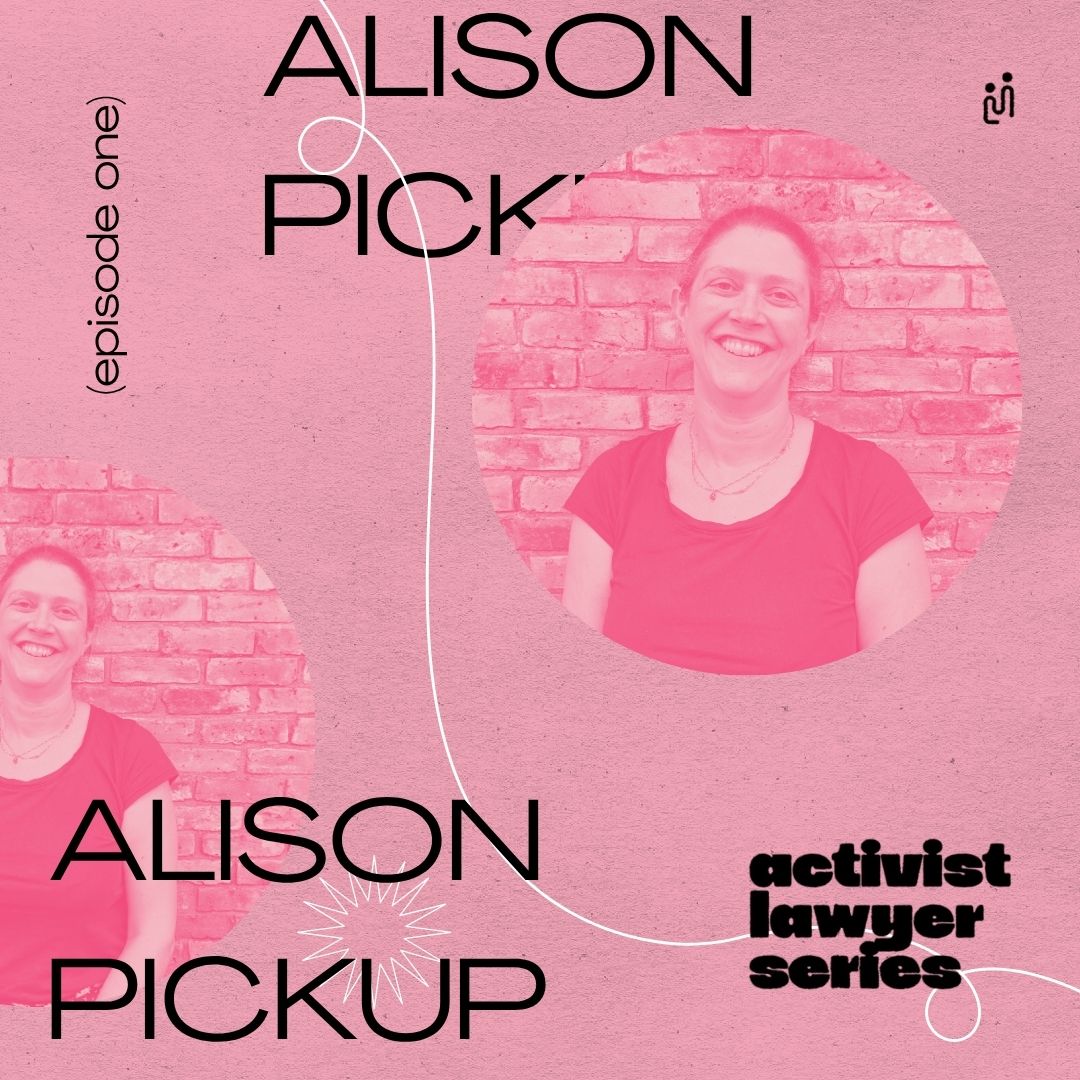
Transcript: Challenging the UK Govt’s Rwanda Policy, with Alison Pickup
Host: Jen Ang
Alison Pickup
“And I think for the clients that one of the hardest things about that initial attempt to remove was that they had, as I say, mostly literally just arrived in the country after a very traumatic and a distressing journey, and they were given so little time that even to sort of get their heads around the idea of being sent to Rwanda..”
Carla Denyer MP
“Nobody is choosing to cross the channel on small boats because they think it will be a laugh. They’re doing it in desperation.”
Jen Ang
Welcome to the Lawmanity Podcast, where we explore the complex relationship between law and activism and discuss the different ways that law can oppress people but can also lead to real social change.
I’m Jen Ang, a human rights lawyer based in Scotland, and your host on the Lawmanity Podcast. Every episode we will bring you legal summaries of interesting cases and one-to-one interviews with activists and lawyers across the UK who are using the law in creative ways to challenge unfairness and secure justice for people and communities who are excluded, discriminated against and overlooked.
This week we’re speaking to human rights lawyer and legend, Alison Pickup.
Alison is a barrister and Executive Director of Asylum Aid where she leads an expert team providing legal representation to asylum seekers and refugees. Before joining Asylum Aid, she was Legal Director of the Public Law Project. a national legal charity which promotes access to public law remedies for those who are disadvantaged by poverty and other barriers.
Alison has won multiple awards for her work, including Outstanding Employed Barrister in an NGO Award by the Bar Council. And, in August 2025, Alison will be taking up the post of CEO at the Helen Bamber Foundation Group, a pioneering group of human rights charities which includes the Helen Bamber Foundation, Asylum Aid and the Migrants Law Project. Together the group supports survivors of trafficking, torture and other forms of human cruelty.
Congratulations on the new role Alison and welcome to today’s show!
Alison Pickup
Thank you.
Jen Ang
I’m so, so pleased that you’re here and I’ll be honest, you’re a total legal hero of mine, so I’m really grateful that you’ve taken the time to speak to us today as well.
Alison Pickup
That was very kind.
Jen Ang
Now, in this podcast as a starter, I’ve been experimenting with a surprise opening question just to get us settled and to learn a little more about the people behind the legal legends who we’re interviewing. So a good friend of mine pointed out that our sense of smell is our oldest sense and observed that sometimes we can hold deep connections between the sense of smell and our memories.
And so if you don’t mind, please can you tell me if there is a smell that is meaningful to you or maybe one that you just really like, or that might be connected to a time and place that you like to bring to mind?
Alison Pickup
Yeah, sure. That’s a lovely question. I don’t exactly know what the smell is, but it’s like a combination of essential oils, I think, that takes me back to a trip I made to Bangkok about ten years ago, and a friend and I were travelling, we’d been staying in fairly cheap accommodation, but in Bangkok, we’d treated ourselves to a couple of nights of slightly nicer accommodation in a hotel … …the whole hotel, just smelled beautiful. And every time I smell that combination, it takes me back to that place.
And then a couple of years ago, a cousin of mine had these bath salts that she was using that had the same smell. So I went out and bought those bath salts, and I can take myself back to that amazing holiday to Thailand whenever I’m feeling stressed.
So it’s the Women’s Balance bath salts from Neal’s Yard Remedies, I think.
Jen Ang
That’s amazing. Thank you for sharing that and big up Neal’s Yard as well!
So we’re here today to help listeners understand how you and your team at Asylum Aid led a successful campaign to challenge the Conservative-led UK Government’s Rwanda policy, and took a series of groundbreaking legal cases – starting in 2022 – that went all the way to the UK Supreme Court.
This is especially timely, as this year, in 2025, the UK Labour Government prepares to repeal the Safety of Rwanda Act in the Border Security, Asylum and Immigration Bill, currently before Parliament.
And so to start with, can I just ask you to explain to us how you got involved with this legal case and this campaign and what it was about?
Alison Pickup
So I had been, I joined Asylum Aid in late 2021, so I’d been there just under six months when the government announced its plan to send asylum seekers to Rwanda. And at the time we were already thinking about the need for a strategic legal working response to the legislation that was going through Parliament, the Nationality, Asylum and Borders Bill, which included plans for offshoring.
But that legislation hadn’t even finished its passage through Parliament, when out of the blue, the government just announced this agreement with Rwanda under which anybody pretty much seeking asylum in the UK who had come through a dangerous route – which, you know, that’s basically the only way to get to the UK to seek asylum – could be sent to Rwanda. And the plan was that this was to be a deterrent to stop other people from using dangerous routes to come here, including crossing the Channel in small boats.
Jen Ang
Here Alison mentions that she and her colleagues were concerned about a new draft law that included plans for “offshoring.” “Offshoring” is a practice where states send people away to some other country or territory for “offshore processing” of their asylum claim. This is a controversial practice and the UNHCR (the UN Refugee Agency) have described the UK Rwanda Plan as “incompatible with the letter and spirit of the Refugee Convention.”
Alison continues:
I was really shocked when I first heard about this because I knew that Rwanda didn’t have a great human rights record, wasn’t known for protecting refugees, and also that it’s thousands of miles away. And for our clients who had, you know, often paid a lot of money, spent a lot of time, gone through a lot of hardship to reach what they saw as a safe country in the UK – the idea that they would then be shipped off thousands of miles to another country where I didn’t feel they would be safe was just horrifying.
And so I mean I remember it really clearly the announcement and the days that followed even kind of lying awake worrying about how we could stop this scheme from happening.
I think it was really clear from the start that it was going to take litigation because the government had announced this as a flagship policy that was the key part of its asylum policy – it’s plan to “stop the boats” as that government called it, and so given the size of the majority that the government had in Parliament, it seemed extremely unlikely that there would be any other way to stop it.
And also because they implemented it in a way that didn’t actually require any new legislation – although the Nationality and Borders Bill had those provisions – so they could they could get on with it straight away.
So that really was kind of where it started and where it became immediately clear that we would need to be thinking about litigation.
The other thing I think is that we were very aware that everyone in the refugee sector was kind of thinking and feeling the same, like: “we need to do something about this.”
Jen Ang
I found it particularly interesting how certain it was for you and your legal team that litigation was the way that that we could use the law in order to challenge this policy – because it was such an important policy for the UK government at the time, it felt like the sphere for policy and influencing was really small – if not, nonexistent.
And the other thing I wanted to reflect was that, you know, because I was also in practice and working in the migration sector at the time that you did this work, I think also seeing your team take these legal challenges did also have like a buoying, or hopeful, impact for people who were doing their day to day work.
So my next question for you was this and what were some of the challenges and as you saw it in running the legal case or maybe in coordinating your efforts with the campaign?
Alison Pickup
Yeah, for sure. I mean, I think coordination was tricky. As I said, obviously, so many actors in the sector were trying to find ways to challenge. And so a key part at the start was kind of reaching out to those other organisations and to lawyers in private practice as well, who were acting on behalf of individual clients and on behalf of other NGOs and trying to understand what everyone else was doing and where we could add value.
So I think that was, it was a challenge, but actually it, I think it was a start of a lot more proactive collaboration in the sector, that we were – the way we had to pull together.
The second and related kind of biggest challenge was the speed at which things started to happen, because the announcement was like mid-April and it was in early May when the Government started detaining people on arrival and threatening them with removal to Rwanda, and we started to see how the process was playing out. And the first removals were due to take place in kind of mid-June.
So it was only really two months from even hearing for the first time that this was a possibility, to when people were supposed to be put on planes. So everything had to be done at kind of breakneck speed, on behalf of individual clients and then Asylum Aid was kind of running our own challenge, which focused on procedural fairness.
And that was really challenging, and then you remember, I’m sure, that in the first instance, the High Court and then the Court of Appeal and then the Supreme Court in the UK all refused injunctions to prevent people being removed to Rwanda.
And I remember the day, the flight was supposed to take off, you know, we were getting updates about what was going on in the Supreme Court, individual clients were still going to the High Court and having the individual cases heard and they might have been refused injunctions – although some were granted. And then Strasbourg kind of stepped in and said there’s a real need for this to be considered properly, so no one should be removed until the domestic courts have done so. So speed was a massive challenge, and the pace of the pace at which everything was happening.
Jen Ang
Here Alison shares her recollection of the legal challenge to the UK Government’s first scheduled flight to remove asylum seekers to Rwanda, which took place on 13-14 June 2022. From the start of June, the UK Government had sent removal directions to a number of asylum seekers – each of whom raised individual challenges to their removal directions in the High Court by way of judicial review. Many of those who raised judicial reviews had their removal directions cancelled, either by the Home Office or after their case had been scrutinized by the court.
But some of those remaining applied for injunctions – an order that a court can issue to stop – or “enjoin” – the removal until such time as the court could examine the substance of the claim that the decision to remove was unlawful. These requests for injunctions we refused by the High Court, and on appeal, by the Court of Appeal and the Supreme Court.
On 13 June 2022, the day before the flight was due to depart, some of those remaining made applications to the European Court of Human Rights – which Alison refers to here as “Strasbourg,” because it sits in Straus bourg France, under its Rule 39 interim measures provision. A Rule 39 interim measure is a power of the European Court to require parties to take an urgent measure – for example to stop a removal flight – where there is “an imminent risk of irreparable harm to a right under the European Convention on Human Rights.” The European Court decided that an interim measure was necessary here, and the decision in one of these cases – NSK v United Kingdom was confirmed by press release on the evening of 14 June 2022 and this led to the Home Office cancelling the flight very shortly before its scheduled departure.
Alison continues:
And even after the Strasbourg Court issued a Rule 39 measure and the kind of final few people were literally taken off the plane, the Court and the Home Office were still pushing the case through at a very fast pace. They originally wanted to have the final hearing at the end of July, which just wasn’t, it was too quick. So it ended up being in September and October of that year, even that was a very fast pace for the, for the complex view of the issues that all of the legal teams have to get their heads around, get on top of, the number of different parties involved, the coordination that was required, those six months were incredibly intense and fast-paced. Yeah,
Jen Ang
I can actually almost like …feel, feel the tension as you describe it.
But also I mean, it must have been, it must have been such a power of work, but also because you and your team were working across so many things, so quickly it must have felt like it went quickly as well. Do you know like in a blur almost?
Okay, so just to make sure that our listeners understand, what was the change in the law that ultimately your litigation across the cases is secured?
Alison Pickup
Yeah so I think there are kind of three parts to the answer to all of those questions.
The first: in the first round of litigation which was from sort of mid 2022 to the end of 2023, the fundamental issue that was being argued in the courts was that Rwanda was not a safe place to send people seeking asylum and refugees. Asylum Aid wasn’t spearheading that particular argument – other people were running that argument on behalf of individual clients. Our focus was on the process that was being used by the Home Office to decide who to send to Rwanda, whether it was safe to do so, which was incredibly fast. So people were given just seven days to respond to a notice of intent to send them to Rwanda when they had literally just arrived in the country, often hadn’t had access to legal advice.
I think the change in the law that our focus on that process and the lack of fairness in that process achieved – although our case was ultimately unsuccessful – was really clear guidance from the Court of Appeal about the requirements for a fair process in this context, including the need for access to legal representation and the need for proper time to understand what is being proposed to gather evidence and make submissions and respond to that, and to secure access to justice.
So that important change was subsequently reflected in guidance when the Home Office had another go at sending people to Rwanda, but it will apply to any similar scheme that might come in the future. So I think it’s an important change for the future.
And I think for the clients that one of the hardest things about that initial attempt to remove was that they had, as I say, mostly literally just arrived in the country after a very traumatic and a distressing journey, and they were given so little time that even to sort of get their heads around the idea of being sent to Rwanda. So what this will do is mean that they should have proper time to get legal representation and advice to understand what is happening and to put forward their case against it.
The second sort of part, I think, is that a lot of people ended up in that kind of limbo, because during the litigation, the Home Office continued at the start to issue these notices of intent threatening to send people to Rwanda, but no one was actually being removed.
And so people spent, in some cases, a couple of years being told they might be sent to Rwanda, but not actually having anything happen in their cases. And we brought litigation in 2024, on behalf of a number of clients challenging those individual notices, and at those cases eventually settled, but I think that whole round of litigation helped to establish that you can’t just leave people in limbo for no reason in the hope that you might one day be able to remove them to a third country. And that is also really important, because that limbo had a really big impact on people really unable to get on with their lives.
And then the third is obviously after the December 2023 Supreme Court judgment, which ruled that Rwanda was not a safe country to send people seeking asylum to.
Lord Reid, UK Supreme Court
The legal test, which has to be applied in this case, is whether there are substantial grounds for believing that asylum seekers sent to Rwanda would be at real risk of refoulement. In the light of the evidence which I have summarised, the Court of Appeal concluded that there were such grounds. We are unanimously of the view that they were entitled to reach that conclusion.
Jen Ang
And that was Lord Reed of the UK Supreme Court reading out the November 2023 judgment in the case just described by Alison, in which the Court finally ruled that Rwanda was not a safe country to return people to, an epic win for campaigners and long awaited for relief for the people they served.
Lord Reed refers to the “principle of non-refoulement” which is a guiding principle in international law which prohibits states from returning a person to a place where they would face a real risk of persecution, torture or cruel, inhumane or degrading treatment. In coming to this decision, the UK Supreme Court found that people seeking asylum expelled to Rwanda from the UK would be at a real risk of return, in violation of both international and UK law.
I then asked Alison: “After the Supreme Court found that Rwanda was not a safe place to return asylum seekers to, what the Government’s response to that ruling was?”
Alison Pickup
The government then introduced legislation in Parliament in the Safety of Rwanda Act, which legislated to say that yes, Rwanda is a safe place, and to try to create a framework which would allow the Home Office to go ahead and remove people to Rwanda without effective scrutiny by the courts, because Parliament had said that Rwanda was safe.
And so Asylum Aid again kind of challenged that – both in our own name, but we also worked across the sector to make sure that any individuals who were affected had the arguments and could bring challenges too.
And that challenge was ongoing when the [UK] General Election was called. I think as a result of that challenge, no one was removed to Rwanda before the election, and obviously then after the election and new government abandoned the plan and committed to Asylum Aid in settling the claim, they would repeal the Safety of Rwanda Act.
That second attempt, they started detaining people in May or June last year for removal to Rwanda, causing a huge amount of stress again to people, and we saw real harm done to people through that action. And I think there was something particularly cruel about the Rwanda scheme in the deterrent purpose because the Home Office was trying to use individual asylum seekers who come here seeking protection, punishing them to deter others,
But I also believe that and you know what you said earlier about how it buoyed up other colleagues and I saw that internally as well. I also think for clients, I hope, that them knowing that somebody was standing up and fighting this policy helped people to survive that really difficult period as well.
And then ultimately of course the policy has been abandoned and they’re not being threatened with removal to Rwanda at least, now.
Jen Ang
The Rwanda policy was so cruel and unusually I feel like the cruelty of it did cut through into mainstream media and conversations that you would have with people.
But I also, you got the sense that people were almost incredulous and that this was the [UK] government’s policy and yet many people believed that if the government had a policy it must be lawful.
And I think one of the things that your litigation brought to light was that there is space to challenge policies that can be unlawful. And that also allowed people to talk about it in the public space in that way.
Humza Yousaf MSP, First Minister of Scotland
That we’ve seen this morning of those who’ve lost their life trying to cross the channel – it’s a reminder that what you need is not unworkable legislation like the Rwanda Bill. What you need to do is to create safe, legal routes for migration, and that hopefully deters the illegal migration that none of us, anybody of any political party, wants to see.
Carla Denyer MP
Nobody is choosing to cross the channel on small boats because they think it will be a laugh. They’re doing it in desperation.
We do need to see the government abandoning this idea with warehousing migrants on barges. That’s clearly inhumane as is deporting them rather than simply assessing their asylum applications quickly. So they’re not having to sit around waiting.
Lord Ponsonby of Shulbrede, UK House of Lords
We are faced with a deeply broken system and layers of bad legislation which have only made things worse. I hope that the Government re-thinks this bill, this plan and this approach to migration, but I fear that we will be left without the change we need until we change the Government.
Lord German, UK House of Lords
Clause 1(2)(b) ) is clear. It says, “This act gives effect to the judgment of Parliament that the Republic of Rwanda is a safe country.” But my Lords, this House of Parliament has not determined that this is the case.
Jen Ang
Just moving on, we’re a few years on,… Do you think the change in the law that you’ve seen, do you think that litigation has had the impact you hoped for?
Alison Pickup
Yeah, thank you. So yes and no, is answer. Did it have the impact we wanted it to? The Rwanda scheme is dead. Like that was the that was the main objective and the main goal. And so that, you know, not just Asylum Aid, but all of the other people who were involved in the litigation and the campaigns, it was really a whole huge partnership across the sector.
I also, as I mentioned, I think the findings that the Court of Appeal made in our case about what procedural fairness requires in this context, that was a real win, although they dismissed our case because they said that Home Office could change the policy and then it would be lawful. So it wasn’t inherently unfair. Those findings are going to be really important. Whatever scheme or plan a government may come up with for processing asylum claims, we have really clear statements from the Court of Appeal about the importance of access to legal representation. I think, a clear finding that seven days is in the majority of cases obviously not enough time to prepare a case is a really important finding going forward.
What still needs to change, you know, this government hasn’t abandoned the idea of inadmissibility. So the idea that you can say to someone who comes here and claims protection and says I am a refugee. Oh, we’re not even going to consider whether you’re a refugee. We’re going to send you to another country to consider that, that kind of shirking of responsibility under the Refugee Convention. That is still a policy of this government.
Asylum Aid really strongly believes in the right to territorial of the asylum. If you arrive in the UK, you should have your asylum claim considered and processed here. So that is another change we would like to see.
And also, I think the strength of the findings from the Supreme Court on what is required for a country to be truly safe as a third country.
The other piece that’s still in the background is although the Border, Security, Asylum and Immigration Bill is repealing most of the Illegal Migration Act. There are some parts of it that are being left on the statute books and that includes Section 59, which hasn’t been brought into force yet. So Section 59 of the Illegal Migration Act, which basically extends the number of the countries from which asylum claims are just automatically inadmissible, beyond EU countries, to countries including India, Georgia and Albania, from which we know that there are people who are refugees. There are people who are survivors of trafficking and at risk of retrafficking. There are, you know, in the Indian and Georgian context, LGBTQ people who are refugees, and if that provision is brought into force, it will prevent those people from having their claims considered at all, and that really worries me that that’s staying.
Jen Ang
Brilliant. Thank you very much for that really clear summary. And I think that actually if you look back, that is a list of accomplishments to be proud of for you and your team. And but also exactly like the clear-sighted lawyer that you are. I appreciate that you have in your sights a number of other areas in which things need to change for people seeking asylum and safety from persecution to actually have the justice and the fair process that they deserve.
So that just leads us on to our final question, and it’s this:
So what advice might you have for someone who’s listening out there who might be a younger version of you, wants to be you when they grow up, who is looking at what you’ve accomplished today leading more than one public interest litigation team. And wants to know how to get there. What advice would you give them, now?
Alison Pickup
I think my number one piece of advice is: don’t hurry.
Like I think when you’re young and enthusiastic, you can be very impatient to get on with your career and with achieving big things, but there’s plenty of time and what’s important is to really take time to know what you enjoy, what motivates you, where your skills are, and focus on that area.
So for me, it was a very gradual path. You know, I started as a caseworker and realised that I really enjoyed being an advocate in court. And so I ended up qualifying as a barrister. And then, you know, after having practiced for kind of nearly ten years, I then decided I wanted to move more into the NGO world. And so, I just think don’t hurry and take your time and learn what’s good.
And the other one I would say is colleagues, partnership network, is really important.
You know, this work can be really challenging emotionally, as well as stressful, it can be very tiring. You can’t do it alone and you need to build that network in, you know, in your workplace with colleagues in the sector, with people who don’t work in this world at all, in order to have like really good support around you and people who understand what drives you, who are there for you when things get tough, is really important.
Jen Ang
Amazing. Thank you for that outstanding advice.
So I’m really pleased that you and your team are still on it and I look forward to what you get up to next. But for today, thank you for your generous time and for, and for answering our questions.
Alison Pickup
Thank you so much. It was always a pleasure to talk, Jen.
Jen Ang
And finally, thanks so much to you, the listener, for tuning into the Lawmanity podcast, and the first in our series highlighting the inspiring cases taken by activist lawyers across the UK.
If you loved this podcast, please do hit the subscribe button, and also like and share our episodes with friends and colleagues who might enjoy learning a little bit about how the law really works in practice, and how it can be used to make the world a better, brighter place.
Our first series of this podcast has been generously supported by a grant from the Clark Foundation for Legal Education.
The Lawmanity podcast is co-produced by me, your host, Jen Ang, and by the brilliant and talented Natalia Uribe. And the music you’ve been listening to is “Always on the Move” by Musicians in Exile, a Glasgow-based music project led by people seeking refuge in Scotland.
Recorded 21 May 2025


