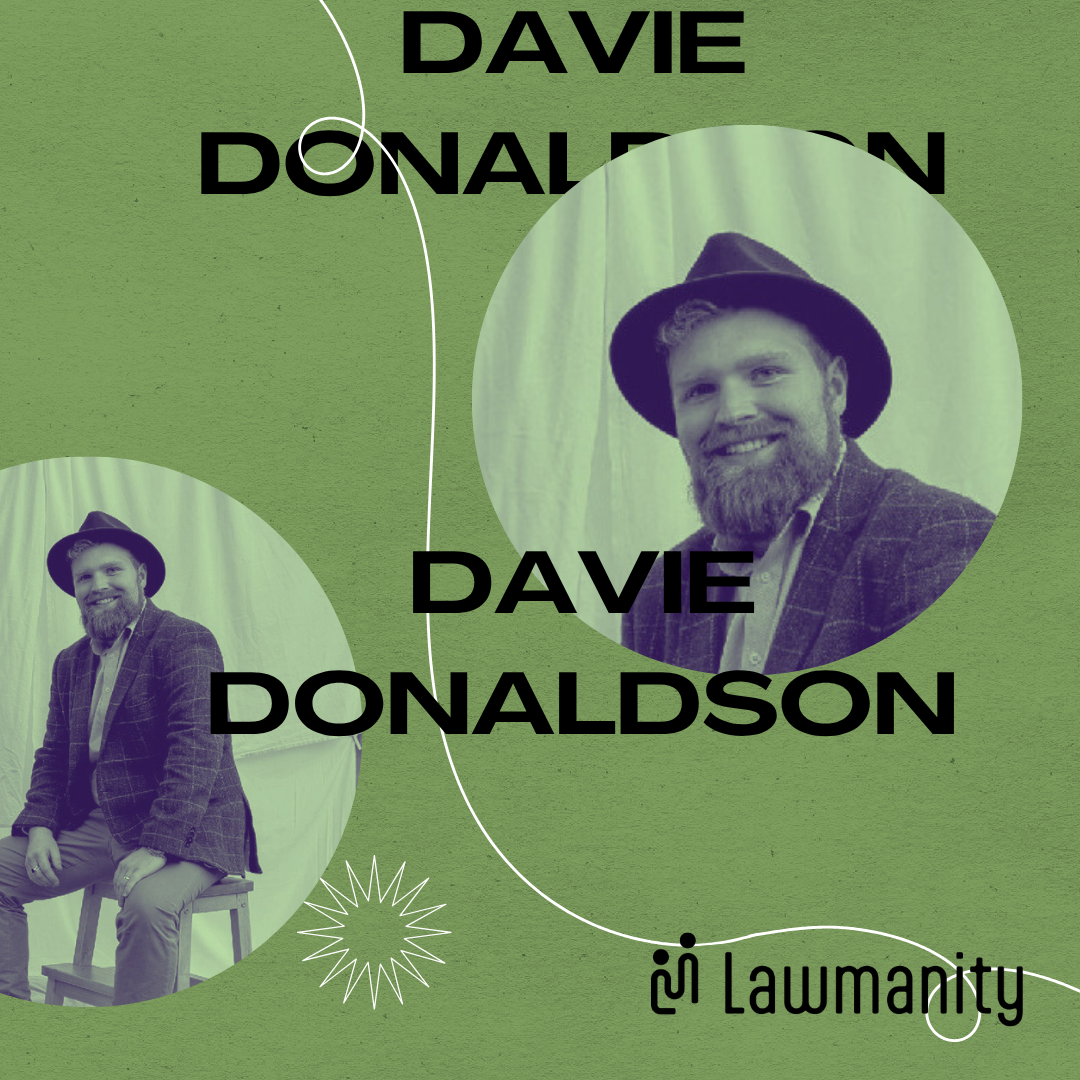
Transcript: “Not Built for Us”: Law and Justice for Scottish Travellers, with Davie Donaldson
Host: Jen Ang
Quote: Davie Donaldson
“For Gypsy Travellers, the law has always been weaponised in Scotland. I mean, you can go right back to the early 1500s and see some of the first anti-Gypsy legislation being brought into play. The law’s been their tool to curtail that. So for Gypsy Travellers, it’s always been this David and Goliath battle.”
Jen Ang
Welcome to the Lawmanity podcast where we explore the complex relationship between law and activism and discuss the different ways that law can oppress but can also lead to real social change. I’m Jen Ang, a human rights lawyer and activist based in Scotland and your host on the Lawmanity podcast.
This week we’re speaking to activist and legend Davie Donaldson. Davie is an award-winning Scottish traveller advocate with over a decade of experience. As senior EDI consultant at Cognac Advocacy and Engagement, Davie supports decision makers at a local, national and international level, to increase the inclusivity of policy towards Gypsy Traveller communities – with one newspaper calling him Scotland’s top campaigner for traveller rights.
Davie is also a regular podcast host with BBC Scotland, most recently hosting the podcast ‘The Cruelty: Stolen Generations’ which has recently been shortlisted for the True Crime 2026 Awards in the ‘Impact for Change’ category. This is an incredible series and if you have not listened to it, I’ll put it in the show notes for you to listen to later.
So welcome to the show, Davie, and I’m so delighted that you’re joining me today.
Davie Donaldson
No, thanks for having me. I’m really excited to get into this.
Jen Ang
It’s a long-awaited excuse to just spend some time with you and to hear a bit more about what you’re up to!
So, as an opener in this podcast, I have a kind of an unusual question. and it’s just to get us settled and to help people learn a little bit about the people behind the legends we’re interviewing. So, a good friend pointed out that our sense of smell is one of our oldest senses and we can hold deep connections between smell and our memories. So, if you don’t mind, could I please ask you to tell me about a smell that is meaningful for you? Maybe one that you really like or one that’s connected to a time or place that you like to bring to mind.
Davie Donaldson
Wow. I mean, that’s a cracker of a question, isn’t it?
A smell… I guess, for me. I mean there’s many smells that bring me back to my childhood and I guess make me feel happy. Right. And I think smell really does touch that kind of human base of, you know, experience and memory and remembrance.
But for me, I guess the smell that I would pick would be the smell of gas. And that may sound a bit strange initially, but I’ll clarify. The smell of gas in a caravan, in a trailer, and when you first click the cooker on in a trailer, you get this kind of puff of gas and it’s an indistinguishable smell from anything else. And that smell to me reminds me of lying in my bed as a child and hearing my dad get up and turn it on to get a cup of tea in the morning. And that smell reminds me of safety because it was also the last smell I would smell before going to sleep at night, as my mum would make us our nighttime snacks right when the door was closed.
So, it’s a smell of safety, it’s a smell of belonging as well, because I only ever smelled it when I was on the road with my own people and it was a smell that I had never had in a house. So for me it’s safety. For me it’s experience and it’s the smell of “wow, today’s another day, it’s a new day where I’m going to experience something great, right? There’s something would be exciting today”.
So, I guess that would be the smell that I would pick. And it’s one that even today as an adult, it really brings me back to that place of being a child and that kind of awe and imagination and I guess the creativity that comes with every day when you’re so young.
Jen Ang
Oh, amazing. Thank you. Thank you for sharing that.
And now, there’s no kind of avoiding it onto a few big questions that I have for you today. From your perspective as an activist, do you feel that the law works equally for you in Scotland or for your community, however you choose to define community, and why or why not?
Davie Donaldson
I mean, where do I begin? Right?
I mean, my work, since I’ve been about 15, has been trying to disentangle and navigate paths that were never built for Gypsy Travellers. Right. Infrastructures that were always built for settled populations and settled people are inherently difficult for Gypsy Travellers to navigate for a number of reasons. But when it comes to the legal system and the law, that task just becomes mammoth.
On a personal level, I don’t believe it works in terms of, I don’t believe it’s very fair, I don’t believe it’s accessible. I don’t believe that the law and justice, I mean, if we pull it back to justice, I don’t believe that it works in a way for, non-sedentary, non-settled communities in Scotland.
I think as well, it’s important to recognise that for Gypsy Travellers, the law has always been weaponised in Scotland. I mean, you can go right back to the early 1500s and see some of the first anti-Gypsy legislation being brought into play. And from that point onwards, the law has always been seen by settled communities, particularly settled authorities who don’t want Gypsy Traveller or nomadic people to exist at times… The law’s been their tool to curtail that. So for Gypsy Travellers, it’s always been this David and Goliath battle since the very start of their, I guess, experience with our modern law system and its foundations.
For me, my experience has been trying to navigate that both as an individual but also as an advocate for communities, right. And what that often means is trying to take word in from this really alien educated environment to the layman, to the local communities who perhaps have had very limited education, certainly not second and third levels of education, but also trying to think about, well, where is the law trying to confuse communities? Because oftentimes when they bring me in, it’s, “we’ve received this document and we don’t know what it means” or “we’ve received this citation and we have no idea what that means”.
I mean, only recently, let’s give you an example. Last week I was contacted by a family who were travelling. It’s also important to notice that for Gypsy Travellers, experience with the law and with the justice system, it tends to be at these… what could be called conflict points. Regularly, those are experienced as Gypsy Travellers travelling, and because we don’t own the land on which we travel, oftentimes it leads to evictions. And evictions are the key, trigger point for our experience with the justice system.
So, I was contacted by this family who were travelling. They stopped on a disused airfield and they’d stopped at 8 o’clock at night. They pulled onto this airfield and by 3 o’ clock the next day they’d received a Court of Session document outlining that they were to be evicted with immediate enforcement. They had 24 hours to respond to this written enforcement letter, which was about 15 pages long, that they had to respond in the form of answers to the Court of Session, which also meant that unless they were able to appoint a solicitor between 3 o’ clock and 5 o’ clock that day, and the solicitor was to be able to read over this document and be able to submit answers on their behalf, they were going to have to put the answers into the Court of Session by hand delivery.
Now, you can imagine the mammoth task that that would be for anyone, but particularly for this family. It’s important to notice that they’d just been evicted from an industrial estate. All of their ancestral camps in the area had been blocked off. And so, they had a number of young children, we had elderly people, a number of disabilities present on the camp as well. And so for this family, it was really important, perhaps more than others, to be in a very safe location. A number of their children had quite severe autism, so they couldn’t stop at the side of the road because of the worry of traffic and the bairns needing space, right.
So they were beside themselves with worry. They had no idea what this meant. All they knew is that the letter threatened sheriff officer action where their vehicles would be towed away, where their caravans would be removed from the site, and where police enforcement might happen. So they were terrified.
So they contacted me. They sent me photographs of the citation that evening. I did my best to read through it from the kind of garbled photos, and then we together pulled together some answers and I then drove from the north of Scotland to Edinburgh to hand deliver it to the Court of Session. Now, when I got to the Court of Session, I was immediately faced with a security barrier. I’d got there at 1 o’ clock, I had to go up to the main office to speak to the reception and say, look, I need to go to the Court of Session and hand this document in. They said, oh, well, I’m sorry, but the Court of Session’s on its lunch break, so you won’t be able to get down there until 2 o’ clock. I said, okay. And they said, but you can wait. So I sat down and I waited for the hour. And in that time of waiting, and this is why I mentioned this, what might seem quite, I guess, an insignificant part of the story, but waiting is something that is highly triggering for Gypsy Traveller communities. Because waiting, particularly in a formal environment like a court or even just in an office building, it triggers all of those juvenile memories of being excluded at school, of being made to feel different, of dealing with the justice system in a way that’s inherently unjust. And so even for me, I guess I’m used to dealing with professional folk and police and social services and so on, but nonetheless, waiting in that moment was highly triggering. I felt my anxiety peaking, I felt my heart rate going… and at moments I wanted to walk out, right? I wanted to leave that building, I didn’t want to be there anymore in this really structured environment that was felt like the walls were closing in on every side.
Eventually I got through. We got through the barrier, went down to the office. When I got there, I handed the document to the reception. They said, right, we need to check this. So then another period of waiting. So I then had to wait for another hour. By that stage, one of their office staff had had the document reviewed and checked by some seniors. They came back and they said, right, have you contacted the solicitor? And I said, no, because I know the name of the solicitor, but it’s a big multinational kind of firm. But I don’t know the name of the individual solicitor who’s dealing with the case. I wasn’t given any contact details because the interlocutor that we’d been given missed out a lot of the appendices. So we weren’t given all the information that the Court of Session had been given. We weren’t given contact details for the solicitor’s firm. Instead we were just given the formal address of the Court of Session. So the admin said, well, you have to speak to the solicitor. We can’t accept these as answers because they’re not in the appropriate format. I said, right, okay. I said, but what, what is the appropriate format? I can’t tell you that, he said, you know, you can hand these in online. I said, I can’t because I’m not a solicitor. He was like, ah, okay. He said, in what capacity are you acting with the occupiers? Now, I knew before going there that I couldn’t do anything that would imply I was a solicitor because then I’d be breaking the law. So I was very, very careful. But then I also wanted to ensure that it was clear that the document had been written with the occupiers and therefore that these families, you know, they weren’t having something placed on them, but they’d actually written this document alongside me, albeit with some support around, you know, the rights and legislation and so on.
And I said, well, I’m an advocate, so I’m just wanting to help the families get their voices heard. Ah but you have to be acting in some capacity. What capacity? I said I knew I couldn’t admit that I had no idea what he was asking. I was terrified to do anything which might get me in hot water. So I think he eventually realised this and he said, look, I would go to the solicitor’s office. So I left there. I drove to the headquarters of the solicitors, went in, of course, I had no idea what solicitor I was asking for. I had no case reference or anything like that. I just had this legal document and I just handed it to someone and I said, look, I said, I really hope this counts as within the 24-hour period, because otherwise these families are facing eviction to, you know, to nowhere. There’s nowhere for them to go. Eventually I got an email back from the solicitors and they said they would consider the position, because there was clear evidence that there would be a breach of Public Sector Equality Duties. There was clear evidence of, there was no EQIA, no Equalities and Human Rights Impact Assessment had been carried out. It was impossible for it to have been carried out in that time period. Anyway,
Jen Ang
Here Davie has mentioned the evidence that no EQIA had been conducted, as clear evidence of a breach of Public Sector Equality Duties.
What’s he talking about?
Well, in the UK, under the Equality Act 2010, public authorities like local councils, the NHS, government departments like the Home Office and the DWP and so on, they have a Public Sector Equality Duty to consciously consider the need to eliminate discrimination, to advance equality of opportunity for everyone and to foster good relations between people, including people of different races, abilities and sexes.
To fulfil this duty, public authorities are supposed to conduct an Equality Impact Assessment, or an EQIA, to analyse how their policies or services or decisions might impact particular groups, especially vulnerable, discriminated against and marginalised groups. They’re supposed to gather evidence, to actually go out and find and speak to people about what impact these decisions might have, to think about what they’ve been told and to make adjustments that minimise those negative impacts and foster good relations when they go about creating those policies or delivering those services or making those decisions.
So here Davie is pointing to the failure to conduct an EQIA prior to the local authority’s decision to evict this family from their home, as relevant to possible discrimination on the basis of race as a protected characteristic, because Gypsy Travellers in Scotland, preserving their travelling way of life, has been recognised as a protected category under the Equality Act.
Davie is pointing to a strong stateable legal reason why this case should not proceed, at least not until a proper EQIA has been produced and can be publicly and, transparently scrutinised. Davie continues.
Davie Donaldson
So there was significant concerns because it was a public authority who was doing the enforcement. So I then went back that night, drove up to the northeast of Scotland, went to visit the families, showed them, told them what had happened, gave them a copy of the letter and so on for their records. When I was speaking to them, they said, I don’t know what all the problems about. There’s no mess, there’s no antisocial behaviour, there’s been no complaints. All we want is somewhere safe for our kids to stay.
And I think that one example shows you just the David and Goliath task that often exists for families. Many of the families that I work with have low rates of literacy. They have an absolute fear of the justice system. So if they’re ever given anything formal, their minds immediately go to what will happen to my children? Will social services get involved? Will my children be removed? What will happen to me? Will I end up in prison? You know, there’s such a lack of information around the rights of Gypsy Travellers within the community. But there’s also this predetermination of, well they’re going to find it wrong against me anyway, so what’s the point, you know.
So it is a difficult situation and for that particular family, they’d been pushed from pillar to post, throughout this local authority. And the night before arriving to that camp they’d been told by a local authority officer who’d came down who was evicting them from their previous camp. They said, look, why are we being evicted? I mean in, in Murray they were stating – some other local authorities – in Murray in Aberdeenshire we even get provided with bins now. Side note, being provided with bins is such a basic thing. But for these families I think that shows you just how little support they get when they’re on the road. And they said that anyway to this local authority officer and her response was, well, if it’s so good up in Murray in Aberdeenshire, why don’t you pack your bags and go there? Because you’re not welcome here.
Jen Ang
Oh… the lawyer in me sort of bridles at that a little bit, but I’m just, I’m just gonna let that pass for now. Wow that’s, that’s horrible. That’s actually, I will actually, I will step in that, you know, that’s a level of sort of human cruelty that again I think probably is commonly seen but is so often actually surfaced and spoken about. And of course not only is there only one of you, but whenever I hear accounts like this I also think about, you know, what’s happened to probably the dozens, if not more, you know, other families in different places at different times who didn’t know who to call or who weren’t confident or sure enough that it would even be worth contesting.
Davie Donaldson
Yeah, I guess that example is the recent one and one that will help your listeners to understand the insurmountable task. I mean, in the words of the family, it would have been impossible and it was an impossible task, and I mean, even it getting taken immediately to the Court of Session in Edinburgh instead of local sheriff court was a tactic, right. These things don’t happen by mistake. it was Crown Authority land, so it also helps to know that you’ve got one of the most marginalised communities in Scotland going up against the King, you know.
So I think there’s something to be said for the fact that solicitors and the legal profession are usually working on behalf of clients who want Gypsy Travellers to be removed, who don’t particularly care for the rights of Gypsy Travellers or the cultural rights or the cultural aspect of why we travel and why it’s so important for us to remain in touch with our culture and our sense of belonging. And so, because of that, unless Gypsy Travellers have means, which very few of us do, due to the structural discrimination that we face, lawyers are just something which is impossible for your average Gypsy Traveller family. And even at that, you know, where would they begin? Where would they start? So, for me, I usually come in at the stage of crisis, and I think something I’m really keen to highlight are these moments of crisis so that we can try and change the legal system so that it works better for communities who are at the sharp end of things. But it’s also important to recognise that there are no legal rights for Gypsy Travellers travelling, really. I mean, when you boil it right down, I was relying on a defence of the fact that this was a Public Sector Equality Duty that had been missed, that there wasn’t a – let’s face it – quite a bureaucratic document done, an EQIA. But there was no law I could lean on to say, well, this is an indigenous community of Scotland who have been travelling for the past thousand years, who have faced major structural discrimination and major environmental racism, meaning that their traditional way of life has been curtailed and so they’re forced to stay on this abandoned airfield because all their ancestral camps are blocked off. There was no legal argument in that sense. So we end up having to rely on quite bureaucratic arguments, which I feel miss the emotion and miss the impact that Gypsy Travellers are telling us at the roadside.
Jen Ang
So you’ve quite vividly described for us how the law, both the substance of the law and also the process of the law, is a forceful barrier actually preventing Gypsy Travellers from living equal or even sort of, you know, positive flourishing lives in Scotland today. What is the role of law in the legal system in relation to a positive social movement that would affirm Gypsy Traveller rights? Or are there any ways in which you’re seeking to use the law as a tool to achieve greater equality, for this community?
Davie Donaldson
Yeah, a fantastic point and, one that really comes to, I guess, where I want us to move into the future.
I think with the law, we need to recognise that the law is written by the majority. And so in most contexts all over the world, indigenous people tend to be either omitted from legislative protection or they’ve had to fight really, really hard for the protections that they have. But I also think that in Scotland, we’re at a really interesting point with the incorporation of the UNCRC, where we can start to think about some of these international agreements, where we can start to think about, you know, elements like CERD, you know, even the UN Declarations of the Rights of Indigenous People, something which, in principle the UK has signed up to, although there’s no kind of legal binding nature to it. But I think we can take another look at these kind of national frameworks and think about, well, where can we use these in a local context and where can they follow the same path as the UNCRC to become, you know, something we can rely on as arguments and in a court of law?
Jen Ang
Here Davie is talking about the ways in which the law can be used as a positive tool for change. He’s listing international human rights treaties like the UNCRC, which is known as the UN Convention on the Rights of the Child, and the CERD, which is the International Convention on the Elimination of All Forms of Racial Discrimination. Davie also mentions the UN Declaration on the Rights of Indigenous People, and he gives all of these as examples of international law that could be used positively, proactively to defend and extend people’s rights here in Scotland.
So how might that work?
Well, Davie goes on to say that the UNCRC, the Children’s Rights Convention, is on a path here in Scotland because we can rely on those arguments in courts of law. But he points out that the other two treaties, the CERD and the Declaration on the Rights of Indigenous People, do not have a legal binding nature here.
What does he mean by that?
Well, these global international treaties are negotiated between states at the UN or Council of Europe level, and then they’re opened for adoption or ratification by individual states. However, even once a state has agreed to adopt, ratify or be bound by a treaty, for example, the UNCRC, that doesn’t mean that individual people within that state can rely directly on the rights in that treaty in a national court in a specific matter that affects them. For some states, and the UK is one of those, those states also need to take steps, or what we call national measures, to fulfil the promises they signed up to in adopting those international treaties. This most often means taking a step, such as passage of legislation or a new law by the UK Westminster Parliament or regional parliament or assembly.
So, for example, although the UK ratified the UNCRC in 1991, no child in a court anywhere in the UK could directly rely on the rights in that treaty in a UK court until July 2024, when Scotland passed the UNCRC Incorporation (Scotland) Act, which only applies in Scotland to certain Scottish public authorities.
So Davie is talking about a new opportunity to protect the rights of Gypsy Traveller families, which has arisen because of the passage of the UNCRC Incorporation (Scotland) Act. And we have actually seen this come to pass in the last few years. In late 2025/early 2026, the legal charity JustRight Scotland successfully defended an attempted eviction by Glasgow City Council of a family of travelling showpeople, relying in part on human rights arguments, including a legal argument about the impact for a child living on the site with reference to the UNCRC Incorporation (Scotland) Act.
Davie goes on to acknowledge, however, that the CERD and the Declaration on the Rights of Indigenous People are not yet incorporated in UK law. Although the UK ratified the third in 1969, it has never taken any steps to incorporate its provisions here. The closest we’ve come is a draft Scottish Human Rights Bill, expected to be introduced in the 2026 Scottish Parliamentary session, which would directly incorporate aspects of CERD in Scotland in a similar manner to how the UNCRC act currently works.
Finally, with regard to the Declaration on the Rights of Indigenous People, the previous Conservative UK government in 2023 has said “the UK supports the provisions in the Declaration. Human rights are universal and apply equally to all. Our position remains that national minority groups and other ethnic groups within the territory of the United Kingdom and its overseas territories do not fall within the scope of indigenous people to which the Declaration applies.”
Davie continues explaining why it is vital for this perception to change both in the minds of policymakers and for the wider public.
Davie Donaldson
Now, I think on one level, you have those tools and the legal system should really embrace some of those and recognise that they do matter in this context. I mean, for a lot of people in the legal system, indigenous rights is not something on their kind of periphery even in Scotland, because they just don’t see it as a legal system or a legal framework which is useful in a British mentality. But actually they need to start to recognise that Gypsy Traveller communities, particularly Scottish Gypsy Travellers, you know, we can significantly prove that they are an indigenous community to Scotland, and likewise other communities. So I think we need to start thinking about how we incorporate those frameworks, but I also think we need to start to see representation in the legal system of our own peoples. Because I think when you see someone who knows how to navigate the system, who perhaps is a solicitor or working in the justice sector in some capacity, you start to recognise, well, actually this system isn’t just a weapon against me, but actually it’s something we can also use to protect ourselves.
And that’s something which is significantly lacking for Gypsy Travellers. There are Gypsy Travellers who have went on and became solicitors and, that has happened. But the difficulty with that is that for those people, they’ve had to deliberately hide their ethnicity to such a degree in order to get to that stage, whether it be even to get to university or to get a job or get a traineeship even, they’ve had to hide that part of themselves to such a level where the community no longer know them or they’re known by the community, but they, the community are worried to put their jobs at risk by asking them to kind of take a platform on behalf of Gypsy Traveller rights.
So we need to see the legal system also change internally to think about, well, how do we respect marginalised people in this profession? How do we think about race? And, you know, even I’ve got close friends who are solicitors. And even the abuse that LGBT people face in the legal system is profound. And on an everyday level, Gypsy Travellers often look at the LGBT movement as an example of, you know, success, right. You know, you went from this place of being illegal to having pride marches, you know, and that’s something that is really visibly a success for marginalised communities. But again, when we look at the legal profession, it’s just so far behind the rest of society and in that capacity.
So I think there’s representation, there’s the incorporation of different legal frameworks, but there’s also the fact that we need to think about relationships between legal professions and Gypsy Traveller communities. Gypsy Traveller communities don’t deal with institutions, they deal with people. And by that I mean, if anyone listening to this has ever worked with Gypsy Traveller communities, they very rarely know where you’re coming from. They don’t particularly care. You can tell them, but they don’t particularly care. They’ll know you by name, right? They know Sheila or they know Stephen or they know a person, they know that Stephen or Sheila works with the legal profession in some way and that they can help, but that’s it. Because they are inherently relationship based. And that goes back to our own indigenous kind of worldviews, around people and place and the fact that personal relationships are more important than anything. So we need to start seeing those personal relationships founded between marginalised communities, particularly Gypsy Travellers and solicitors. We need to start seeing people having a bit of patience.
There’s also a recognition that by the time, for example, take an eviction, by the time an eviction goes to court and perhaps all the paperwork has been done for legal aid or whatever it may be, the Gypsy Travellers might no longer need to stay there anymore. They might have moved on in their traditional travelling pattern or they might have faced so much hostility that they just cannot, for their own mental health and their own family safety, stay there any longer. And that often faces a little bit of backlash from the legal profession because they think, well, you know, we’ve went to all this effort, we’ve done all this paperwork, we’ve formed all this argumentation, we’ve got all these documents into the court, which I totally get, but I guess there’s a lack of understanding around the transient nature of place as well. And that’s something where I think the current legal system has been built, particularly around evictions, on an assumption that the families will want to stay there long-term.
So we need to start seeing all of those kind of, at times divergent stratas of work coming together to try and create a fairer justice system. But we also just need to, the very base level, have a better awareness for communities, you know, legal – and then this is an argument I wanted to get to but – legal argumentation is something that’s very difficult to do if you’re just a grassroots campaigner or a grassroots advocate without legal training. If you have done it long enough, like I have, you eventually start to learn some of the legal processes. But it’s a very closed shop, right. Solicitors aren’t overly keen to diverge all of it and they’re very keen to speak in language that’s quite inaccessible for your everyday person. And I think that also it creates this dependent nature from marginalised communities on the legal system and particularly legal professionals. There’s very little opportunity for Gypsy Traveller families who are stuck in these situations of cyclical eviction or facing human rights abuses as well, at the sharper end of things, to learn their rights, to think, well, actually this lawyer made X, Y and Z argument and I can use those myself, come the next time this is going to happen to me. And I think if we had that level of empowerment instead of the closed shop around, you know, what rights are, then we would start to see the public at large and also landowners and authorities start to question their actions prior to them doing it and prior to them retraumatising families because they’ll have the recognition that families know their rights. Families aren’t just going to allow people to evict them and tow their homes off of a piece of land without the proper documentation being done, or have the wool pulled over their eyes.
In the case of that recent eviction on Crown Estate land, there was an argument in the interlocutor that the families were staying on a location that had unexploded munitions from the Second World War, therefore there was a safety risk. Now, on the very base reading of that, you think, well, completely like that’s fine, like, yeah, the eviction should go ahead because the families are at risk. And yeah, I completely get that. You know, it’s not a personal thing, this is about safety. But interestingly, the appendix which showed the survey data, was missing. And when we actually researched into the survey, we found that a recent survey that had been done found no munitions on that place that was being occupied at all. So again, the wool gets pulled over family’s eyes, right?
And I think if there was more investment into the empowerment of communities long term, we would start to see that shift. So it’s multifaceted. There’s a lot of different things that need to happen for the legal system to be more just. But I also think we need to start to see Gypsy Travellers really treated with a degree of respect, you know, and common sense. You know, for example, the solicitor which put a 24-hour period on responding to that interlocutor who, you know, we had to hand deliver the letter, a bit of common sense would have shown that, well actually that’s going to be impossible for that family. So I think we need to start see those questions being asked as well and not just the harsh rule of law being applied at every stage.
Jen Ang
So I mean, you know, true to the legendary advocate that you are, a wide range of powerful challenges for the legal profession and for the justice system. I particularly heard the idea that there will be a consistent gap actually in the legal system’s ability to recognise and uphold the dignity of Gypsy Travellers unless there is greater representation and representation of people in their whole identities, perhaps with a structure that allows them to do this work that you were doing so effectively but as an advocate. So really a lot for us to think about. You’ve, you’ve sketched out powerfully where we’re going wrong and so, my last big question for you is hopefully a nice one to answer and that is, if we get it right, what does justice look like for you or for your community?
Davie Donaldson
Yeah. And it’s a question that I ask myself every time I visit a camp or every time that I’m speaking to someone who’s just experienced hate crime or someone who is terrified of losing their kids to social services and just doesn’t know how to go about even challenging decisions, right.
And because of that, I think justice is something which is experienced on a really individual level. Justice is something that really relies upon former experience. It relies upon an acknowledgement of past trauma. both collective and individual. But it also recognises that everyone has a right to live in a dignified and respected way. Right. And that’s where our justice system falls short. Right, let’s pull it right back. I mean, I’m really keen to talk about legal arguments and legal frameworks, but at the very baseline of all of this is the fact that everybody in Scotland should be allowed to live respectfully and in a dignified way.
And for Gypsy Travellers that means we want to experience our culture, our indigenous culture that’s been passed down by our ancestors for generation after generation. We want to ensure that our children and the next generation get to hear the stories and the songs which link us to the landscape. It’s about knowing where you come from, learning your language, having the ability to come together as a community and experience your own sense of identity and your own sense of belonging. Currently, the justice system in Scotland is a barrier to all of that.
Now, how justice would look would be a Gypsy Traveller family would be able to travel unimpeded to their ancestral stopping places. There would be significant and sustained support for Gypsy Travellers travelling – and “shifting” is our word for that – but shifting around the country, basic support, access to basic sanitation, access to running water, access to refuse collection and bins, toilets, you know, really basic human needs should be met in a just society.
We should recognise and respect that there are very few nomadic communities left in the world, particularly in the Western world, and so having a nomadic community in Scotland, like the Gypsy Travellers, is something that should be celebrated, it shouldn’t be impeded, right. I mean, living in a nomadic way, having a particular unique relationship to the landscape and the oral heritage of the land, is something that we should all want to celebrate, whether or not we are Gypsy Travellers. And to be able to travel and not worry about eviction, not have that constant stress, that constant feeling of surveillance every single time you move, knowing that local settled communities will respect your right to be there and will support you to be there in a safe and dignified manner. You know, they won’t expect you to have to remove all of your rubbish and travel from place to place with these cartloads of rubbish because you can’t access a council recycling facility. Because if you burn the rubbish, you’ll get charged, because you aren’t provided any bins. You know, they don’t expect you to have the toilet behind a hedge because they won’t provide you toilets, or they’ll lock the public toilets so you don’t access them, or they’ll refuse to allow you access to toilets in a local shop. Dignity, you know, that’s what the justice system should look like.
And I think if we move to a place where there are legal protections on the right for Gypsy Travellers to travel, it won’t only positively impact the Gypsy traveller community, but it’ll positively impact the settled community as well, because it’ll allow that travelling to be done in a safer, more community-cohesive way. And it’ll avoid a lot of the common issues that we see, dragged up time and time again as argumentation against shifting.
Now, this shouldn’t be against an indigenous community. You know, the argument shouldn’t be whether or not we still have Travellers travelling. The argument should be how do we, as a modern developed society, ensure that Indigenous communities can live dignified and respectfully. How can we recognise, like the First Minister did very recently with his apology to Gypsy Traveller communities, how can we recognise the historical trauma that as a collective mainstream society we have placed on this Indigenous community for generations? You know, where can we sit amongst all of this?
So on one level there’s, there’s the kind of collective culture and justice, but I also think that when it comes to justice, we need to think about accessibility much more. We need to think about, for that Gypsy Traveller mother who is about to lose our kids because they’ve not been at school long enough or they’ve been removed from school in order to travel, what support was there for her to be able to access education for her children? What support is there for her to be able to navigate the social services in a way that supports her family to stay intact? And if her family is fragmented, what support is there for that child to then grow up knowing about its heritage and its identity as a Gypsy Traveller? Because right now there are gaps in all of that.
So the justice system is one that is a weaponised mechanism in Scotland and it’s certainly weaponised and has been written in many cases to be weaponised against Indigenous communities at home and abroad. But right now we’re starting to see, I guess, the cultural trauma, the transgenerational impact of, forced sedentarisation or forced removal coming to the fore.
And really we’re at a crucial time. You know, if the justice system doesn’t become just in the next generation, we are going to lose Gypsy Travellers as we know them because there are no ancestral camps left. The families are consistently being pushed to the margins. Many families will report saying we can’t travel anymore because there’s nowhere safe to stop. Nowhere. The locations where we have ancestral memory, where we have a sense of belonging, have been blocked off for so long now that many families grow up not knowing their connection to the landscape because they’ve not been able to experience and inhabit that land in the way that their forebears have. So really, in the next generation we’re going to see a real crisis point for our community where… I believe Gypsy Travellers will always exist, but being able to be a nomadic or even semi-nomadic community in Scotland, being able to experience our language and our oral histories, being able to experience our sense of community and belonging as we know now is really coming to the stage where we need to do something, otherwise we’re going to lose that forever.
Jen Ang
A thoughtful and urgent and powerful critique, I think And I recently read an article that you had republished, I think about sacred spaces to the Gypsy Traveller community. And it struck me as, you know, as someone who loves driving across Scotland as well and walking in its wilderness, it struck me how sad it is that our collective understanding of those spaces is so poor and actually that that was the result of really an intentional erasure and oppressing of that history.
But in any event I am so heartened that you for one are continuing to work in this area and of stridently defend the possibility that we can get this right for the next generation, that it’s not too late, but also that there are people with hearts and hands and minds who are willing to put their hand to the wheel. So there’s so much more that I want to hear from you Davie, but I’m also conscious that I need to let you away.
Davie Donaldson
Yeah, no, I guess just to Because it was a bit of a do or not, wasn’t it? But I want to also say that you know there is, there is a lot of resilience in the community, you know, and adaptability. Right. And I mean Tyson Fury, right, who’s not the biggest champion for many causes, however, he did say one thing that I agreed with, just the one: he said that as a Gypsy man, he could be taken butt naked and dropped in the middle of the rainforest with no resources, with nothing and he would come out a month later a millionaire with a dead chinchilla on his head.
And you know it’s a bit tongue-in-cheek but it speaks to that adaptability of Gypsy Traveller communities. You know, it’s never been legal for our people to exist ever. You know, I mean we can go right back to the early dawn of, of kind of the mediaeval literature that we can read and the legal landscape and see. Well, you know, there was a benign neglect toward Gypsy Travellers at that time at best, right. But there’s never been a legal right to travel, but our people have continued to do it. So there is an adaptability and a resilience to navigate legal system.
I guess what I want to really end with is the fact that this generation of lawmakers, whether they be, you know, legal professionals or people who want to influence the legal system or even advocates and campaigners like me, we need to see a responsibility on their shoulders to think, well this potentially is the last generation of lawmaking that we have where we can really protect Gypsy Traveller communities as we know them and ensure that the next generation can grow up, not just Gypsy Travellers, but experiencing the whole culture and their whole sense of belonging.
There was a quote from one of our most famous ballad singers, Bill Stewart, who was an advocate in her own right. She was, you know, celebrated by royalty. She, you know, performed for politicians and whatever it may be. But she was, well known within the community as Granny. Everyone knew her as Granny, right? but she was once asked by a journalist, and the journalist said, when do you think Travellers will cease to exist? When do you think they’ll disappear? You know, you’re an older Traveller, there’s not many people like you. – And this was in the 90s, right? – There’s not many people like you anymore are still singing the old ballads, the old Travellers, you know, when, when will it die? Will it die with you? And she laughed and she’s quoted as saying, son, Travellers will be with us until doomsday in the afternoon. And I think that shows such an act of resilience and humility as well from our elders in our community that I think the legal system can really learn from, but also respect that there is a responsibility placed by that quote on all of our shoulders to ensure that Travellers are here until doomsday in the afternoon.
Jen Ang
A strong and beautiful reminder of the depth of this history, but also of the urgency of the work that needs to be done.
So I’m going to very cheekily ask you one final question. I know that you need to go, but there will be people who are listening to this series of podcasts, who would be human rights activists, maybe also lawyers, and who are looking at you and who you are and what you’ve accomplished today.
They might be a younger version of you, or they might actually want to be you, Davie. So my question is, what advice might you have for someone listening today, who wants to know what it takes to get to where you’ve gotten to.
Davie Donaldson
To put it in a different way, an activist who I look up to in the civil rights movement is Harry Belafonte, right? And he’s famously quoted as saying, “I became an activist because I grew up in poverty,” right? And I think for me, that is a situation… I never chose to be an activist or a campaigner or an advocate or whatever title I place on whatever it is that I do, right? But I grew up as a Gypsy Traveller in Scotland, and I think, by that experience, I recognised that something needed to change so that the next generation didn’t grow up in the way that I did, right?
So I think for anyone out there who is thinking about becoming a human rights defender or, you know, whether that be at the grassroots level as a community campaigner, as an advocate, as a human rights lawyer even, and, you know, moving into the legal profession, I think do it, right? If you’ve got that calling in you, then there’s something in your lived experience which recognises injustice as injustice, right? And that’s, that’s the basic point of it. You know, you don’t need a particular degree – or you will if you want to be a lawyer, right? But in order to actually campaign on these things, I think it’s important to just have that base level of, here’s where I’m starting from, here’s what injustice looks like and here’s how it needs to change. And that basic human relationship with justice is something which we can all tap into, whether or not we’re legally trained.
So what I would tell a younger version of myself is: what you’re seeing around you right now doesn’t have to be that way, right? It doesn’t have to be that way. You don’t need to experience the evictions that you’ve experienced. You don’t need to experience the hate, the discrimination, the… the barriers to your culture, to accessing the voices of your ancestors. You don’t need to experience that. And you have the tools, everyone does, in order to move forward and to change that for the next generation and for yourself. You know, let’s… let’s move into a place where we’re not just thinking about fifty, sixty, you know, hundred years, potentially down the line, you know, and the descendants to come.
Oftentimes indigenous communities, we fall into that perspective of, yeah, we’re doing this for the future. And it’s this quite indistinguishable, ungraspable future, right? Let’s do it for ourselves. You know, why can’t things change now? Why can’t we lead dialogue and conversation which can impact our communities and our families now? And why do we have to face these indignities and sacrifice our own sense of belonging, our own sense of justice, in order for the future? We shouldn’t have to sacrifice that. Let’s claim justice today and make sure that we ourselves can also experience what we believe justice should look like.
Jen Ang
And that’s a wrap for today’s episode with Davie Donaldson, award-winning advocate for the Traveller community here in Scotland, relational facilitator and commentator and podcast host for the BBC.
If you are inspired by what Davie has shared and want to learn more, please do have a listen to his most recent podcast projects, his work at Cognac Advocacy and learn more about how you can help combat discrimination against Indigenous peoples local to you. Find out about the history of your local area. Explore connections and histories that have been hidden, suppressed or lost that you could help to revive like Davie does. This is the first step towards recognising the equal dignity, belonging and the rights of all people who live here.
We will be back again soon with our next episode, a one-to-one interview with the brilliant Talat Yaqoob, a feminist activist and political commentator and co-chair of the First Minister’s National Advisory Council for Women and Girls in Scotland. She will share with us a timely take on the relationship between law and inequality and highlight some of the key challenges facing the new Scottish Government in 2026.
Thanks for tuning in to our Lawmanity podcast again and if you enjoyed today’s episode, please do hit the like and subscribe buttons and share our episodes with friends and colleagues who might enjoy learning a little bit more about how law really works in practice and how it can be used to make the world a better, brighter place.
The Lawmanity podcast is co-produced by me, your host Jen Ang, and by the brilliant and talented Natalia Uribe. Shout out to Helena Refai for mentoring us through our first year of this incredible project. And thanks also to Amanda Amaeshi, on graphics and socials. The music you’ve been listening to is Always On The Move by Musicians in Exile, a Glasgow-based music project led by people seeking refuge in Scotland. Thanks so much for tuning in today. We hope you enjoyed listening and see you next time.


