Our Futures: A Call for Actions, Not Words
This week, my feed is full of “we regret” and “we stand with” and “we hope you feel.”
If you thought my next observation was that these expressions feel performative, I might surprise you in saying that I don’t think they are. I think that people genuinely feel, in the moment, that expressing sympathy, empathy and solidarity is a good thing – a positive action – and these expressions come from a good place.
What’s bothering me, though, is the sense that we have entered an era where “our statement on…” and “politician’s speech expressing regret / concern” becomes the sum total of meaningful action taken in response to what is becoming an existential threat to the very real and tangible lives of black and brown people across the UK, and in Scotland, today.
In case anyone needs a reminder:
🗣️ Saying you’ll do a thing is not the same as doing it

A few weeks ago, I expressed frustration with my long-suffering partner, who is AuDHD (Autistic and ADHD).
I asked him why, when something bothered him – for example, the fact that our family members (myself included) seem incapable of stacking our clean pots and pans in size order, but instead resort to chaotically hurling them into the pots cupboard – he and I would spend ages talking about the solution to the problem, arriving at a solution, and then … nothing would happen.
Until the next time he went to open the cupboard at the wrong end of a tough day, and voilà: all the frustration comes flooding back, and we have another conversation.
Except this time, the conversation is shorter: I point out that there is no point being upset; we had this conversation, we arrived at a solution, and in this case, the next move was his. Why, then, is he upset? But more importantly, why hasn’t he resolved the thing that is so clearly upsetting him?
The answer I got was a little bit of a revelation: that sometimes, talking about doing a thing can sort of trick your brain into thinking that it has been done.
This is not a scientific blog and so I’m not going to retrieve some citations for you; I just want the “sense” of my partner’s explanation to sink in, because his answer definitely passed the “gut truth” test for me.
Haven’t you felt before that dealing with the emotional impact of a thing was enough for you, and that sometimes meant you didn’t have to go on to deal with the actual impact at all?
That can be a healthy approach for individuals facing individual people problems – we lack agency and control in our lives in all sorts of ways, so sometimes talking through the emotional impact of a problem is all that we are capable of doing.
But that, is not this.
When it comes to issues of governance, social policy, economy and law – our leaders carry responsibilities that go far beyond the trivial state of my pots cupboard.
Those leaders chose to lead – they are capable of making change happen, and for that reason, we can call them out on this point:
🙅🏻♀️Words, without action, are not enough
Again, I do think words matter. What we say, and how we say it, matters. Words and language are the precursor to change, and lots of people expressing a dissatisfaction with how things are – and a desire for change – is a good start.
But just as British suffragettes in the early part of the 20th century eventually rallied under the motto: Deeds, Not Words, so too the present situation calls for clear strategy and action to tackle head-on the conditions that have normalised the idea that groups of white people rampaging the streets of our cities in order to harass, intimidate, and violently attack black and brown people, is somehow okay.
Scotland, today, is so far from okay, it’s hard to know where to start. And every step of the way here, people – politicians, leaders, journalists, intellectuals – have wrung their hands, and agreed that our journey here is concerning, a tragedy, an urgent thing.
But the fact remains that every single one of us has failed to make these streets safe* for innocent people who are marked out as acceptable victims of violence because the state – and I do mean the British state, the Scottish state, and every city and local authority in this country – the state has legitimised targeting migrants (and by extension, black and brown people) as somehow more acceptable than any form of violence against British or white people.
I won’t succeed in changing that alone – no one could – but I’d prefer to make a start.
☝🏽Let’s try asking our leaders – every time they “regret” or “stand with” – to “name one thing” they plan to do to actually solve the problem of anti-migrant governance and systemic racism
I won’t be overly critical if they do: actions can be simple, direct. They can be imaginative, fun, cost-free. Many solutions – such as increasing the social housing stock or encouraging community cohesion – are really worthy and important aims in their own right.
But instead of pretending that we are not facing an escalating crisis of social division, rising racism and a poorer, bleaker future for our children – politicians and leaders need to find the courage to name the problem and connect that problem to the solutions – out loud.
Then they need to do the doing.
And we need to stand watch, and make sure they do it right.

* Our streets are not only unsafe for migrants, and black and brown people, they are also unsafe for women and girls, for visibly trans and queer people, and for lots of lovely people who are none of these things and just minding their own business, but who somehow look different in a way that causes others to want to harm them. In a future world that I want to live in, our streets would be safe for everyone, in the way that our public libraries are safe for everyone (because we are all afraid of the librarians, but also kind of love them). Roll on that world ✊🏽
📝 Postscript
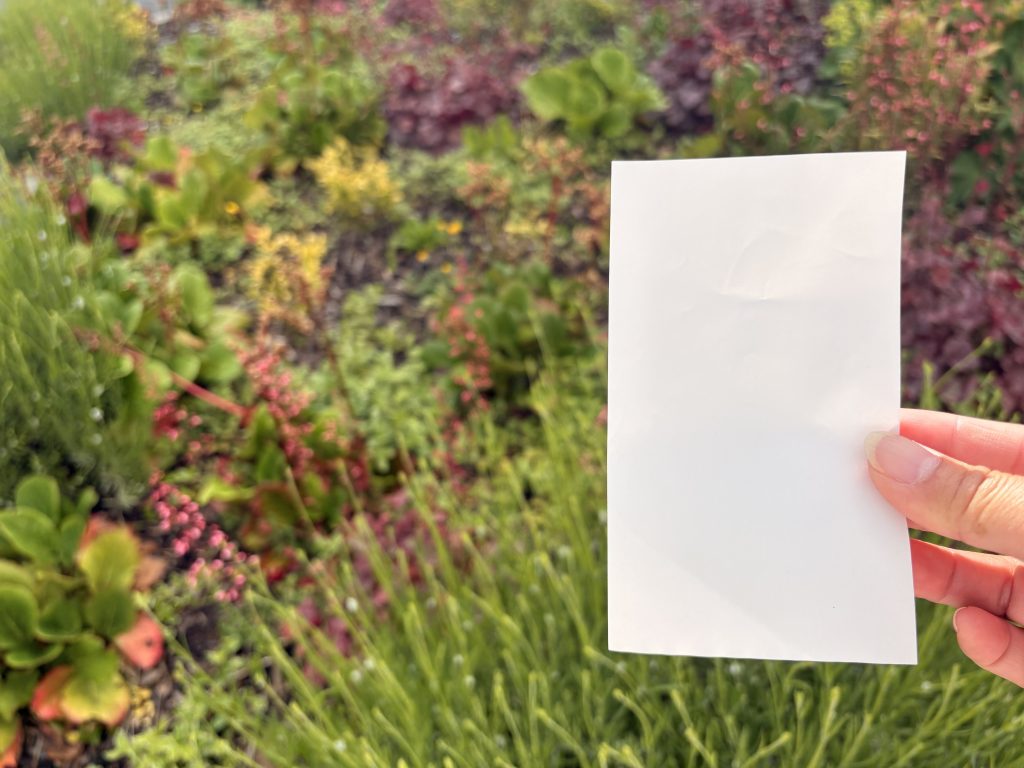
The photo at the top of this post is a blank receipt which a parking barrier at Edinburgh airport produced for me on Monday this week, as I tried to exit the airport. The barrier would not open, if I did not take the receipt – in a neat trick of coercion which demonstrates what happens when you allow companies to exercise private property rights over public transport infrastructure.
I will leave you, this leisurely Friday afternoon, to think about what it all means. But when you’re daydreaming, please also think about what could be.
In a world where you decide, what would you have the machine print on this receipt?
First published on 12 June 2026 on The Long View: https://www.linkedin.com/pulse/our-futures-call-actions-words-jen-ang-28cwe/