Transcript: “We’re Going to Have a Party”: Law, Protest, and Social Change, with Lily Greenan
Host: Jen Ang
Quote: Lily Greenan
“I think that we’ve had a significant amount of success in Scotland in shifting the legal frameworks. I’m not sure that that has actually had as much impact on the lives of women and girls as we would like to think.“
Jen Ang
Welcome to the Lawmanity podcast where we explore the complex relationship between law and activism and discuss the different ways that law can oppress people but can also lead to real social change. I’m Jen Ang, a human rights lawyer and activist based in Scotland and your host on the Lawmanity podcast.
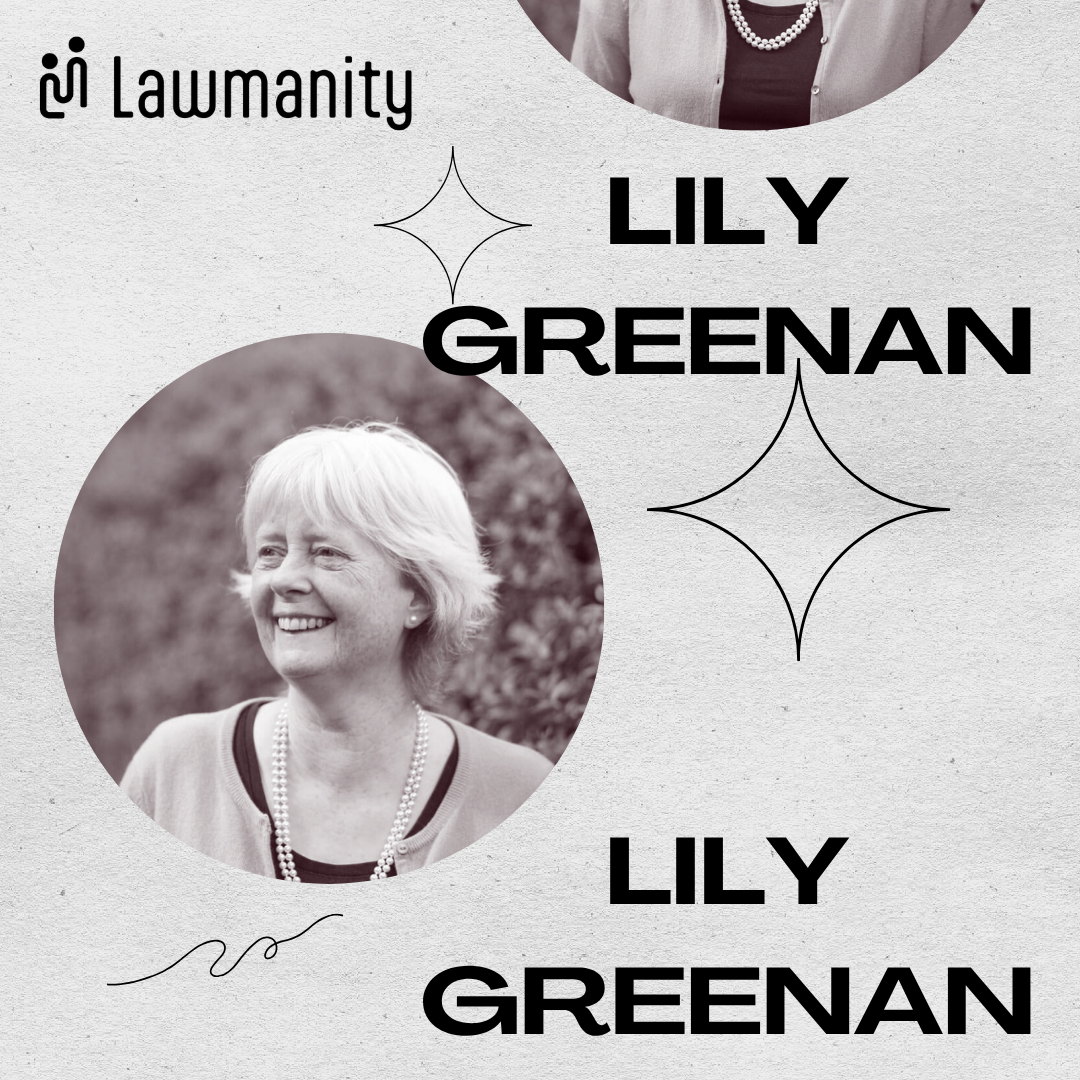
This week, we’re speaking to activist and legend Lily Greenan. Lily has been involved in work that challenges and seeks to eliminate violence against women and girls since the early 1980s, as an activist, an advocate, and in strategic leadership roles, including serving as chief executive of Scottish Women’s Aid for nine years.
Since 2015, Lily has been a freelance consultant, researcher, and a trainer with a focus on gender equality and violence against women and girls. And she shares with us here some reflections on using the law to push for progress in her time, including the genesis of the groundbreaking Domestic Abuse Scotland Act 2018.
Lily also brings considerable experience and wisdom as an LGBT activist in the late 1980s, when she campaigned with others against the Conservative Government’s notorious Section 28 law, which prohibited talking about queer lives and identities in schools.
I so enjoyed my conversation with Lily. It was warm, thought provoking, and wise, just like the legend herself. I hope you do too.
Welcome to the show, Lily, and I’m so delighted to be speaking to you.
Lily Greenan
Thanks, Jen. Legend feels a little bit daunting! but I’m really looking forward to the conversation. I think that what you’re doing is really interesting, and I’m very happy to be part of it. Thank you for inviting me.
Jen Ang
That’s very kind, Lily. I think it’s appropriate in the circumstances.
So, just to get started in this podcast, I’ve been experimenting with a surprise opener question to get us settled and to learn a little bit more about the people, behind the activist legends we’re interviewing. A good friend of mine pointed out that our sense of smell is our oldest sense and observed that we can hold deep connections between the sense of smell and other memories.
So, if you don’t mind, would you be willing to tell me about a smell that’s meaningful to you? Maybe one that’s connected to a place or a time that you like to bring to mind?
Lily Greenan
I read the briefing note for this and saw the little prompt that you were going to ask about smells. What immediately came to mind was the smell of za’atar which is a spice that is used in Middle Eastern, and Palestinian in particular, cooking. And I had used it before this visit that I’m going to mention. But now what it brings back is the Old City of Jerusalem, because I was very privileged to be part of a choir that went to Palestine in 2017 to sing in solidarity with people there and the spice market in the Old City, it literally blew my mind. And the overwhelming smell that has, stayed with me, it was the smell of the za’atar spice, which is a mix of thyme and salt and sesame and sumac and just an incredible blend of stuff that both tastes delicious and has a really powerful smell. Not powerful in a bad way, just it stays days. And if I pass a shop that sells it, I smell it. So. and it’s been much on my mind recently because of what’s happening in Palestine, and it’s just special. So a heart smell for me.
Jen Ang
Thank you so much for sharing that. And actually, when you share that, I actually think a little bit about za’atar in my life as well. And at our family’s table, you probably don’t know this, but for many years my parents lived and worked in the Middle East and we had been given a gift of za’atar from some family friends that we would serve the kids with olive oil and bread sometimes. So even though my kids grew up here in Scotland, they grew up with that taste. And they sometimes ask for it, like they expect that to be part of our table, which I think is a really nice expression as well of how gifts of food and memories travel, travel to other places. So thank you for sharing that.
And now that we’re a bit settled, we move from that to really quite a huge question. So my first question for you: throughout your career in your work, do you feel that the law works equally for you or for your community, however you define that, whether that is the people you work with or for and why or why not?
Lily Greenan
Who, huh? Does it? Yeah. No, it doesn’t.
It doesn’t in two senses. One, my work has focused on violence against women. And particularly in the first few years, I was focused on rape and sexual assault and the legal response to those assaults and women’s experiences of the legal system, of the justice system. And then laterally, I worked with Scottish Women’s Aid and that had done sort of a few years before that in an NHS-based project which brought us into contact with legal responses to all forms of gender-based violence. And it just fails over and over and over again. Some of it is in the framing of the law itself, like how the law is framed and who it serves. Some of it is in process. You know, like, sometimes the framing shifts, the legislation moves on, but the way in which it is implemented doesn’t because the system is still rooted in where it was 40 years ago. So that there is that area, which is work where I feel like the community I work with and that I’m part of as a woman is not well served by the law in relation to assaults against our person.
The other community that I identify with is the LGBT community. I’m a lesbian and I was active in the late 80s in the campaign against clause 28. Where a Conservative Government, didn’t actively try to criminalise homosexuality, but made it unlawful to talk about it in schools, particularly in schools. Their focus was education and it was a sideways way of marginalising a community that was already pretty marginalised, but at least had achieved some legal recognition, as in not any longer being criminalised from 1967 onwards. And that, I remember the day that I heard that they were trying to introduce, via an amendment to a Miscellaneous Provisions Act – you know, like, it wasn’t a specific, “we’re going to go for the gays” act, it was an addition to a local government reform Act – and it just, it was headed in there and a few of us got together in a cafe that had not long opened in Edinburgh, which was the Blue Moon Cafe, which became the locus for the campaign. We called ourselves the Scottish Homosexual Action Group. There was at the time, ah, and the acronym was deliberate! There was at the time a well-established group, the Scottish Homosexual Rights Group, which had previously been the Scottish Minorities Group based in Broughton Street. And the cafe was in that premises. And so we became an activist group. We were mixed: lesbian, gay, bisexual and trans. The terminology was different in 1988 and the goal we set was to have a party in Princes Street. We basically decided we would try and get a picnic at the Ross Bandstand. So the law was definitely working against us. The local council leaders were open to having a conversation with us. And what happened in the end was they both gave us the use of the bandstand, which was council owned, and a small grant just before the law got royal assent.
Jen Ang
Wow.
Lily Greenan
And then we had the party, the picnic in the park, the Lark in the Park, almost immediately after Royal Assent was given. It was the first public LGBT event to happen after that piece of legislation came into force. And on the way I learned a lot about what the law did or did not do in relation to supporting people’s rights. We were allowed to do that picnic in the park because elected representatives and officials who understood how to bend things, I would say, said, “yeah, okay, we’re going to see what we can do here”. And they did it by making sure that we got our application in so that we were able to process the whole thing before the law was enacted. I think it had been passed but assent hadn’t been given at the point where the council said, yeah, we’re doing it. But I remember also in that time trying to unravel a banner, along the side of Arthur’s Seat, halfway up it, that just said lesbian and gay rights are human rights. And being hauled down by the Holyrood park police because it’s crown property and you’re not allowed to do politics on crown property. And I thought, okay, so, you know, it was actually the only time we were actively stopped from doing something. They made us get off Arthur’s Seat, they confiscated the banner, which was really annoying. Nobody was arrested. You know, it was a fairly low-key event. But yeah, there was just a lot of recognition that, even though there was more acceptance of lesbian, gay, bi and trans identities – I wouldn’t say bi and trans, bisexuals were almost invisible at that time as a group, and then trans people were hidden, very hidden.
But yeah, there’s something about the realisation that I actually was in very much not liked by the law minority, where as a woman working on violence against women issues, I was using advocacy as a tool. So it wasn’t on the streets activism for me. I got involved in legal campaigning very early in my time at Rape Crisis. I started there in 1981 in Edinburgh. And Edinburgh Rape Crisis Centre had quite an active profile as a legal campaigning organisation, because Aileen Christianson, bless her, was committed to doing legal reform and just stuck with it. And we had lawyers and trainee lawyers in the collective in those early days. So it was well informed strategy, I would say. But there was at least a recognition in general and in law that rape and sexual assault were wrong. Discriminating against gay people was not considered to be wrong. There wasn’t a lot of public sympathy for our campaign against that, legal clause that was being introduced. And it has shifted. We’re in a different place now. The fights are different, the allies are different, there are different issues. On violence against women across the board, I think that we’ve had a significant amount of success in Scotland in shifting the legal frameworks. I’m not sure that that has actually had as much impact on the lives of women and girls as we would like to think. The processes, from all that I have read recently, there have been a number of projects that have looked at women’s experiences going through court processes. The processes are as grim now as they were when I first started. Somewhere in the mid-80s, I was one of the research assistants. I wouldn’t even call me a research assistant. There was a group of us who got involved in sitting in courts doing verbatim transcripts for the piece of research into the sexual history and sexual character evidence. It was a section introduced into law that limited the introduction, or was supposed to limit the introduction, of sexual history and sexual character evidence in relation to women complainers of sexual assault and put in place an application process. So either defence or prosecution were supposed to make an application to the judge or sheriff to introduce such evidence and justify why it was reasonable to do so. And the research was conducted by Beverly Brown, Lynne Jamison and Michelle Berman. And it was looking at how far has the application been successful in terms of limiting the unapproved introduction of such evidence. So I sat in courtrooms and I wrote down every word I heard. Like we were doing, this is in the days before laptops and digital transcription and stuff like that. We literally, we hand wrote on full scan, wow. Everything that we could get down that was said and noted. We were looking as well at the non verbals and behaviours of the personnel involved and any observations we had about the environment, about how the woman was treated. And it was just really clear all the way through that women were not equal citizens, didn’t have the same rights as the accused. The accused was protected, innocent till proven guilty, didn’t have to stand up and say anything. There was a presumption that the complainer had to give evidence. If they didn’t, they were uncooperative. And that they could be subjected to any range of questions about any aspect of their lives and their relationship with the accused and what they’d been doing before, what they did after, who they spoke to, whether they’d been drinking, what they’d been wearing, what their underwear looked like. They were all considered valid questions and they still are.
So, no, I don’t think that the law has served us well. Both of my communities are still struggling with legal recognition, legal rights and legal status. You know, like they’re both of the communities that I identify with, their clear human rights breaches. So, yeah, I don’t think that we’re very well served still.
Jen Ang
Thank you for such a rich explanation and also one that highlights, I mean, there’s so much I could say, I’m not going to say a lot, in order to bring us on to the next point.
But first of all, the points that you make about the experience of women, complainers of violence, sexual violence in the courts, are still front and centre, the issues that activists and campaigners are raising today. And also, I find it really interesting and so thought-provoking, actually, some of the tactics that you talk about in campaigning and activism. So courtroom attendance projects, which are still a really good way to get work done but also bringing humour and joy to public protest. I feel like we could do a little more of that, actually. I feel like we should bring back a little bit of that resistance magic, because I think the way that you describe some of the public action around, advancing LGBT rights in earlier decades was an acknowledgement that there is a point to trying things or making a visible statement, even in the face of total lack of public support and, legal discrimination. So I’m just going to store that one away as a useful reminder.
So, coming on to the number of different ways that activist campaigners seek to change the law or challenge it, or simply just highlight inequality, I wanted to ask another big question, and that is, do you see the law as a barrier or a tool in the struggle to achieve equality for people who are marginalised and disadvantaged?
Lily Greenan
I’d say it depends on what you’re actually trying to achieve. If you want to dismantle the patriarchy, it ain’t the way to go. Yeah, okay. It just isn’t, you know, like, it’s, to use language that feels a wee bit dated, maybe, but maybe isn’t, or the understanding of it: it’s a liberal route in the sense it’s rather than a radical route.
Like that whole thing of working within the system. It’s what I’ve always done. You know, I trained police officers. You know, like, I was keen to get involved in that work because I thought it was important to work with the people who were doing the work. And that we couldn’t change anything unless we understood how police officers thought about the women that they were interviewing. This is back in the early 80s. So I started doing that from about 1983, 84, and, you know, alongside a more experienced rape crisis collective member, and then began to do them later and I carried on doing those for quite a long time. And we called them police training. It was police talks. We called them the talks, the police talks. And we got 45 minutes to speak to probationers who were on a two-year probation course entering into the police force. Lothian and Borders. This was pre–Police Scotland, so like seven or eight regional police forces. So I did police probationers, sergeants, refresher courses for sergeants which were always hard work, and occasionally inspectors. But the probationer training was seen as the, we need to get at them while they’re still in training. But we got 45 minutes out of a two-year probation training and we shared the space that, the afternoon space usually that they gave us, with Women’s Aid and Victim Support. So each of those three organisations got 45 minutes to say this is what we do and this is what you need to be aware of when you’re working with this group of people. And it’s different now. Again there’s been a shift in the way that they carry out the training and there’s more in-depth training across the board. Because it’s a large workforce, the police have actually got pretty good at doing, we need this group of people to have in depth training on this issue. Everyone has to have the basic. This group has to have more in-depth, this small group of specialists who will be the go-to if we need something extra. And ah, that is echoed in other public sector, in other justice organisations. I think the fiscal, the Crown Office does a similar thing, possibly, the health service does it, but a generalist approach. For most staff it was domestic abuse. I’m not sure if they’ve broadened it to all forms of violence against women.
So going back to the justice system, back to the legal system, I’ve worked within, I’ve worked with lawyers, I’ve done advocacy work trying to change the law and I’ve done a lot of backroom work. And it can be very effective if you understand that your goal is to improve this situation for this relatively small number of women. So, this is just about improving the response to women who experience domestic abuse and gets reported and they go to court. It does not change the context, you know, like within which that abuse has happened. It doesn’t challenge or change the societal context. I’m not sure everyone would agree with me on that around some things.
Jen Ang
It’s definitely okay for people not to agree with you. This is what you think.
So can I ask, for example, just to draw that out a little bit so there you’re referring to the work that you and others did around the Domestic Abuse Scotland Act. So when you say it was worth putting in that effort because it changed some things for some people. But, again, thinking about the law as a tool for change, you have to recognise that, only addresses part of the problem and not actually other things that you still have your eye on, that we all have our eye on, actually.
That’s interesting and I guess that leads nicely on because you’ve spoken about working with lawyers, you’ve spoken about also scrutinising the justice system as a court observer and without doubt have worked closely with people throughout their lives engaging with the justice system. So this question is for you, what’s the role of lawyers and the legal system in relation to social justice movements? And I always kind of remind people here what I remember, which is that we’re not just talking about maybe community lawyers or people who are working alongside civil society, but obviously government and prosecutorial service and judges. They are all also lawyers. People who drafted unhelpful laws or enforced them also are lawyers. So for you, what’s the role of lawyers in relation to social justice?
Lily Greenan
I think they can be great proponents for it or enemies of it. I don’t think it’s a straight either, I mean, it’s not straightforward. I think there are people who without a doubt go into law, become lawyers and judges who move through the legal profession, who work in different roles in the legal profession, who carry with them a commitment to social justice, to improving society for everybody. And there are also people who go into it, who are in it to, uphold the status quo and for whom it isn’t the question of balancing rights or levelling the playing field or lifting up people who have been oppressed. It’s not about that for those folk. It’s, this is working fine for me. Let’s just keep it that way. And I think those lawyers and judges are human beings and we can be right-wing, left-wing, sit in the middle, never think about politics too. And they also that range of potential profile. I know some fantastic human rights lawyers. You’re one of them who have done really brilliant work. And I’ve known some wonderful sheriffs and judges that I really rate in terms of how they tried to ensure that there was balance and scrutiny. But I have also known some not so nice people.
Jen Ang
Nicely and characteristically put. Anyway, we’ll move on to the penultimate question, which is a nice one actually, and that is taking in everything that you’ve said and you have really taken a long view across your activism. What does justice look like for you and for the communities that you serve or feel a part of?
Lily Greenan
I’m not sure if I know anymore. If I think just about women going through court processes, women who’ve been abused, whether by partners or by other, and being heard, being respected, having your experience validated. It’s not always just about the result, the verdict. I think that the process plays a significant part in how women feel about whether justice was served. And the verdict, without a doubt, you know, is part of it. But I think there is also something about just being treated like a human being from the beginning of the process. And, that’s difficult in an adversarial system. You know, the system is adversarial right from the start. When the police get involved, they’re probing, they’re looking at what did you do to provoke it? What was your part? That is the implication is what did you do to make this happen? Those are bigger issues than the justice system. Those are about how society at large sees gender roles, the place of women, the place of men, the place of people who don’t identify as either of those things. I used to believe that the law could change the world. That if we got the laws right, it didn’t do it on its own… And I think there is something in it. If you have legal recognition for something that is criminal or that your existence is valid, you know, whichever of those that, you know, like we’re thinking two different areas of law here, then that begins to shift public discourse, public recognition, public acknowledgement. It’s a very long-term process. And I did used to have more faith that it could work like that, that if we focused on transforming the legislative framework around whichever issue, that it would feed into a wider understanding and acceptance and, and recognition.
But I think now we need something different. We’re up against really big challenges and just focusing on the law in isolation doesn’t do it anymore for me. Which is not to say that I regret any of the work done or think that it was a waste of time, because it wasn’t. You mentioned the Domestic Abuse Scotland Act, when I went into Scottish Women’s Aid, at the start, the position was that domestic abuse was usually prosecuted in a summary court. So a sheriff sitting without a jury because the offences were seen as minor, it was incident-based. So it was all about that incident on that occasion, you know, like that slap, that kick, that punch, that beating. The role of psychological and emotional abuse didn’t really come into it and all the other behaviours that are now recognised and categorised, thanks to dear Evan Stark, as coercive control didn’t exist in the legal framework. And we had spent years saying domestic abuse is not about one incident. It’s years and years long experience daily of being undermined and belittled and in many different ways abused and isolated. And anyone working with, with women who’d lived that, understood that but the legal system acted as if that was nothing, that didn’t exist. And then Bill Walker happened. Bill Walker was the SNP MSP who was charged and prosecuted and ultimately convicted of domestic abuse against three ex-partners, three ex-wives and a stepdaughter. And it attracted a huge amount of media attention and public attention because he was a politician. Even though he was dropped from the SNP immediately when he was arrested, he was a sitting politician, it became clear that because he was being prosecuted in a sheriff court, in a summary court, sheriff court, he couldn’t be made to leave his role as a politician. He couldn’t be kicked out of Parliament because he was only going to be sentenced to a maximum of one year because it was a sheriff summary.
And I was at that time the chief exec of Scottish Women’s Aid. And I was in and like there were phone calls from journalists like for days saying how is this possible? Like Catherine Mackie, the sheriff, read out the list of things he had done in her summing up, I think there were a couple of assaults. There were assaults but a lot of the behaviours were extreme control and manipulation of those women’s lives. And the journalist question was always the same. It was like, how is this possible? He’s been at this for 30 years and blah, blah, blah, blah, blah, blah blah. And see, because like this is what happens. Domestic abuse gets prosecuted in a lower court because it’s seen as a minor offence. And yeah, he hit them and he hurt them, but there were no fractures, there were no broken bones, there was no blood, there were no lacerations. So it’s considered to be a minor offence, and they were horrified and it gave us a space for action, you know, like we went, well, like it’s shitty, this is awful, but what do we do here? And what we did was convene a Chatham House Rules roundtable, which you will not know about because it was Chatham House. The fact that we had it is not a secret, who was at it and what we talked about isn’t for disclosure. But what we did was I sat down with Louise Johnson who was the legal issues worker and said, right, who do we need in the room? We want to have a conversation about how we change this, how do we change the way that domestic abuse is prosecuted? How do we use this moment to move away from an incident-based approach? Is there a way to do it? Is it a new law that’s needed? Is it a different way of prosecuting? What is it that we need? And we had domestic abuse courts already there were specialist court approaches that helped. So, yeah, we had a meeting. We had representation from the Crown Office and Fiscal Service, we had representation from the Faculty of Advocates, from the Scottish Government Policy Unit, we had the Law Society, we had Judicial Studies Institute. We hauled in everybody we could think of. We invited everyone that might be interested in having a conversation. And the hook was Evan Stark had just arrived to do a three-month fellowship at the Centre for Research and Families and Relationships. And Evan wrote the book on coercive control. And I would always have been the first to say I didn’t invent the concept. I gave it a name and he wrote about it. And he had just arrived and we invited them to a roundtable with Evan Stark to talk about how we could move the needle, so to speak, and really think about a different way to treat domestic abuse within the legal system itself, Police Scotland were there. We had everyone who had a role at a strategic level in relation to. And we just opened the space and we said, there’s no notes, there’s no minutes. We’re not publicising this. We didn’t tell the media we were doing it. We just had a very open and frank conversation and then went on you go. And sometime after that, I think six months later, the Solicitor General made a statement that she would not be opposed to the idea of a specific offence.
Jen Ang
Amazing. Wow.
Lily Greenan
At the COPFS annual conference. And then the policy people got involved and then the drafting process started and I wasn’t there for most of the drafting process. Marsha Scott came in to the role when I left and, you know, she led the organisation through that bit of the process. But I think about the bits that just came together and sometimes it’s that, you know, like, in terms of the, how can you use the law? Sometimes you just, you get an opportunity that you can take advantage of and really push for stuff.
Jen Ang
Thank you so much for outlining that history, which is fascinating and as you said, you know, some of which I did not know. There’s so many timely lessons, for the work that continues across activism in Scotland. But something very relevant and recent is work that’s being led to decriminalise abortion in Scotland. You’ll know that there was recently a vote in England. And one of the things that I think the campaign is mulling over is what are effective ways to engage lawyers, and the legal system as well as the judiciary in a conversation about where Scots Law sits on this issue.
I like, again, that reminder, that big questions, that we’ve had convenings in the past, where big questions are asked and where you can have frank conversation. I never expected to find that in this conversation today, but that’s something that I’m definitely going to take away.
So the last question is, there will be people out there listening to this series of podcasts who are really interested in activism, maybe how the law fits into activism. And they will be looking at who you are and what you have accomplished in your career. And they may be in awe, they will be in awe and they may actually even want to be you. Like, they’ll wonder how you got there. I mean, you know. So my question for you is, what advice would you have for someone out there, who might be a younger version of you, or if you prefer, what advice do you have for your younger self?
Lily Greenan
I think advice from my younger self would be: be less afraid. Yeah, I was anxious 20-year-old, for lots of reasons. And since then… I didn’t grow up in a religious household, but I heard someone who was Quaker talking about the feeling of being moved to speak in worship, in a meeting for worship, which is a silent meeting unless someone feels moved to speak. And someone who I knew well described it. And I thought: oh, I, I know that feeling.
And it’s that I was anxious and worried about doing the wrong thing in whatever context, socially and academically and like whatever, I worried about doing things wrong. And I would still be a bit plagued by that after I got involved with Rape Crisis, and other sort of bits of activism. So what would happen is that I would be really wound up, really anxious and then I would just have to speak. And my back used to spasm. It was that extreme. Like I would stand up and speak and when I sat down my back would be in spasm because I was so wound up.
And I think I would love it if younger people coming into this kind of work, could learn ways to be more relaxed about it, because it really wasn’t that big a deal, most of the time. I think it held me back from doing maybe more than I did and, you know, and I got past it, but it took a while.
And the other is write stuff down. I’m sitting in my attic office at home, looking at the archive boxes that I have to sort. I’ve been keeping… I wouldn’t call it a diary – I keep notes at meetings, I take notes at meetings. It’s partly because I’ve always had a bit of a shit memory, so I needed to be able to remind myself what. And what I have realised over the last few years is that I can go back and find the notes from that meeting in 2010 and, you know, something will happen. It allows me to connect the dots. If I need to, I can go back and check, you know, like, that’s there. I don’t know what I’m going to do with them because there’s quite a lot of notebooks. But they’re a useful personal archive and a resource about how the different areas of the work connect up. Because they’re not just about, they’re not just notes I took in meetings I was being paid to attend. I’ve been doing it, you know, sort of since the early 80s. And, yeah, or find, find some way to, to document what you’re doing and to be able to go back now and again and remind yourself that you’ve learned a few things since then. And that you maybe wouldn’t approach the problem in quite that way now. But also there’s some good ideas in there that you forget because you move on and you do other things. So there’s something that I would encourage people to document and not just for ourselves.
There are areas of our activist histories that are just not visible. The Scottish Homosexual Action Group, I went looking for some information about Lark in the Park and it’s attributed to the other more established group, as the group that organised it on Wikipedia, because the Scottish Homosexual Action Group wasn’t that organised with documenting. So I’m going to learn how to edit Wikipedia, so I can fix that because… you know, it’s a small thing, but I was like, they didn’t do it, we did that, you know. And I, thought, yeah, okay, it’s, it’s worth taking some notes and, for… well, for future generations as well, you know, there are libraries.
I hope that we will always have libraries of some sort, and we need to be able to learn what worked and what didn’t work. So even if it’s not stuff that’s going to be published, being able to share it somehow, finding a way to share what you’ve done that worked that was successful, and what you did that just landed flat and left everyone feeling a bit yuck because activism, you mentioned joy earlier and yeah, the picnic in the park was all about… like we’re going to have a party, they’re telling us we’re not real, we’re going to have a party. And finding ways to hold on to those bits of joy and successes is worth it. Other people need to know.
Jen Ang
Thank you so much, Lily. I think that’s a brilliant way to end an essentially and joyfully Lily conversation, if I can put it that way. Be a bit brave, take a note for your own reflection, but actually as a contribution to, you know, a collective learning, which I think you still believe in, I can see over your shoulder.
Lily Greenan
I still believe.
Jen Ang
Yeah, I still believe. which is something I love about you. But that’s also why, well beyond when you had to, you continue to do this work. So thank you again for your time.
And that’s a wrap. Thank you, our lovely listeners, for joining us for another episode of the Lawmanity podcast. If you wanted to learn more about the definitive history of SHAG and the Domestic Abuse (Scotland) Act, we’re all going to have to wait until Lily gets around to writing that book and learning to edit Wikipedia. But meanwhile, we’ll put some links in the episode notes for you to explore.
Want to take action? We’ve suggested this on the podcast before but consider volunteering at your local Women’s Aid. They have lots of different roles depending on your skills and how much time you might be able to offer. And we’re heading into Pride Month in June with no shortage of opportunities to help raise money, support projects and generally shout from the rooftops about the further changes that we still need to see in queer rights, and particularly trans rights from the incoming Scottish Parliament.
Our next episode features migrant justice activist and theatre maker and researcher Dr. Pinar Aksu from the University of Glasgow, speaking about the many successful campaigns she has led for migrant rights, as well as why and how she uses art practices to explore access to justice and social change movement building.
If you love today’s episode, please do hit the like and subscribe buttons and share our episodes with friends and colleagues who might also enjoy learning a little bit about how law really works in practice and how it can be used to make the world a better, brighter place.
The Lawmanity podcast is co-produced by me, your host Jen Ang, and by the brilliant and talented Natalia Uribe. Shout out to Helena Refai for mentoring us through our first year of this incredible project. And thanks also to Amanda Amaeshi, on graphics and socials. The music you’ve been listening to is “Always On The Move” by Musicians in Exile, a Glasgow-based music project led by people seeking refuge in Scotland. Thanks so much for tuning in today. We hope you enjoyed listening and see you next time!
Additional resources for this episode are linked below:
Learn More
- About the Women’s Aid movement through the Speak Out project, hosted by Glasgow Women’s Library: featuring oral history clips of women connected to the movement
- “Section 28, how it came and went”: A blog post on Section 28, the Scottish Homosexual Action Group (SHAG) and Lark in the Park, by the Equality Network: https://www.equality-network.org/our-work/history/section-28-how-it-came-and-went/
Take Action
- Find your nearest Scottish Women’s Aid group
- Find your nearest Pride 2026 event