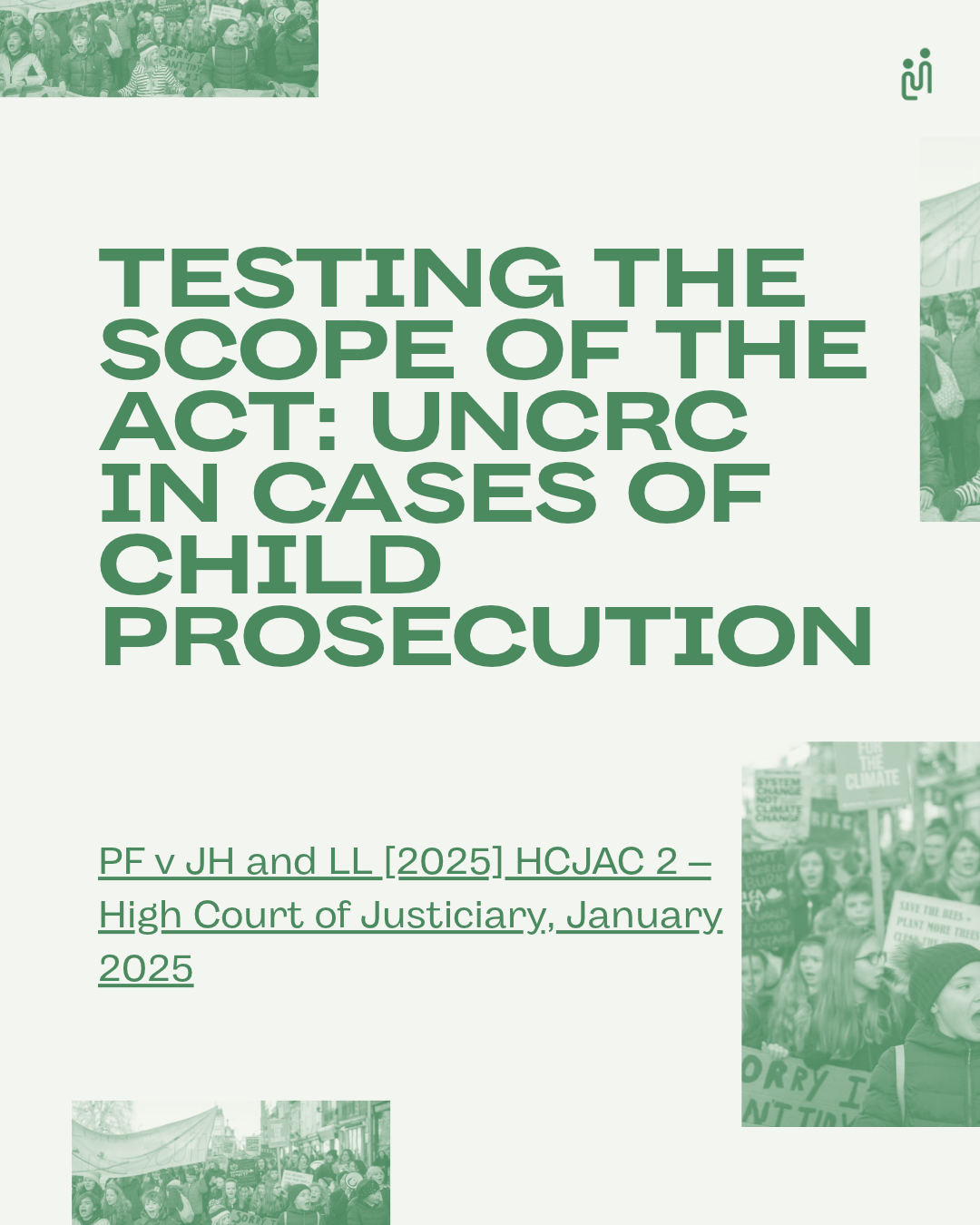
Testing the Scope of the Act: UNCRC in Cases of Child Prosecution
PF v JH and LL [2025] HCJAC 2 – High Court of Justiciary, January 2025
By Katie Hall
This is the second in a series of blog posts looking at how children’s rights in Scotland are being shaped by the UNCRC (Incorporation) (Scotland) Act 2024. This post looks at the first case to be decided under the Act – which examined whether the Act applies to decisions to prosecute children. The ruling established an important principle about the reach of the new law, with consequences extending beyond the two young people involved.
Background
Coming into contact with the law is a complicating factor in children’s lives. In Scotland, the children’s hearing system is designed to keep children out of the criminal courts. However, the Lord Advocate – Scotland’s most senior public prosecutor – retains the power to prosecute children aged 12 and over in the criminal courts, and 16- and 17-year-olds typically face court proceedings.
The cases of JH and LL (aged 16 and 17 at the time of their charges) arose in Dundee Sheriff Court in the summer of 2024, just as the UNCRC Act came into force. Both faced serious charges, including allegations of domestic abuse against other children.
Legal representatives used the newly passed UNCRC Act to argue that their rights under the UNCRC had been breached. Namely, they referred to Article 3 (best interests of the child), Article 12 (respect for the views of the child) and Article 40 (access to justice), raising concerns with procedural elements of these cases. This included that they both appeared at procedural hearings which were open to the public and that one child appeared without legal representation at one of these hearings.
The Lord Advocate referred to the High Court, seeking to first establish whether the UNCRC Act applied in the decision to prosecute a child, and to accordingly assess whether the Crown had acted unlawfully in the cases of these two children.
The Legal Questions
This case centred on the origins of prosecutorial power. The Lord Advocate’s argument was that her power to prosecute derived from the Criminal Procedure (Scotland) Act 1995 (a UK Act, rather than a Scottish one) and that the UNCRC Act, which only applies to devolved functions, thus did not apply to her exercise of this power.
The Children and Young People’s Commissioner for Scotland intervened in this case. This intervention was itself made possible through new powers created for the Commissioner’s office by the UNCRC Act. The Commissioner’s position was that the Lord Advocate’s power to prosecute does not originate in the 1995 Act; instead, the power derives from Scots common law, with the 1995 Act setting out how the power should be used. The UNCRC Act expressly covers functions conferred by common law rules.
The court agreed with this argument, finding that the Lord Advocate is not required by the 1995 Act to prosecute any child. The decision to prosecute was found to be within the scope of the UNCRC Act, as the decision and conduct of the prosecution was not dictated by the terms of the 1995 Act.
Once the court had determined that the UNCRC Act applied, the court also had to decide whether, on the specific facts of both cases, the Crown had acted unlawfully. In doing so, the court found that the initial decision to prosecute both young people was not unlawful, as the Crown had considered their best interests and the serious nature of the charges. It was also highlighted that the complainers in the cases were also children whose rights and interests had to be weighed.
On the procedural concerns, the court acknowledged that appearing in open public court was a potential breach of the children’s privacy rights under Articles 12 and 40 of the UNCRC. The court declined to desert the prosecutions, weighing the procedural nature of the breaches, the rights of the child complainers and the wider interests of justice. It did required future hearings to be conducted in compliance with the statutory rules on privacy for child proceedings.
Why This Matters
This case has both legal and practical impacts. Legally, it provides useful insight into how to approach the question of scope in future cases where it is argued that the UNCRC Act applies. The case also demonstrated the balancing act which must be conducted when considering whether children’s rights are in breach under the UNCRC Act. The court weighed a range of factors, including the seriousness of the charges and the rights of child complainers, before concluding that, on these facts, the prosecutions should continue.
Practically, the case has already changed how child prosecutions are conducted in Scotland. Hearings involving children should now routinely take place behind closed doors, protecting young people from the exposure and stigma of public proceedings. This is a concrete and immediate improvement for children appearing in Scotland’s criminal courts.
Further Reading
- CYPCS: Future decisions to prosecute children must meet UNCRC Act standards – the Commissioner’s account of the case
- Together Scotland: First legal case decided under UNCRC Act – accessible summary with links to the full judgment
- CYCJ: Court ruling on applying the UNCRC Act to criminal prosecutions – the Children and Young People’s Centre for Justice’s response
- Scottish Parliament Research: Children and the Scottish Criminal Justice System – background on children’s experiences in Scotland’s criminal courts