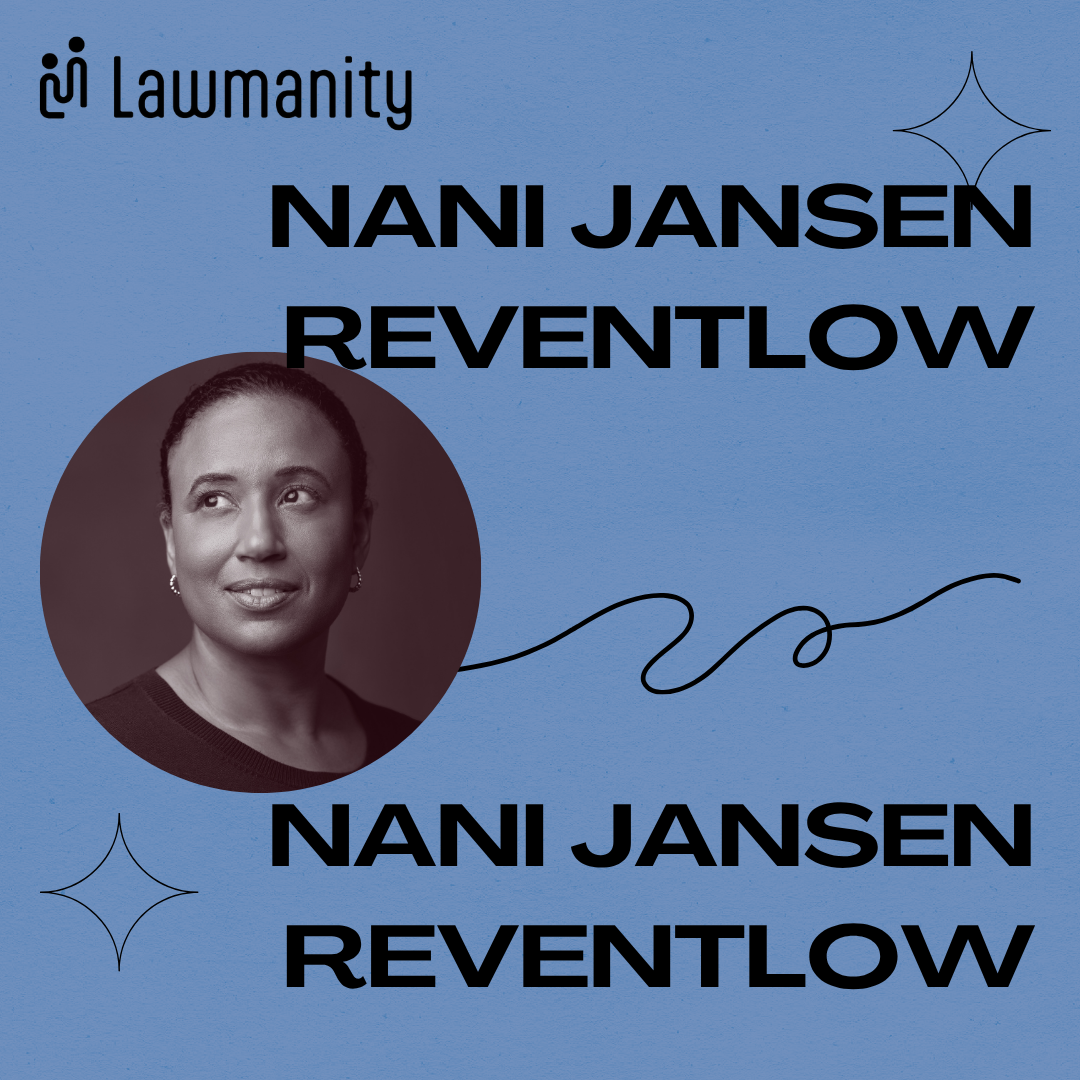
Transcript: “Grasping Things by the Root”: Radical Justice and Systemic Change, with Nani Jansen Reventlow
Host: Jen Ang
Quote: Nani Jansen Reventlow
“Being able to have this space to really explore some topics in depth kind of reignited that passion that I’d always had for writing. So it was a really nice way of reconnecting with that part of myself as well.”
Jen Ang
Welcome everyone to the Lawmanity podcast where we explore the complex relationship between law and activism and discuss the different ways that law can oppress people but can also lead to real positive social change. I’m Jen Ang, a human rights lawyer and activist based in Scotland and your host on the Lawmanity podcast.
This week, we’re speaking to activist and legend Nani Jansen Reventlow. Nani is an author and award-winning human rights lawyer specialised in strategic litigation at the intersection of human rights, social justice, and technology.
She’s the founder of Systemic Justice, an organisation that seeks to radically transform how the law works for communities fighting for racial, social, and economic justice.
She also has an extensive background promoting human rights in the digital context, and defending journalists and activists in some of the most repressive environments in the world. She previously founded and built the Digital Freedom Fund, which supports digital rights litigation.
Now, Nani is also the author of Radical Justice, a collection of nine essays on how to build a better world, published in Dutch in 2024 and followed by an English edition recently published in March of this year.
Today, we’re going to speak to Nani, both about her stunning career and the recent publication of the English edition of her book Radical Justice.
Welcome to the show, Nani.
Nani Jansen Reventlow
Thanks so much for having me, Jen.
Jen Ang
Oh, I’m so pleased that you’ve made time to speak to us. I know that you’ve been really busy, both in your role at Systemic Justice but also touring the English edition of your book. So, thank you so much.
So in this podcast, I’ve been experimenting with a surprise opener question to get us settled and to learn a little bit more about the people behind the legal legends who we’re interviewing. Now, a really good friend of mine pointed out that our sense of smell is our oldest sense and observed that we can hold deep connections between our sense of smell and our memories. So, if you don’t mind, can I ask you to tell us about a smell that’s meaningful to you, maybe something you really like, or something that’s connected to a place or time that you like to bring to mind?
Nani Jansen Reventlow
Oh, that’s such a good question. Yeah, I’m very conscious of the way that I kind of… the place that I give scent and smell in my life. I know that sounds perhaps a little bit strange, but I have a lot of things that I associate with different seasons and different settings and so on.
And I think, uh, the one that I would pick here is actually a smell of my writing room. You can’t tell right now, but I’m behind my writing desk, which is in a room that’s adjacent to the garden in our house. And, um, there’s a really big cypress tree, actually when you look out of the window, that’s like a little bit behind me over there. So, and I have like these really nice scent sticks that are cypress scented and that I really associate with this room.
So whenever I go in here, I’m like, oh, yeah, I kind of like go into that mindset and it’s very nice and kind of like a little bit fresh, but a little bit woody, kind of grounding scent. And yeah, I associate it with a very happy space and a very happy activity.
Jen Ang
Oh, thank you so much for sharing that. And how I’m not surprised in a way, because your writing is run through with actually a sense of centredness and groundedness. And I kind of love the idea that I will now think of you in your writing space with those scents around. How smart is well to have a peaceful space to write, because I certainly hope that you will be writing and speaking to us more over the years. So, thanks for sharing.
I would love to turn to the title of your book now. So, you know, Radical Justice is a big, beautiful, bold title. And I wonder, can you talk me through the naming of the book? So, what did you mean by radical when you wrote it? And how is that different from maybe what we would ordinarily mean when we use the word justice?
Nani Jansen Reventlow
So the book’s title is derived from Angela Davis’s quote that radical simply means grasping things by the root. And it connects to the, well, the desire in the book to really set out root causes of the injustices that we’re seeing in the world today, um, with the idea that if we don’t really understand what the systems of oppression are that we’re, that we’re were facing and that we’re resisting, we’re unable to properly address them. Right? We might go to superficial changes or cosmetic solutions. So, the idea is to really go to the to the heart of things, to the root of things, but at the same time, to not have that feel too overwhelming for the reader. So what I also try to do is build a bridge between kind of like understanding root causes and also being able to take action in your day-to-day life. And I try to do that by both giving a lot of examples of activism from around the world, but also to, yeah, give entry points to the reader on how to reflect how these bigger systems show up in their daily life, and also what that means for their possibilities to actually do something within their own sphere of influence. But the radical thing is really about getting to the core of things so that we can also pursue systemic change that is going to be lasting.
Jen Ang
I love that. And again, I just building on what you said before, I feel particularly that using a word like radical, which brings to mind a set of visions as well, of growth and that idea of getting to the root. It’s unusual, actually, youknow, we use that word radical quite a lot. But your title asks us to reflect a little bit on the core meaning of that, of that word, which I love for this year in particular.
And I’m really curious about your own journey as a lawyer and an activist. So how did you get to this point in your career when you thought you needed to write this book, and who do you hope you’re speaking to as you write it?
Nani Jansen Reventlow
I’m not sure that I thought I had to write this book, but once I got going, it was very nice to do it.
And so the book came about, um, because I had published an op-ed in a Dutch newspaper about the need to have better conversations about reparations. That op-ed was actually kind of like born a little bit out of frustration of seeing always like, you know, half apologies, offers to commemorate, offers to do some more research and so on. And no one ever wants to talk about the money. And so, I made two arguments in the op-ed, basically like, first of all, we should be able to talk about the money. But the other thing is also that there are so many ways in which the impact of the transatlantic slave trade, of colonialism, is showing up in our day to day lives. Right now, there are so many entry points in which we can actually start addressing that legacy or that very much still alive dynamic rather than legacy, which kind of implies that it’s something that’s behind us. Right?
But then I was approached by a Dutch publisher who said like, oh, would you be interested in writing a book about reparations? Because that conversation always seems to get a bit stuck. And I was like, well… I don’t think I’m the person to write a book about reparations. I’m not a reparations expert. But then instead of just saying no, I was like, well, maybe there’s a way in which we can actually bring that second element in, right? Like, how do we actually look at the intertwining systems of injustice that we’re seeing in our society today? And what could we do to address that?
And that was basically how the how the idea for the book got started. And it was a really wonderful opportunity to have a little bit more space than, you know, a blog post or an op-ed or a journal article to actually think through some of the issues I’ve been working on, some issues thematic and some issues that I saw as like cross-cutting across activism. Yeah. So that’s how that came about.
And I think a little bit, and I write about this in the introduction of the book, that I used to write a lot when I was much younger, and then ended up writing for work quite a lot. But being able to have this space to really explore some topics in depth kind of reignited that passion that I’d always had for writing. So it was a really nice way of reconnecting with that part of myself as well.
I hope that the book is not only interesting for lawyers, let me maybe put it that way first. I think it will resonate naturally with a lot of lawyers because obviously I’m a lawyer myself, and that’s kind of like my corner of activism in this world and strategic litigation in particular. But I hope that it will be, um, well, two things.
One is that I hope for people who are engaged in activism in whatever shape or form, it can kind of be a combination of both recognition, but also hopefully a bit of inspiration by reading about what other people are doing to resist in other parts of the world, that it might spark new ideas or, yeah, that people kind of like feel like, oh, we have allies, we have people who are doing similar things. Perhaps, you know, that that might encourage and yeah, reinvigorate, what people are already doing.
The other thing is that I hope that some people will pick up the book just because they’re kind of fed up with what they’re seeing around them, and they want to figure out how they can get involved. And I hope that the book can help lower the threshold. As I mentioned, there’s a there’s a number of different thematic issues that are being addressed in the book. And I usually kind of read essay collections just starting wherever the mood of the day takes me and I start here. And then I hope across the book in different ways, I’m just hoping that someone might pick up the book because they’re interested in, I don’t know, reparations or in digital rights or they are intrigued by the idea of hero worship and activism, and, you know, why I think that’s a problem. And they might start there. And then they might kind of like read a bit about other things and find some new things about topics that they already know and also get exposed to some new ideas. I hope that it might open some doors and lower some thresholds to taking action.
Jen Ang
Thank you Nani, I have to agree and we will put links to where you can get the book in the show notes.
But something that I really loved about it is that your essays, they don’t shy away from the detail and the history that informs your thinking, but each of them is followed by a set of further resources and some practical steps that people can take, which to me feels very satisfyingly activist, but also welcoming, because I think a lot of these ideas seem quite intimidating in the abstract, particularly if you’re not a lawyer or you’ve never thought about that area. I’ve not thought about reparations a lot, but that format for each of your chapters really invites people to kind of dip in and dip out. And yeah, I like that idea and to browse between topics. So it’s a bit like going into a library, picking up a book, and then actually turning and saying maybe something that’s nearby I might be interested in as well. And I’ll just because I’m so curious – so now that you have your serene writing space and you have sort of allowed a bit of space for your passion for writing to resurface, can we expect more writing from you. Are you taking a bit of a break or would you, would you consider doing some short articles from time to time?
Nani Jansen Reventlow
So I actually just yesterday finished a new manuscript. So it’s a more personal story that I’m telling there. I speak about it a little bit in introduction to the book. It’s about the relationship with my white Dutch mother who raised me. So my father is a Black Malian man, and my mother was a white Dutch woman. And my mother never really educated herself on anti-racism. And, in the beginning when I was younger, that wasn’t that big a deal because I just kind of existed in this bubble in which I kind of like looked at the world through, through a white lens. But as my kind of my professional but also personal journey kind of like took me more and more into this field that I’m very deeply involved in now, on racial, social and economic justice, that became more and more of a point of tension between us. And I thought it would be good to just kind of like reflect on that. Like, what does that actually mean? What does it mean in relation to the idea of, of love, right within a family? And, uh, how does that actually correspond to willingness or unwillingness to learn about anti-racism? So that’s a manuscript that that has just been finished.
I have wild plans of writing fiction. Uh, I have a number of,I think, nice ideas for short stories. I’m also contemplating the next book that will probably be more aligned with Radical Justice in which I would love to examine what stands between us as activists, what is the thing that prevents us from acting in proper strategic unity when it comes to fighting for change? The thing that we see the far-right being so incredibly good at, overcoming differences and just kind of forming a united front. And I want to look at both the things that make our ecosystem so difficult, such as the whole, you know, capitalist dynamic with funding and resourcing and so on, but also the human dimension. Like we’re generally, we don’t learn very well how to deal with things such as jealousy or envy and things like that. Like, how do we deal with that? How can we get better at, you know, acknowledging conflict and navigating that – with the hope that we can have better conversations about those things that, in the hope that we can actually start working together better.
Jen Ang
Well, Nani, I want to read all those things that you’ve already written or suggest you will write, but I also want you to write them quickly because I feel particularly now we need them both and quickly! But I will be patient.
But I just want to say, I think there’s such a real value sharing your thoughts in these ways, that I know you do, which are, you know, consciously accessible and clear and very generous actually in bringing yourself to that work. Sothank you.
I’m going to actually sort of pull a bit of a thread now about law and activism, because it’s one of the reasons I wanted to speak to you. I’m so curious about your career, but also how you have positioned yourself in the work that you do. So this question is as follows.
As a fellow lawyer and activist, I really struggle with the role of law in creating and reinforcing inequality. And I wonder whether there is a role for law and lawyers in using law to create positive social change. And or if really, when we see the law and we see the law in other people’s hands, we feel we see the oppression first. So how do you sit with this tension for yourself in your career, but also in your book?
Nani Jansen Reventlow
So I talk about this in the book and I reference Audre Lorde’s famous, almost overly quoted, words that the master’s tools will never dismantle the master’s house. Because when I read that essay again a number of years ago, it just really made me pause deeply about working as a lawyer, as a human rights lawyer. And it really made me question like, how can I, how can I say that I want to kind of like change things. I want to bring about structural change. I want to improve things. And at the same time, I’m using like the ultimate master’s tools, right? Because if we look at our legal system as something that really reproduces power structures in our society, like, yeah.
And so I sat with that for quite a while. It’s like, should I throw it all out the window? Or should I just kind of do something completely different? And… I ended up, um, with the view that we have to operate on two different tracks simultaneously. Um, one is the big work, right, of imagining alternative systems. Like what, what should it look like if we could design our world from scratch, what would it look like? How, how would it really work for everyone in it? Uh, everyone and everything in it. So that’s the world making project, right? It’s the big imagining and it’s constructing and so on, which is long term work. And it’s not going to happen overnight. And while we do that work, we also need to make sure that the systems that we have right now work better than they do at the moment. At the very least, they should not create more harm. That’s a very, you know, hard like line there. But ideally they start actually work maybe producing some justice, right? Like in the meantime, while we work on rebuilding the systems, the important thing there is to not mistake making the systems work better in the interim for the end goal, because that’s not the ambition that we should be having. We should really be dreaming about alternatives. But while we do that and while we build them, we need to make sure that what we have works.
This is where like, I think that the work, for example, that we’re doing with Systemic Justice now sits like in working with marginalised communities and how they can actually use the law for their campaigns for change rather thanthe experience that a lot of them have of the law being used against them, being weaponised against them. How can we make sure that we, for example, de-centre ourselves as lawyers, that we really create the space for marginalised communities to lead, for their vision to lead the work for their choices and decisions to really guide the process. I hope that at least as an interim, that can be… that can be a good thing, good thing to do. But the ideal obviously is that an organisation like ours wouldn’t be needed anymore because we figured out a much better alternative to the systems that we have today.
Jen Ang
Yeah, 100%. I will sign up to that vision. And meanwhile, I love that combination of not giving up on the dreaming and visioning but also taking practical steps day to day. I could carry on for a while, but I’m not going to abuse your generosity. And we’ll move towards the next set of questions.
So, I’m quite curious as well – and you spoke a little bit earlier, I kind of drew you on doing a bit more writing, but – overall, um, your career has been varied, but really full of lots of different pieces of work and you’ve practised as a lawyer, you’ve founded more than one organisation, you’ve funded legal work, you supervise it. You’re an author and a thinker. I’m curious to know what’s next for you now? So aside from your writing projects… what more could you possibly do, Nani? Or maybe another way, what, what other issues most capture your imagination now in 2026?
Nani Jansen Reventlow
Oh, this is a really good question. So I actually am process of leaving Systemic Justice – so the second organisation that I founded and that process will be complete this summer, and I’m actually quite deliberately trying to not make up my mind yet. And first actually take a moment. I want to take a break. I have never done that in my working life, also not between my previous organisation, the Digital Freedom Fund and this one, and just kind of give it a bit of space to see what emerges.
I have some ideas of like how in an ideal world, I can continue building on some of the things that I’ve learned over the past years, right? Like what are the things that are hard or that could work better, especially for people starting organisations or starting initiatives and things like that. But also, I want to have a bit more space to do that writing. So, I’m hoping to figure out a way to balance those two. But I’m very deliberately trying to see like what will actually happen in my head when I’m not in the process of either already building a project or finishing it, or like having it run and things like that. Just to, maybe there is something completely different that comes out of that. Looking back at the work that I’ve done so far, it always looks like a very neatly laid plan. But it wasn’t. It was basically me just kind of like following my curiosity and wanting to kind of always like, move a little bit out of my comfort zone, being able to learn new things. And yeah, I’m hoping that there’ll be a next step like that to pursue.
Jen Ang
Brilliant. Well, Nani, I have to say that if that is your approach, following your curiosity, learning new things and obviously standing up when you see injustice, that’s been working for you so far. So I think I think more of that! And also, I think if you’ve not taken a break for a long while, that is well deserved and overdue.
And I will say for myself, as listeners know, I founded JustRight Scotland and then stepped down and for a period of time, also, my only goal was just not to fill that time with the many different interesting things that I could fill it with. But I think there is something both for yourself, but also for the world about, you know, quite consciously giving space for reflection, because a lot of what we know doesn’t really surface until we actually sit and allow it to. So I hope you enjoy that come the summer. And as I said before, we’ll all be eagerly awaiting your next your next big thing.
So meanwhile, I have one more question for you. So, there will be people listening. There’ll be people out there who might be a younger version of you, who might actually want to be you when they grow up. And I wonder what advice might you have for those people?
Nani Jansen Reventlow
Oh, so I think maybe… one moment in my working life so far, found really difficult and also illuminating was when I, for the first time, stepped away from very clearly defined role. This was when I had been defending journalists and bloggers around the world at Media Defence, and I was just like, okay, I don’t want to be pigeonholed in this forever. I need to kind of like figure out something broader. I want to do other human rights work as well, but I didn’tknow exactly what to do. And I just found myself just like looking at the offerings that were there, right, within other human rights organisations. And nothing seemed to really fit. And I ended up as a next step, like, um, because I was in a fellowship, kind of like an interim year. They’re working on a project, but I found myself as a next step actually is setting up an organisation, which was not something that I ever imagined that I’d do, not something that I probably, if I’d known what that was like, I don’t know if I would have. It was kind of like blissful ignorance and kind of like jumping into that and just figuring out, oh, I can just figure it out as I go along.
But I think that the most informative thing about all of that was that… you can create the thing that allows for you to do the work that really drives you. And… it’s not necessarily a very clear-cut path from this kind of role to that kind of role, etc… I very much remember that when I went to law school, which for me already was like a second choice, right? Because I first studied to be a dentist and ran away from that. So I’ve taken some detours and kind of like… and finding my way.
But that there were people that I was in class with who were just know exactly like, yes, I want to be a judge on child custody cases in a family court in this… and I was just like, how do you know that? Like already? And I think just kind of giving yourself the flexibility to just kind of indeed, like have a plan, by all means, it’s great. But also please be flexible and… don’t be tough on yourself. If you end up taking a different route than you than you might have expected.
There’s a lot of interesting stuff out there that you can’t possibly know. When you start out, you have to discover it as you go along. So yeah, try to be like both purposeful but also flexible. I think that is probably the best summary of my slightly long answer there.
Jen Ang
Oh, thank you so much, Nani, for those wise and warm words. And also thank you for joining us today on the show.
Nani Jansen Reventlow
Thanks so much for having us. Absolute pleasure.
Jen Ang
And that’s a wrap for today’s episode with Nani Jansen Reventlow, award-winning lawyer, activist, and author of the recently published book Radical Justice.
If you are inspired by what Nani has shared, please have a look at our show notes for links where you can learn more. And if you want some practical pointers for getting involved, I particularly recommend looking at some of the further resources and practical tips that appear at the end of each chapter to her new book.
We will be back again soon with our next episode, a one-to-one interview with the brilliant Lily Greenan, a queer and feminist activist and former chief executive of Scottish Women’s Aid. She will share with us lessons learned from the early days of LGBT+ rights activism in the 80s and 90s in Scotland, as well as an insight into what it really takes to continue to battle for equal protection against harm for all women and girls in Scotland.
Thanks for tuning in to our Lawmanity podcast again and if you enjoyed today’s episode, please do hit the like and subscribe buttons and share our episodes with friends and colleagues who might enjoy learning a little bit more about how law really works in practice and how it can be used to make the world a better, brighter place.
The Lawmanity podcast is co-produced by me, your host Jen Ang, and by the brilliant and talented Natalia Uribe. Shout out to Helena Refai for mentoring us through our first year of this incredible project. And thanks also to Amanda Amaeshi, on graphics and socials. The music you’ve been listening to is Always On The Move by Musicians in Exile, a Glasgow-based music project led by people seeking refuge in Scotland. Thanks so much for tuning in today. We hope you enjoyed listening and see you next time.
Additional resources for this episode are linked below:
- Buy Nani’s book ‘Radical Justice’ here: https://www.plutobooks.com/product/radical-justice/
- Inspired and want to do something about it? Check out “Take Action” on the Radical Justice website: https://radicaljusticebook.com/take-action/
- Want to hear more from Nani and also get 30% off the book? Sign up to Nani’s newsletter here: https://tinyurl.com/y3v8mfwu follow her other projects here: https://www.nanijansen.org/