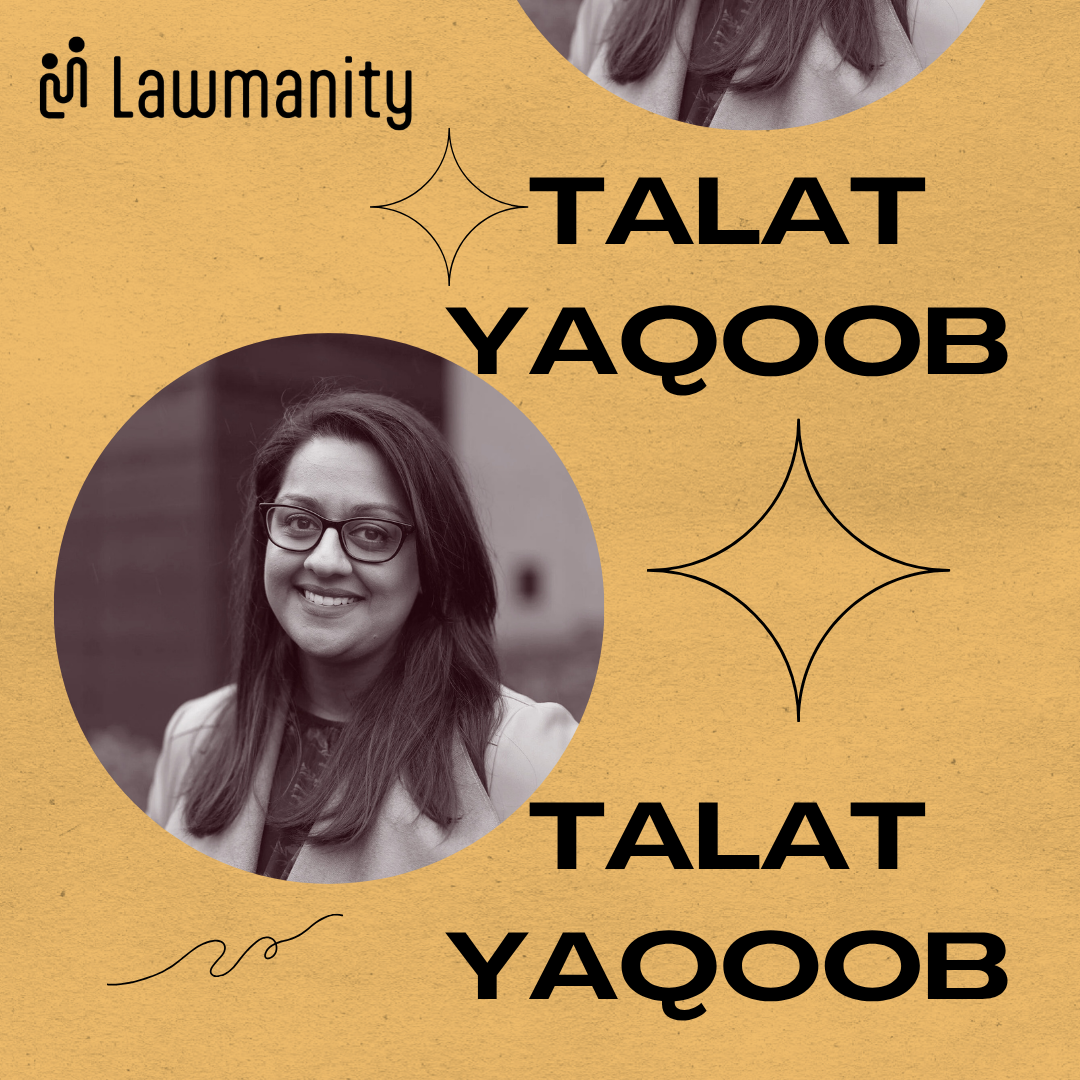
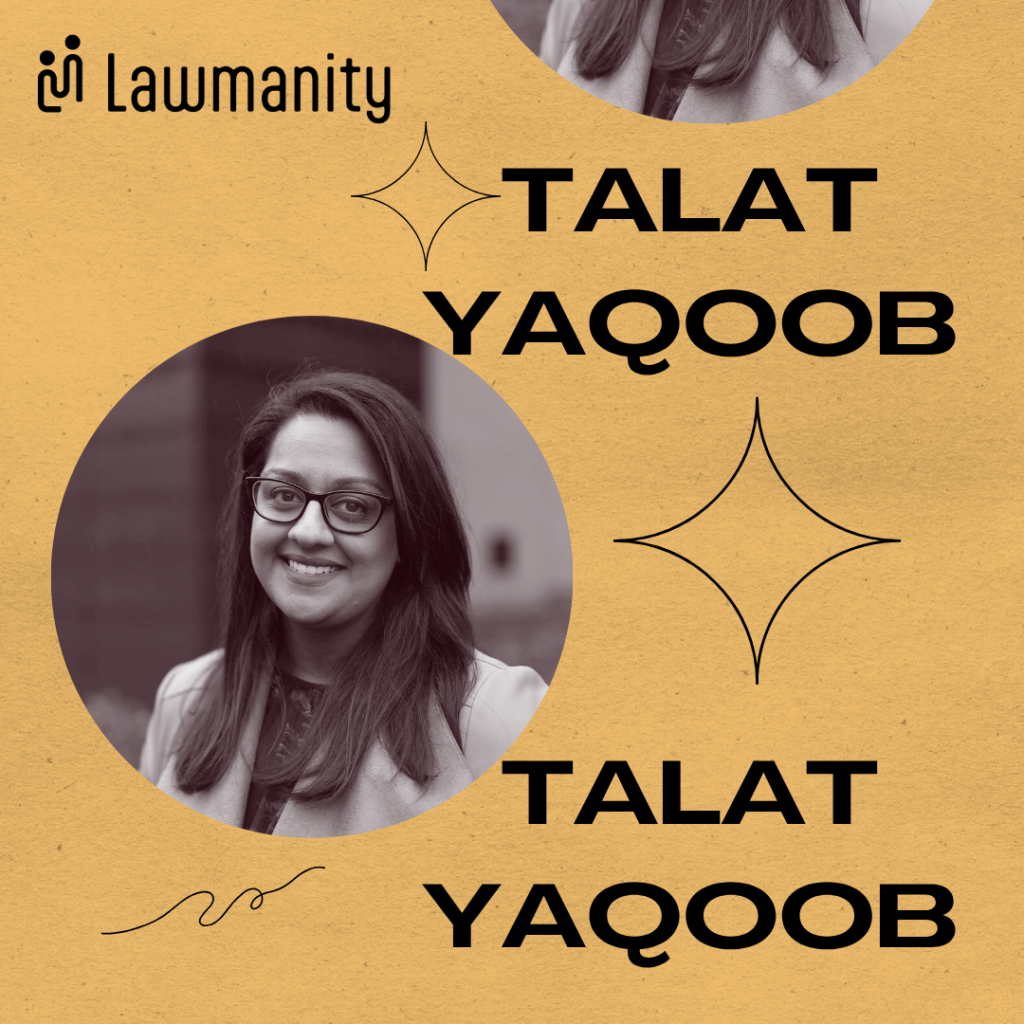
Transcript: Redistributing Power: What’s at Stake for Scotland in 2026, with Talat Yaqoob
Host: Jen Ang
Quote: Talat Yaqoob
“If we can use law as a way to redistribute power, that would be justice.”
Jen Ang
Welcome to the Lawmanity podcast where we explore the complex relationship between law and activism and discuss the different ways that law can oppress but can also lead to real positive social change. I’m Jen Ang, a human rights lawyer and activist based in Scotland and your host on the Lawmanity podcast.
This week we’re speaking to the brilliant Talat Yaqoob. Talat is an award-winning feminist campaigner, consultant and commentator who focuses on women’s inequality, racism and intersecting inequalities. She is co-founder and chair of the cross-party campaign group Women 50:50, pushing for equal representation of women in Scottish politics. In 2019, she also launched Pass the Mic, an organisation which hosts the first and only directory of women of colour experts in Scotland, challenging underrepresentation and misrepresentation in media and influencing. Talat is also co-chair of the First Minister’s National Advisory Council for Women and Girls in Scotland and a Fellow of the Royal Society of Edinburgh.
Welcome to the show, Talat. It is such a pleasure to have you.
Talat Yaqoob
Thanks. It’s great to be here.
Jen Ang
I am a total fan, as you know! But also one of the things that I really enjoy when I’m listening to you speak and write is actually the breadth of your perspective on some of these questions and also the incredibly clear way that you put across those views. So I’m really looking forward to hearing more from you today about the law very broadly, and how you feel it works or doesn’t work, for you, for your community, for the people you work with.
And that rolls us into our first question which is just a bit of a surprise opener. When I speak to people, I really like to try and start with a bit of a sense of who people are, you know, the, the actual personalities behind the work that we do. And a friend of mine told me a while ago that our oldest sense is our sense of smell. And that actually the sense of smell can connect to deep memories or to places that you know, that just come to mind when you, when you think of something.
So my first question for you is actually is there a particular smell that love or that you, that transports you to a place or that you recognise when you smell, that you want to tell us about?
Talat Yaqoob
Okay, that is a left field question!
Well, first things first, I’m also a big fan of yours. So this can just be a podcast where we’re fangirling over each other, I would endorse that.
In terms of smell. When you were talking, the first thing I thought about was my mum’s cooking. So, it would be when walking home from school Friday, half day in Edinburgh and I would, when you get to, outside the door, you could already figure out what it was that was being cooked and you knew you were into a treat, if Mum had, the smell of aloo paratha – so that is, chapati with butter spiced potato stuffed inside. That smell, that is the best smell. That’s when you know you’re home, and it’s also going to be a really good day.
Jen Ang
Oh, that’s amazing. Thank you. And even as you describe that, I’m sort of transported and a little bit jealous.
Talat Yaqoob
Yeah, come over anytime.
Jen Ang
I can relate. Yeah, that’s amazing. The smells of home.
So the series is about equality before the law. And the idea that the law, strives for equality or treats people equally is a really important concept for lawyers. There are times when people question whether that’s really true.
So the first question is for you, do you think that the law does achieve equality or treat people equally for you and the communities you work with?
Talat Yaqoob
So if I was to talk about it for myself and the vast majority of communities I work with – that would be, you know, the community of women, of sisterhood, community of colours that I work with, so whether it was black, Asian minority, ethnic communities, disabled people’s communities that I work with, and then Muslim communities of which I am part and also work with – and it’s a resounding no. With the intention, you would hope, the intention of the law seeing everybody as equal would be there. But the law in itself does not sit in a vacuum away from the realities of society, whether historic or current, existing, the institutionalised, the systemic inequalities are threaded into which laws are made, how they are made and, critically, how they’re implemented. And the mindsets, the thinking, the institutionalised inequalities across the board within that they will come to the fore in all of those spaces with wherever law is being written, developed, implemented. So unless there is some real proactive work to rectify that, then actually in the current society we exist within, can it ever treat everybody equally?
Jen Ang
Understood. And I think just to ask a bit of a cheeky follow up question: you’ve named a number of different communities that you hold in mind. Are there any particular types of law or examples of places where you feel that the law as it’s written or the law is applied doesn’t feel like it’s treating people equally.
Talat Yaqoob
So unfortunately there’s no shortage of examples and this is largely because I’ve been reading quite a lot about this recently and when you were chatting to me, the first thing that I was thinking about that was in the back of my mind was the Counter Terrorism and Security Act of, I think, 2015. So, in law, in writing, that is about keeping the nation and the nation’s people safe. But actually, it has created unsafe spaces, insecurity and concern for those of us who will appear Muslim, who are particularly for black and brown men, for hijab or burqa wearing women. And we see that largely through the way in which the Prevent strategy, which is obviously part of that Act, is implemented. Now human rights organisations have repeatedly called out and evidenced the racism and Islamophobia that is inherent in the way in which the Prevent strategy has been implemented and how it is being used as a method to penalise rather than protect.
And in particular what I often go to is the way in which the Prevent strategy has a obligation on those who work in the public sector, public authority spaces. So within our NHS, within schools, to report what they determine as extremism and the definition of terrorism within it is so wide and if you think about systemic inequality and leaving it to the perceived objectivity of an individual to decide what is extremism. We have seen multiple reporting and referrals to Prevent which have been wholly inappropriate, unevidenced. A disproportionate number are children and young people. In one case that was, was described it was because a young woman had decided to start wearing the hijab. That was reason enough for her to be considered potentially radicalised. Now that is the demonisation of a religion, that’s a demonisation of the expression of religion and religious belief. And so that is an example of where the implementation of so-called protection in law is implemented in a way and in my view also written in a way that demonises a particular community.
Jen Ang
Thank you for sharing that example, very clearly actually, and I’m inclined to agree. Something that I recall about the Prevent strategy is that it was challenged in the drafting. So, from the earliest stages there was plenty of input pointing out that some of what might happen in terms of the unequal application of that law might come to pass. And it has been repeatedly challenged, with empirical research around the consequences.
Talat Yaqoob
Absolutely.
Jen Ang
Something that’s particularly frustrating to me is one of the ways in which the law has been defended successfully has been the assertion that there may be, for some cases and in some communities, an unequal impact, but that is somehow justifiable with reference to the need to protect national security. And many of you will know that there are various exclusions to the application of some areas of law, like national security, public health and so on. But those exclusions are not absolute. That’s not an absolute response to the idea that the law or the implementation of the law is having a harmful impact. And yet we seem quite stuck, publicly at least, and also perhaps in the law itself, around those points.
And that brings me on to my next question, which is actually asking that we sort of zoom out a little bit. Do you sort of, in your gut, do you see the law as more of a barrier or a tool for positive social change or the equality that you’re seeking to advance?
Talat Yaqoob
So I think it can be both, but I think it is so deeply influenced by where society, people and politics is at the time.
So if you’d asked me a few years ago, I think I’d be much more secure in saying both. In the current political landscape that we’re in, where law is being very successfully used to demonise communities, either to eradicate rights that are in law, or to manipulate the interpretation of the law, or to change completely the law or implement new ones.
Now, I’m not just talking about America here, I am talking about here in the UK. We’re seeing it across Europe as well. The rise of far-right politics and populism actually uses the law to its advantage with exceptional strength, with exceptional clarity. So with that influence right now, it feels more like a barrier than a positive tool, but it is so dependent on where society is, and I think that really reinforces how law is not separate from politics and society. Where we are as a society dictates what laws we prioritise, implement, write, and how they’re written, who they’re written by, all of those things.
So I think I still hold strong to the fact that it can be both, but it is so dependent on where politics and society is at the time.
Jen Ang
So, for Talat with us, coming up to the May 2026 elections in Scotland, I wondered what, for you, are some of the key issues that you’d like to see the new Scottish Government focus on to tackle that inequality that we’ve talked about as already baked into our laws and to ensure that Scotland doesn’t become the next site for uses of the law that, as you put it, demonise communities and eradicate individual rights.
Talat Yaqoob
Yeah, I think this is a really important political point in the landscape for Scotland.
As polling currently indicates, it might be an SNP majority. It’s looking really quite possible that it might be Reform that is in opposition. So the kind of conversations, the rhetoric, the priorities of the next Parliament will be really, I think, indicative of some of the concerns of the rise of far-right, the suppression of our own progress, advancement of the realisation of human rights. And so for me, the next Scottish Government needs to be unapologetic in pushing for progress, pushing for social and economic justice, and the protection of our institutions.
So that means the protection of democratic institutions, the right to protest. Think what we’ve seen across the UK pursued by Westminster in terms of Palestine Action, for example, the right to protest, the right to challenge, methods of accountability – all of these things will be so incredibly important. And when it comes to the law, it is about rapid advancement and investment in the law being fit for purpose and access to justice for the most marginalised communities because they are such a clear target by the far-right. So, migrants, people of colour, asylum seekers, LGBT community, Muslims. What is the recourse to justice and how do we enable that to happen in a meaningful way that tackles systemic racism and misogyny within those sectors themselves, and actually puts money into the pockets of those individuals and those who are marginalised and economically disenfranchised to be able to pursue justice?
Jen Ang
And that, as we can see, that can change so quickly. Absolutely. And is really actually something that I hope people are starting to think about, you know, more and more because that change is so visible for everyone in society just now. Certainly, as you know, I am American and I have been really surprised actually at how much more people are talking about law and political structures now than they were perhaps before the start of 2025.
So, what for you is the role of lawyers in working with communities to advance equality?
Talat Yaqoob
So I think, you know, and I’m not just saying this because I’ve got lawyers in the family, so I’ve got to be nice about them! I do think that we should welcome lawyers having a role within community activism and the ability to be able to use the law in, what I would, my opinion would say, the right way. So that advancing of human rights, the protection of law, so, you know, for example, Liberty, the human rights organisation, successfully being able to illustrate evidence that the anti-protest laws were unlawful by the last government and maintained by this government. That is an example of activism and therefore communities engaged in activism being protected through the law.
So here Talat is referring to a legal challenge brought by Liberty against the anti-protest measures set out in 2013 [errata: Jen meant to say: 2023] and brought into effect by then Home Secretary Suella Braverman, which significantly lowered the threshold of when police can impose conditions on protests from anything that causes, quote, “serious disruption” to anything that causes, quote, more than “minor disruption”. These measures had been democratically voted down just a few months earlier, but Braverman had used secondary legislation which requires less parliamentary scrutiny to bring them into effect anyway. This was widely seen as a serious attack on the right to protest on all issues across the UK. And hundreds of protesters were arrested under these new measures before they were finally declared unlawful by the High Court in May 2024. This declaration was then upheld by the Court of Appeal for England and Wales in May 2025. The courts ruled, in essence, that then Home Secretary Suella Braverman did not have the power to create these regulations. Crucially, however, the question of how far a sitting parliamentary democracy can go in restricting those rights through democratic means has not yet been fully tested and remains a live site of contestation, as seen, for example, in the Crime and Policing Bill 2026 currently before Parliament, which radically expands police powers to restrict the right to protest, including banning repeat protests or protesting on an issue more than once over an unspecified area for an unspecified period of time.
As Lord Peter Hain pointed out when he and other peers opposed the Bill in the House of Lords, “no protest movement has ever brought about change through one single march or action”. This bill, if passed into law, is bound to also face legal challenge. Let’s go back to Talat’s thoughts on the role of lawyers in challenging inequality under the law.
Talat Yaqoob
And so having that space, having that platform used by lawyers, by human rights defenders, I think that is an exceptional use of law. And that is where I think you can have the law for good and lawyers for good, absolutely.
I think in the same way with politics that I wouldn’t agree with, you have lawyers that are doing the same thing on the other side. And I think that the idea of objectivity and the law being absolute and all lawyers have to take this line and it’s… I think that illustrates how much of a myth that is because the interpretation of the law is political in itself.
So I think there’s… there absolutely can be and should be a role for that activism for lawyers. And I’ve seen it happen here in Scotland, I’ve seen it happen across the UK, I’ve seen it happen across the world: where rights have been advanced, people have been protected, asylum seekers have been, vulnerable asylum seekers prevented from being wrongly deported, because of the right use of the law. So, it’s to be welcomed and I’d love to see even more of it.
Jen Ang
Thank you for that reflection. And I also, actually, I feel, as a practising human rights lawyer, that was quite positive and rousing reflection on, some of the uses of the law and where it works. And I would want to invite you to come speak to my colleagues and my team sometime just to remind us of that, because I think exactly as you said, there are lawyers on both sides of any major case. And one of the things that we struggle with as lawyers and our own identity actually is how much is our role about being sort of a neutral advocate or, ah, the phrase we use is maybe, an “advocate for hire”. And how much of what we do is about only taking work that will advance positions or causes that are important to us. And that’s definitely something that we grapple with throughout these podcasts.
So my near final question, what to you, if the law were equal and it were just, what does justice in the law look like for you or your community or the people you work with?
Talat Yaqoob
Wow. Okay, so what does law as injustice look like, for the community? Do you know what? I have to say that I think if we can use law as a way to redistribute power, that would be justice. That’s not the way in which we think about law and write law. A lot of law is written as… in a reactionary way. An issue has occurred, a law is required, this is what will be done in the future. And it is focused deeply on criminalisation. It’s focused on… And I know that sounds like, well, of course it is, but actually, no, the thinking around it, about the realisation of rights and law as a tool to redistribute power, to create accountability, that is law that creates justice. That’s law that people can have more trust in. You know, so if we think about things like we’re in Scotland, the acts that we pass, the law that we implement, regardless of whether it’s Scotland, UK, any nation actually, if we write law that centres the redistribution of power, that centres the ability for accountability to be closer to people, that’s transformative. That’s transformative justice. In my view, that is social justice being realised through the law. And for me it’s about looking at the way in which law is written and the rationale with which new laws are created. The mindset behind that is what needs to change. And if that can be more about redistribution, that can be more about transformation and social justice in which laws we choose to prioritise and the mindset behind them. I think that could change the face of society in a radically short time. And actually it would make law and lawmaking an accessible feature of society. But it’s about the mindset behind why law is created and what law is for. If we could do more about that, if we could do more to challenge that, that it doesn’t need to be this traditional, archaic view of what law is and why law exists and that law is to pursue the criminalisation of society or for a hierarchy to come and protect society rather than enabling the protection of itself. I think that would be transformative.
Jen Ang
I love that. And I also don’t, almost don’t want to carry on and comment because that’s the world I want to live in. But I think, I also think, you know, what you highlighted is certainly a part of legal jurisprudence. It’s part of what law students learn about as a theory of how the law relates to society. And that does give me some hope because it means that the roots of that approach to thinking about law and lawmaking, they run deep, and they’re still kind of accessible to us through the institutions as they now run. But I also think that you’re right that maybe in recent years, and particularly here in the UK, law as a tool of social control or criminalisation has become the more prominent way that we talk about and we see lawmaking happen. And actually I’ll probably add as well, and where the judiciary or other, other parts of the legal system step out of line with that, sometimes you will see quite strong attacks on, on methods of lawmaking that are very much within our longer tradition. So, yes, that was a really interesting reflection that got me to sort of think about, or to relate back to what the practise of law has looked like and how it’s changed over the last few years.
So on to our final, final question. And the last question, is just this – and I’m sure you do get asked this quite a lot because I know that you are such a mentor and someone that many people I know look up to, and it is-
Talat Yaqoob
I’m trying really hard to not, like, to keep my face straight while you say that.
Jen Ang
I know, I know you hate that, but I’m going to ask you anyway, because this is the sort of thing that people want to know.
So, my question is, if someone is listening to this podcast and they kind of, they just wonder how you got to where you are and you know, and what it takes. What would be your advice to your younger self or to someone who is maybe just starting their career and thinking about what a journey like yours would look like?
Talat Yaqoob
Okay, so the somewhat facetious response is sunscreen and moisturiser – and I do wish I had gone back and said that to myself.
I think, what’s really interesting is that this is not a… I didn’t know this was a career. At no point did I think this was a career. If I was to follow what it was that I thought I’d be doing at the age of 18, I should be a clinical psychologist right now. And so I guess the advice would be if an opportunity presents itself and it lights something, even if it’s not on the plan, do it. Because I very, very easily, and very closely didn’t do it because I was like, well, I’ve got a five-year plan and I meant to go and do a master’s and then I meant to go and become a clinical psychologist and I meant to do my doctorate and… and I, I almost didn’t do it, but then, you know, at university I realised that actually, hold on, my politics has been given an outlet and there are these really great people that I’m able to have conversations with and we’re debating and nobody’s telling me shush, like, like they do at the dinner table at home. Like it’s not. And, and had I not taken that opportunity, that feels kind of exciting but isn’t in the plan, isn’t the status quo, nobody before me has done it… I wouldn’t get to do what I do now. And as hard as it is and sometimes as upsetting as it is, I wouldn’t want to be anybody else, I wouldn’t want to be doing anything else.
So even if it’s not on the plan, it’s not in the five-year plan or the ten-year plan – and if you’re, you’re like me, you probably have one – if it feels good and it feels exciting, give it a try. Especially if it maybe is a little bit uncomfortable. I would advocate for that because 100% I would not be doing anything that I did if I didn’t go to become, ah, my student union and suddenly get involved and find really awesome people and then suddenly get involved in other campaigns and yeah, give it a try. Even if it’s temporary, it’s something worth learning.
Jen Ang
Amazing. Thank you for that motivating and inspiring advice. I think we’re all really pleased that you gave it a try and that you continue to, just looking back at the number of organisations that you’ve had a hand in founding, co-founding and supporting over the years.
Also thank you so much for your time today. You’ve been very generous. We know how busy you are but I’m so, so pleased to have been able to have this chat with you and also learned a little bit more about you. I reflect that however long you work with someone, sometimes it’s always worth spending a little more time speaking about yourself, having a cuppa.
Talat Yaqoob
This was really surprisingly soothing conversation given what it is that we’re talking about. So thank you so much for the invitation and, and thank you for everything that you do, Jen. It’s always an inspiration and I really value learning from you. Thank you.
Jen Ang
If you wanted to learn more about some of the issues Talat has raised, have a look at our show notes for this episode and we’ll point you towards a few resources for finding out more about the impact of the Prevent strategy in the UK, about your right to protest and upcoming changes in the government bill to restrict those rights. And if you want to get involved locally, I asked Talat what her recommendations are and here’s what she said.
Talat Yaqoob
Well, I’m going to obviously recommend that they join Women Against the Far Right Scotland because I’m co-convener of Women Against the Far Right Scotland. But there are lots of campaigns happening in civic society and whether that is disabled people’s organisations and disabled people organising themselves. There’s a lot of work happening to push for a different economy, a radical, genuine wealth redistribution, for example Tax Justice, which is a UK-wide campaign. Patriotic Millionaires, if you happen to be somebody who’s very wealthy and cares about a new tax system, would be a space for you to go. And also there’s a lot of people who are fighting for justice and for accountability in for example policing like the Sheku Bayoh case for justice, and campaign for justice for him. So there’s so many things that are happening in Scotland and beyond and what we need is movement-building, community connections and building up power for people to be able to also do their own campaigning because the more we can do that, the more justice and accountability we can actually pursue and systemic change we can pursue.
Jen Ang
And that’s a wrap for today’s episode with Talat Yaqoob, feminist activist, political commentator, stone-cold legend and my hero.
We’ll be back again soon with our next episode, an interview with Nani Jansen Reventlow, human rights lawyer and founder of the fierce and fearless strategic litigation organisation Systemic Justice, on the publication of her new book Radical Justice.
Thanks for tuning in to our Lawmanity podcast again and if you enjoyed today’s episode, please do hit the like and subscribe buttons and share our episodes with friends and colleagues who might enjoy learning a little bit more about how law really works in practice and how it can be used to make the world a better, brighter place.
The Lawmanity podcast is co-produced by me, your host Jen Ang, and by the brilliant and talented Natalia Uribe. Shout out to Halina Rifai for mentoring us through our first year of this incredible project. And thanks also to Amanda Amaeshi, on graphics and socials. The music you’ve been listening to is Always On The Move by Musicians in Exile, a Glasgow-based music project led by people seeking refuge in Scotland. Thanks so much for tuning in today. We hope you enjoyed listening and see you next time.
Episode Notes:
Additional resources for this episode are linked below:
Learn More
- Amnesty International, “UK’s Governtment’s Prevent Duty ‘Fundamentally Incompatible’ with Human Rights – Major New Report,” 2 November 2023, https://www.amnesty.org.uk/latest/uk-governments-prevent-duty-fundamentally-incompatible-human-rights-major-new-report/
- Liberty – Protest Rights, https://www.libertyhumanrights.org.uk/fundamental/protest-rights/
Get Involved
- Women Against the Far Right Scotlandhttps://www.instagram.com/womenagainstfarrightscotland/
- Tax Justice UK & Patriotic Millionaires UKhttps://taxjustice.uk/ and https://patrioticmillionaires.uk/
- The Justice for Sheku Bayoh Campaignhttps://www.stuc.org.uk/campaigns-sheku/
Errata: In the podcast, Jen refers to “a legal challenge brought by Liberty against the anti-protest measures set out in 2013 and brought into effect by then Home Secretary Suella Braverman” – this should refer to “2023,” not “2013.”


