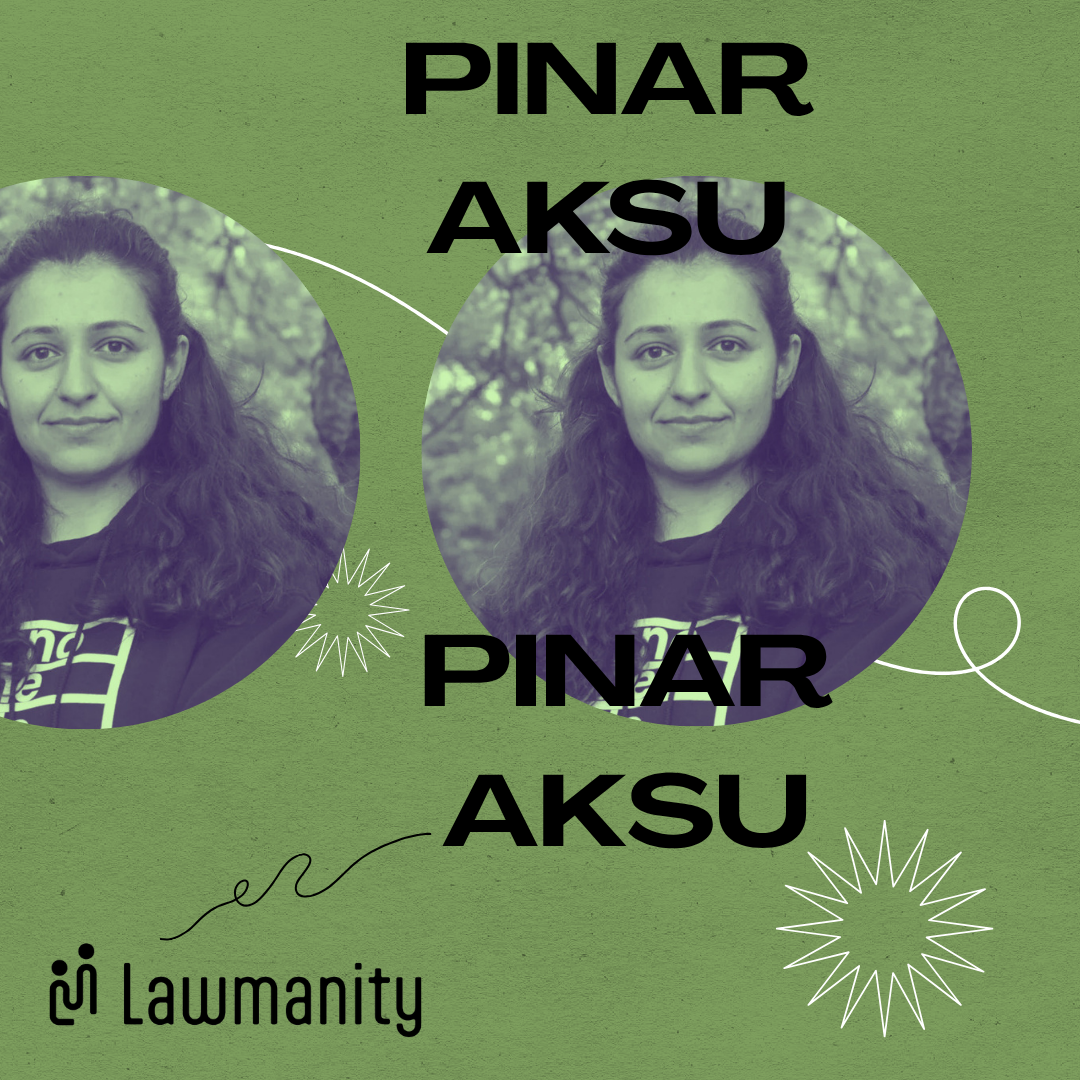
Transcript: More Than a Label: Migration Law and Justice in the UK, with Pinar Aksu
Host: Jen Ang
Quote: Dr Pinar Aksu
“The first immigration law we had in the UK was the 1905 Alien Act. And then when you compare that to the current immigration laws we have under language, when you look at the language of the way it’s been described within legislations, but also within the title of the law is Bell, it makes you question, has anything changed since more than 100 years ago? “
Jen Ang
So hello and welcome to the Lawmanity podcast, where we explore the complex relationship between law and activism and discuss the different ways the law can oppress people, but can also lead to real social change.
I’m Jen Ang, a human rights lawyer and activist based in Scotland and your host on the Lawmanity podcast.
This week we’re talking to Dr. Pinar. Aksu. Pinar is a researcher at the University of Glasgow, a theatre maker and an award-winning human rights campaigner. Her work sits at the powerful intersection of art, justice and activism.
Pinar was previously advocacy coordinator at Maryhill Integration Network in Glasgow, working on projects for welcoming people seeking asylum and refuge in the community, which is where we first met together. We worked on migrant justice campaigns, including the Our Grades Not Visas campaign, which we discussed in an earlier podcast episode with Andy Sirel of JustRight Scotland, as well as advocacy around the Scottish Franchise Bill, which extended voting and candidacy rights in Scottish elections to people with indefinite and limited leave to remain widening pathways to political participation for migrants, the benefits of which we have finally seen in the most recent round of, Scottish parliamentary elections in 2026.
Pinar’s doctoral research, Art and Law and Migration, draws together all these threads using art practises drawn from Theatre of the Oppressed methodology to produce Cycle of Migration, a play about access to justice and the immigration system, written and performed by people with living experience of that system.
I’m so, so pleased to have you here, Pinar. You’re one of my very favourite people and I think that that introduction describes the huge range of things that interest you, but also the many places where you contribute to social change in Scotland. So welcome to.
Dr. Pinar Aksu
Thank you.
Jen Ang
So, listen, I have a kind of opener question. In this podcast, I have been experimenting with a way to get us settled and also help people learn about the person behind the legends who we’re interviewing. So if you don’t mind, can you tell me about a smell that’s meaningful to you? Maybe one that you really like, or one that’s connected to a place or time that you like to bring to mind?
Dr. Pinar Aksu
Yeah, I was actually thinking about this, the other day and someone that previously asked me the same question. I really love the smell of marigolds, the flower of marigolds, because they come in, like, different sizes, shapes, but also they’re usually yellow, red, orange colour. I just love the flower, the smell of it. and that’s because my gran used to have lots in her garden and it reminds me of my childhood.
Well, I’m trying to grow it also in my balcony this year. I don’t think I’ve been successful, but previous years it’s. It’s been a success. Yeah, I just. The smell of marigold is so fresh and it just reminds me of my gran’s garden. It reminds me of my childhood with her. and sometimes, I would get her to send pictures or show her little garden and see how they’re growing. Yeah, it’s a task to grow in Scotland, but it does happen. Not, this year.
Jen Ang
Well, thank you for sharing that. And I’m totally transported. I actually. My mother also had a garden full of marigolds when I was little. And actually, when you say it, that I’m imagining I’m remembering the smell of, like a hot, dry summer, actually, I think. And it’s quite. It’s quite sweet and sort of dusty, you know, and. Yeah, that’s. That’s lovely. so thank you for sharing. I have never, tried to grow them here in Scotland, so wishing you luck.
Dr. Pinar Aksu
It is easy to grow. But what I did last year was after I tried to reuse the seeds, so I just, you know, plugged out and then put it in a little jar. I’ve done. I’ve been doing that for three, four years now, but. But this year, I don’t know what happened. Maybe they were too dry or, the soil wasn’t the right texture or it was just. Yeah, it was just not right. So this year it didn’t grow, which is sad, but other little flowers managed to come out, which is good.
Jen Ang
Well, onwards and good luck with next year. But thank you for. Thank you so much for sharing that. and so now I wanted to move kind of to. Actually, the key questions for today that I had for you. the first one is quite broad, but it’s this, we’re thinking about law and social change. I wonder if just now, if you feel the law is working equally for you or for your community, however you choose to define that, and why or why not.
Dr. Pinar Aksu
This is a question I’ve explored within my research in the PhD and it was something generated interesting dialogue about the role of law and how it is used and who it benefits. So within my work, I work in the migration sector, especially people who are seeking asylum and refuge. I think witnessing the changes of the immigration law has been really interesting in the last few years and also observing the pattern of the laws that was generated over the time. I mean the first immigration law we had in the UK was the 1905 Alien Act.
And then when you compare that to the current immigration laws we have under language, when you look at the language of the way it’s been described within the legislations, but also within the title of the law as well, it makes you question, has anything changed since more than 100, years ago?
We still use similar divisive languages within the law when we are talking about movement, when we’re designing and defining what migration is. And I think that is very disappointing to see that nothing has really changed. What’s been interesting for me is since I’ve started my PhD, every single year there was a new law on immigration that has passed. So we had the Nationality, and Borders Act and then we had the Illegal Migration Act and then we had the Rwanda Act and now we have a new bill that’s being proposed in the Parliament as well. So that’s been very crucial for me to witness it and see how the law itself is developed and to see who it benefits.
And I find that problematic because when you see a lot of the structural problems within migration, whether that is not having the right to work for people who are in the asylum process or whether that is using hotel accommodation in the communities, a lot of these policies are written within the law, which makes it possible for it to be implemented and enacted. So that makes me question, is the problem the law itself that we have, what would happen if we didn’t have these laws that said about criminalising people who are taking unsafe routes, so called illegal routes, if, yeah, we didn’t have these policies, what would happen? Would people still be treated differently?
And I think that helps me to define how I see law and what, how law is seen by, by people. And that’s something we always talk about within the community as well. And it becomes quite depressive when you have to keep the momentum up. You have to be like, okay, let’s work on this project or let’s continue to challenge this policy. But then when the policy itself and the law itself becomes more violent over the years, that also demotivates people and asks the question of, well, nothing is changing. It’s been five years, six years, such as for the Right to Work campaign, we’re not seeing any changes, but we are seeing actually more hostility within the law that it gives. Yeah, it gives the, I would say, the gateway to be implemented and become more violent. I think that’s how I would view the law itself. And, obviously it sometimes benefits certain people. It doesn’t benefit other people who really need protection. Yeah, I think that’s. That’s how I would define it.
I also find it fascinating the way the performative side of the law as well, and that’s something I’ve been looking into for my research about how the laws are designed, how legislations are designed, how they are being proposed, such as in House of Lords, House of Commons. And then you have this monarchy, and then you have this place where decisions are being made by a elite group of people who are, I think, truly disconnected from realities. And the performative side element of it, of the fact that it’s. It’s just, yeah, group of people making decisions for thousands and millions of people. And then that makes me question, is this what we want and is this how the law should be drafted? What about people’s voices? Can we have a structure where we reimagine how the law should be and how that should look like?
Jen Ang
So for you, then, where you stand now, with all your experience and your research, do you feel that the law can be a tool for social change? Or is it more a barrier for change in the areas that matter to you? So if we’re seeking equality, where do you sit? Or is there a little bit of both?
Dr. Pinar Aksu
Yeah, I think it’s a combination. And it depends who uses the law and how they use the law. It’s a combination because when we talk about migration, such as right now, the new, Borders Bill, that’s being gone through and being debated, that’s going to make things very difficult for a lot of people. And that is using the law and how can we challenge that is very difficult, I think, as activists or even people who are lawyers themselves or by the general public, because I think we have reached a certain, state or we have reached a moment in the UK that becomes very difficult to intervene and challenge.
And the government is able to just pass policies just there and here, just like that. And that, for me, is concerning for democracy and is concerning for all of us. And everyone should be concerned. If, if a government is easily able to pass such a bill or being debated, never mind being enacted as a act yet or implemented, then it’s concerning what they will do in different areas of human rights for a lot of the people. That said, obviously there are lawyers out, there who uses the law to protect people and who uses the law to find different ways to uphold their human rights and find different mechanisms as well. and I think it’s a difficult one because they are challenging the law itself as lawyers, but then it’s the law that’s the problem. Yeah.
And I find, I respect that needs to happen, but at the same time, yes, it’s very difficult when there’s a policy that’s been passed. How do you reverse that? How do you mobilise the whole community, the whole country basically, to say what you’ve written there is wrong and how do we change that? And I think, yeah, there’s a combination of how it could be challenged, but how it could be used positively as well.
Jen Ang
So you’re speaking about the role of lawyers and kind of this interesting bind, which is that lawyers may be using the law to challenge the law, but let’s be honest, it’s lawyers that wrote the law as well, and they’re challenging that law within a system. Are they friend or foe, allies or adversaries? What’s your view of the legal profession in the context of the work that you’re trying to do?
Dr. Pinar Aksu
I think especially for immigration lawyers at the moment, they experience great pressure regarding supporting their clients, as they call like clients. Whether that’s because there are funding cuts for legal aid, whether that’s because the regulations change so quickly that they must submit an evidence for someone’s asylum claim and they have one week to do this and they have so many clients and how do they do that? The fact that in different areas of the uk, obviously there’s different legal aid, implementations, and the impact on that is on lawyers is severe.
And we see that, when we. When we work with people, or when you’re trying to, direct people to access justice, access lawyers, we can’t really say you should go with this lawyer, but we’re able to say, here are a list of lawyers or here’s at the website in Scotland for all immigration lawyers. You can go on, decide which lawyer is best suitable for you. But then we also know that there is a waiting time and there’s capacity issue as well, where law firms are at capacity of accepting new clients and that, becomes problematic. Then what happens to the person, they have to keep trying different lawyers, but at the same time they miss appointments from the home Office, then they get penalised and then they have the trust of Luck within the law and with the lawyers.
I also witness people becoming really angry with lawyers. And we try to talk this out and I think that happens because somebody messages their lawyer, they don’t get a reply, maybe in a day or two. And then they start panicking, they get anxious and say, why am I not getting any response from the lawyer? Are, they just ignoring me? And then you try to explain, well, maybe they’re on holiday or they’re at a court or they’ve got, they’re dealing with other cases. So there is that miscommunication with the, with lawyer and clients as well and which can lead to distrust, between themselves as well. Again, no one is at ah, fault here. It’s the fact that there’s no capacity within the legal team, maybe within the lawyers and there are so much more clients and cases that needs to be, that needs to be addressed.
Jen Ang
At this point. In our interview, Pinar has set out quite clearly the consequences of year on year real money cuts in legal aid funding for immigration lawyers and the resultant collapse in the provider base of legal aid law firms. The situation is so bad in England and Wales that 57% of people who need a legal aid lawyer for an immigration matter and who are eligible and have a right to that lawyer are not able to find one. That means that more than half of the people who require help with immigration representation in England and Wales are not getting it and are forced to represent themselves in Scotland. Although the situation is not yet as severe, Pinar has clearly described a similar situation – people who are eligible for legal aid and have a right to a lawyer and who do need one, do not realistically have any expectation of being able to find one with the capacity and willingness to take on their case.
Shifting to alternatives, Pinar then goes on to talk about a different approach to lawyering, which she encouraged and facilitated during her own time as a community organiser at the Maryhill Integration Network. This is known as community lawyering, a model of social justice lawyering where lawyers seek to decenter themselves from how they work with clients. Instead of seeing the lawyer as the centre or the focus of the work, a community lawyer will centre the communities facing injustice and try to find ways of working that generates ideas, goals and strategies that start with and are directed by the communities themselves.
A community can mean a geographic community, such as the people of Maryhill or the people of Govan and Glasgow, but it can also mean a community of interest, defined as people drawn together and identifiable by having similar identities, experiences or facing similar challenges. Such as people seeking asylum or disabled people, or unpaid carers or neurodiverse people. Community lawyering can take many forms, but a starting place is for lawyers to actually physically leave their offices and go out into the community to listen, to learn, to educate and to be educated.
In this next part of the interview, Pinar talks about working alongside Andy Sirel of JustRight Scotland as community organiser and community lawyer working together. She goes on to talk about how she met Ahmed Al Hindi and the very start of the Our Grades Not Visas campaign, which Andy also spoke about with us in an earlier episode of the Lawmanity podcast.
Dr. Pinar Aksu
We do work with lawyers, and especially immigration lawyers, and I have friends and colleagues who do fantastic work. I know you were talking about the colleagues at JustRight Scotland, especially with Andy, who we worked on the Campaign for Access to Education on Our Grades Not Visas, which I think was an amazing example of how a company could be successful when you work with the communities in a, compassionate.
And I’m using more of a human rights approach within the community and I think that’s something I have been trying to work on, where people are informed about the changes within the law and people are able to see lawyers at a community setting. So it’s not just, oh, we go to the office, I have a legal appointment and that’s it. And this is something I’ve been able to do over the past few years within my role, where I think it’s important for the immigration lawyers to come to the community setting and to meet people and also to hear their stories and for them to explain. It depends on the topic.
So, for example, we welcomed Andy and other lawyers as well. A friend of mine who’s, Abed, he came to our group a few times as well, where we invited them and asked them to talk about the recent changes. So when the Rwanda plan was. The offshoring of people seeking asylum to Rwanda was being discussed. So we invited Andy and, Abed as well, different times for them to talk about what this means, what does it look like? Who is it going to impact? And we did that by asking them to come to the community setting and to explain in a way that it’s more accessible for people. So it’s not just, oh, yeah, article one says this and then. Because that way people are just going to zone out and they’re not going to listen. So we wanted. I was. I made it very clear all the time, like, we need to make this more accessible, maybe even do some group activity. Let’s talk about, what do you think about the Rwanda plan? And I think that worked really well and that way we were able to create that connection and people felt more comfortable of, oh, okay, I don’t have to be too scared when I go to see my lawyer. Because they’re also human being who has capacity. They’ve got, you know, they also need holidays, they also need time off.
They also deal with a lot of traumatic experiences as well. Ah, within their work. And I think bridging that gap was so important for everyone that we, when we worked on the, Our Grades campaign, obviously, as it was founded by, the young person Ahmed. And I think that was really clear way of showing how we can work together with people who are experiencing the issue, then strategizing what methods we can use and then working together in collaboration of whether that’s with the lawyers or within the media. And, that’s what happened with Our Grades Not Visas.
When we first met, Ahmed actually was, my colleague. It was at the Parents Council evening and my colleague said, oh, there’s a young person who wants to do this company. He just needs some guidance. Can I connect you with him? And I was like, yeah, sure, I’m happy to chat with him. And then we went for a coffee at Glasgow Uni, actually. And he was a young person. You mean, like, oh, I want to do this, do this. And I was, okay, let’s, let’s plan it out. Actually, we have a campaign on access to education for asylum seekers, so maybe we could do it all together. And then taking it from there, of, okay, let’s see who your allies are. Let’s get you speaking of the media and then finding out then there’s a legal case that’s going on, but then it’s not just one story, then trying to find out combine that this is many stories, and how we can use these many stories and experiences in a way that it will positively change for the many people in the long term as well. And I think that method was worked out. And sometimes when you do campaigning, things just plan out.
And I love when that happens because you could sit down and be like, okay, we’re going to use this approach. We’re going to go to this place and you can spend weeks and months, but sometimes there are opportunities. You just grab it and you say, okay, this will be good if I do it now. and you just have to keep in that opportunities and find a good time, good moment and good partner as well who gets to work or who, who’s also dedicated at a level that you are dedicated. And I think that, yeah, that example of community work and then lawyers coming in the other thing which I think was fascinating in that case. But generally as well, when we have, when we welcome lawyers into community level and they, they see the people as people not as, okay, your service users, client, but going to listen, let’s just have a chat. And I think that expectation for me is also important where I say to the group members, you know, this lawyer is coming to speak to you, but if they’re not going to solve your case, you, you can ask questions, you can listen, you can learn. I think that’s also important and also for people not to feel intimidated. Oh, there’s a big name coming or there’s that lawyer coming. So and that’s something I m, I just say to people. You ask whatever you want to ask. you know, there’s no wrong question, no wrong answer. So just feel free to ask anything you want to. If it makes the other person uncomfortable, oh well, you know, that’s the whole purpose. So that generates that difficult conversation and that critical conversation.
Jen Ang
I love that. And I think it actually, you know, some of the things that you spoke through highlights the importance of understanding the dynamics that people might bring to a conversation with a lawyer. But also all of the careful work around building a long term partnership and a campaign and the fact that it may, and in fact it did take years, it has taken years to achieve some amazing things in the Our Grades Not Visas campaign.
So moving on from what can lawyers do? I guess I want to ask a much broader question and very much a forward looking question which is what looks like justice to you for your community?
Dr. Pinar Aksu
It’s a difficult question I think and it depends again how we understand justice. It could mean that somebody is campaigning for something or somebody wants something and then how do we achieve that and what’s the most best outcome for people? For me is I guess justice within the migration. Especially when you look at how there are so many violent policies being implemented on people and is for people to just live a normal life. I would say for me that would be justice for people to just be treated as a human being and to live a normal life where they don’t have to go through many hurdles to prove themselves of who they are, where they don’t have to continuously go to give evidence at the Home Office or where they don’t have to continuously, you know, fight for their rights and within society and live with long term difference that’s been created in communities.
Yeah. I think just being treated as a human being and to have a normal life, that for me would be justice and also to seen as equal. I think that’s the most important thing. A lot of this time we talk about labels within migration, how everyone is given different labels, whether you’re asylum seeker, refugee, migrant, you know, client service user. There are so many different labels people are given throughout their journey of migration, whether that’s when they first arrive or after they get their refugee status as well. And you get given that labels within the law, but by society as well. And I think people just want to get rid of that and just live a normal life. Even when you’ve been in the country for so long, then you’re seen as different or you’re not from here. and you have to live with that label of facing daily racism or discrimination. And I think that’s tiring for people to continue to prove themselves who they are. Like they deserve to be here. And that’s. Yeah, for me, that’s just not just. And if people were treated equally, it will solve a lot of the problems we have, in society, I think.
Jen Ang
Thank you very much. You put that so simply. It’s also such a beautiful vision, actually. when you say it, I mean, I’m fully on board and I also appreciate, because of the reasons you’ve outlined, that there are many, many more steps to take before we achieve that equality for migrants in Scotland. But thank you for that.
So we’re on to our final, final question, which is this. So there will be some listeners out there today who are rightly blown away by the work that you’ve done and they may be thinking about a career or voluntary work in migration justice, or maybe learning more about your Active Inquiry work in Theatre of the Oppressed. And so the question is, what would you say to, your younger self, or someone who admires what you’ve accomplished today and maybe wants to be you? What would your advice be to someone who’s listening in that position?
Dr. Pinar Aksu
Yeah, So I should probably say, advice that is more positive, right? Because my advice would be, don’t do it. Have a peaceful life, I don’t know, go into farming, raise some chickens.
Jen Ang
I’ve been very clear with my children that they should probably not be lawyers.
Dr. Pinar Aksu
See?
Jen Ang
Exactly.
Dr. Pinar Aksu
It’s a difficult one because, it depends on your experience. I don’t think I just had a vision of, oh, should be in this sector of, whether to start as a Campaigner and then to be embedded in so much of the kind of community work and the policy work of the, of the area.
But generally people, you know, if people do want to be involved in the migration sector they, they should be involved with a vision of bringing compassion and care and I guess the justice side of element of the work as well. and where the get, they are involved in a sense to remember that why it’s important to have welcoming communities, why it’s important that we should stand up for what is not right.
So whether that’s the the racist immigration policies that’s being imposed, imposed on people or whether that’s the hostility that we experience in the communities and I think people should be reminded of okay, this is what we should do, we should be standing up for these these inequalities. And that’s what happened in Scotland, you know, when, in 2021, in May, when the people of Glasgow came out at Kenmure street and said these are our neighbours, they belong in the community. At the same time, we had in 2020 the Park Inn incident when somebody lost their life at the hotel accommodation.
And sometimes there are victories where the community wins when they come together and they challenge the hostile environment, the policies and the hostility. But then we have realities of the impact, the real impact of these violent laws I would say and implementations like at the parking incident. And then now we have increase in the far right and the impact is going to have in communities at a long term level. So whether that’s going to be this year, the following year, these divisions is going to be witnessed at a great level. and I think this is, this impacts all of us. So and this is why people should maybe choose the powerful standing up for what is right together with different campaigners and allies. And I think that’s one of the key elements when we do the campaigning and advocacy and people should remember the new generation I’m considering as older generation for myself but the new people who are maybe going into activism or want to campaign on equality, equalities is the importance of allies where you connect different causes together.
And we highlight that this is not just an issue for the migration sector, for the refugee organisations, this is an issue for all of us. So bringing the trade unions on board, bringing different movements, whether that’s on migration, right, climate change or any different areas, to remember that this policies impact all of us for a long term. And I think that’s something that should be kept in mind.
I was very lucky that when I was first involved in activism, I called them elders, people who had so much experience and, people who were already campaigning, let’s say, in the 70s, 80s, and I had learned so much from them, where they showed me meaning of solidarity, what that means, meaning of comrades, meaning of working together and campaigning together, where we didn’t label, or you’re like, you’re a refugee, asylum seeker, or you’re this, that. But where we said, okay, we’re comrades, we’re working on this together, we’re campaigning on this together.
And, this is just not fair and we must do something about it. And I think people should keep that in, in their mind if they’re interested in this. And I, again, very lucky that I had people like that around me, who guided me, who seen me as their peers, not as somebody with a label, but somebody that we can walk the walk rather than give me different roles. And I think we just need to remind ourselves that’s important. The ally, working together, but also working together creatively.
And that’s something I try to do in, whether in campaigning or raising awareness or within my work, is to use the creative element. Because sometimes it becomes too boring when you have a policy paper or when you present something at a conference by saying, oh, and this is what ABC says. But if you do that creatively, you’re actually reaching to more audiences and you’re enabling more conversation and more critical conversation rather than, yeah, maybe reading a piece of policy or a paper. And I think we need to do more of that within the campaigning, but within communities, wherever, whatever the message that we’re trying to share. So if it’s on migration, we need to do that, engage with the communities more creatively and use that area as well.
Jen Ang
Gosh, it took me a long time to get this podcast episode to you, and in that time the political environment has shifted on again in Scotland in significant ways. I asked Pinar if she had anything to add in light of the recent Scottish elections and the challenges facing the new Parliament as Scottish MSPs return to Holyrood this week to take up their offices.
Dr Pinar Aksu
I think it’s been some journey and, we did not expect about 17 reform MSPs to be elected. This has been shown across the country as well. We’ve seen the election results in England and in Wales. There’s a change in the political system and I think we are also witnessing this in Scotland. I think there’s going to be lots more to do as activists, whether you’re working in migration on Equalities or in housing, in any spectrum of human rights. I think we’ve got lots to do in terms of challenging the negative narratives from the Reform Party.
And what makes me sad is the fact that we have, Reform MSPs within our parliament, and having known their track record of their using languages around migration and people seeking asylum and refuge, I am hoping that such narratives will not be normalised within our Parliament, in the Scottish Parliament, and that we will not normalise hate and, racism. And unfortunately, these are the things that the Reform are doing is creating a hostile environment where they are being very vicious with their policies, but as well as their words, and for me, words matter.
And I think the minute we start to use terms such as illegal migrants, illegal migration, this has a significant impact on the community. So I really hope we’ll not normalise this within our Parliament and in terms of communities. We have the local council elections next year in 2027, and I think we need to do more. We need to really listen to people and understand that we had years of austerity, we had funding cuts in our communities, we had issues around housing, we had issues around violence against women, and girls. And we need to talk with the communities and try to understand where these fears are coming from and listen to one another and try to look at where the root causes of such problems are. And I think this could only be done by compassion, by care and, by listening to one another, because if we don’t, then the result will be we will have more reform being elected. And I think that’s not what we want and that’s not who we are as a country and in Scotland. So let’s be more active, let’s start planning in our communities. Let’s do this by listening to one another, creating spaces where we can have critical and difficult conversations. And I think that is extremely important that we have such difficult and critical conversations so that we can understand where the anger and the fears are coming from. So, yeah, let’s see what happens in the communities. I’m sure compassion will win over hostility.
Jen Ang
Thank you so much, Pinar, for those closing thoughts about where we are today after the 2026 Scottish elections. If I may, I have one more question: So towards the end of the podcast, I always offer people an opportunity to explore, maybe organisations or campaigns that they didn’t know about, and I also encourage them to take action. Are there any organisations or places that you would give a shout out to that people should be looking at?
Dr Pinar Aksu
Yes, I mean, there are so many amazing groups local groups, national groups who try to do work on raising awareness about that direct solidarity as well. I mean, I would like to give a shout out to, our group, which is Refugees for Justice, where we’ve been advocating to end hotel accommodation in Scotland and look at alternative ways of housing people seeking asylum and refuge.
And together with the lawyers, we have the fatal accident inquiry into the death of the. So having solidarity at the hearings and solidarity for Bedreddin’s family, but also people who are in hotel accommodations is very much important. And I guess shout, out to all the local groups across Scotland who are currently working under such hostile moments, especially groups in Falkirk like FOSS, groups in East Kilbride, which is EKIN, who are the East Kilbride Integration Network, people in Perth, Perth Against Racism in Aberdeen, the GREC, which is the Grampian Regional Equalities Council, and all the anti racism work that’s being done in the communities.
And maybe one final shout out to the amazing toolkit around Anti Raid’s work, as well as toolkit into asylum system of Right to Remain and obviously to Scottish Refugee Council for all the solidarity work they do. So the list could go on, but I would say maybe these are some of the groups that we can keep an eye on, and also support one another not just by donating, but being physically there at protests and when needed, because that’s what we need more than ever.
Jen Ang
Thank you so much again, Pinar, for your time. We appreciate it.
And that’s a wrap. Thank you, our lovely listeners, for joining us for yet another episode of the Lawmanity podcast. If you wanted to learn more about some of the campaigns that Pinar has mentioned, we’ll put those in the show notes. And for those of you legal beagles, out there who are intrigued by the idea of community lawyering, we’ll share some resources for learning more about that too.
Our next episode is a special edition on disability rights, featuring Louise Whitfield, Legal Director of Liberty, as well as Heather Fiskin, Chief Executive Officer of Inclusion Scotland, and Tressa Burke, Chief Executive Officer, Glasgow Disability Alliance. Join us to listen to a fearless and fierce conversation about the state of disabled people’s rights in the uk, the role of strategic litigation in pressing for change and what more needs to be done for rights on paper to be realised in the lives of disabled people today.
If you love today’s episode, please do hit the like and subscribe buttons and share our episodes with friends and colleagues who might also enjoy learning a little bit about how law really works in practise and how it can be used to make the world a better, brighter place.
The Lawmanity podcast is co produced by me, your host Jen Ang and by the brilliant and talented Natalia Uribe. Shout out to Halina Refai for mentoring us through this first year of this incredible project and thanks also to Amanda Amaeshi on graphics and socials. The music you’ve been listening to is always on the move by Musicians in Exile, a Glasgow based music project led by people seeking refuge in Scotland. Thanks so much for tuning in today.
We hope you enjoyed listening and see you next time.
Additional resources for this episode are linked below:
Learn More
- Listen to Lawmanity podcast episode “Breaking Barriers: Access to Education for Young Migrants, with Andy Sirel”: podfollow.com/lawmanity/view
- Read “Our Grades Not Visas: How community lawyering brought education justice for young migrant and refugee people in Scotland”: https://www.justrightscotland.org.uk/2025/10/our-grades-not-visas-how-community-lawyering-brought-education-justice-for-young-migrant-and-refugee-people-in-scotland/
- Read “Jo Wilding chronicles deepening immigration and asylum legal aid crisis, with failure to recruit staff an ‘existential threat’ to the sector” https://www.ein.org.uk/news/jo-wilding-chronicles-deepening-immigration-and-asylum-legal-aid-crisis-failure-recruit-staff
- Read “Scotland adopts a more inclusive franchise”: https://globalcit.eu/scotland-adopts-a-more-inclusive-franchise/
- Read “Can a Student visa holder sit as a member of the Scottish Parliament? Yes, they can”: https://freemovement.org.uk/student-visa-member-of-scottish-parliament/
- Check out “#LiftTheBan: Give People Seeking Asylum the Right to Work”: https://www.refugee-action.org.uk/lift-the-ban/
- Check out Refugees for Justice: https://www.refugeesforjustice.org.uk/
- Check out Sistren Legal Collective: https://sistren.co.uk/community-lawyering/
Take Action
- Maryhill Integration Network: https://maryhillintegration.org.uk/get-involved/
- Govan Community Project: https://govancommunityproject.org.uk/get-involved/
- Community Infosource: https://www.infosource.org.uk/get-involved.html
- Refuweegee: https://www.refuweegee.co.uk/copy-of-about
- Scottish Detainees Visitors: https://sdv.org.uk/join-us
- The Welcoming (Edinburgh): https://www.thewelcoming.org/get-involved-the-welcoming-edinburgh/